

The landing at Mindelo: Dom Pedro's 7,500 come ashore, 8 July 1832
A fleet from the Azores put a small liberal army on a beach north of Porto without losing a man. The next day it took the country's second city, and then spent a year trapped inside it.
At a glance
- On Sunday 8 July 1832 a liberal fleet from the Azores landed Dom Pedro's army on the beach of Arnosa de Pampelido, north of Porto, in today's Matosinhos. The landing is named after the nearby village of Mindelo.
- Pedro, the former Emperor of Brazil, was fighting his brother Miguel, who had made himself absolute king in 1828, for the throne of Pedro's daughter, Maria II.
- Pedro himself later put his force at 7,500 men. Other contemporary counts of the force that sailed and landed run from about 7,000 bayonets to 8,300 men of every corps; a review a month earlier counted 6,500. Miguel's army was put at more than 80,000.
- Nobody opposed the landing and not a man was lost. Miguel's commander left Porto in the night, and the liberals marched in on 9 July.
- Within weeks the liberals were besieged in Porto. The siege lasted until August 1833 and brought bombardment, hunger and cholera, and it earned Porto the title 'Invicta'.
A calm sea off Pampelido
On the morning of Sunday 8 July 1832 the sea off the coast north of Porto was as flat as a pond. Simão José da Luz Soriano, the historian of the siege, describes warships and transports drifting back and forth over it within sight of land. At nine o'clock the royal standard went up on the frigate Rainha de Portugal and the fleet fired its salute.
At daybreak a single officer had already gone ashore. Bernardo de Sá Nogueira carried Dom Pedro's manifesto to Brigadier José Cardoso, the Miguelist commander at Vila do Conde, and an invitation to change sides. He was met with shouts of “Viva Dom Miguel, absolute king”. Cardoso refused the papers and, according to Charles Napier, the British naval officer who took command of Pedro's fleet the next year and wrote a history of the war, threatened to shoot him as a traitor and gave him fifteen minutes to get back to his boat.
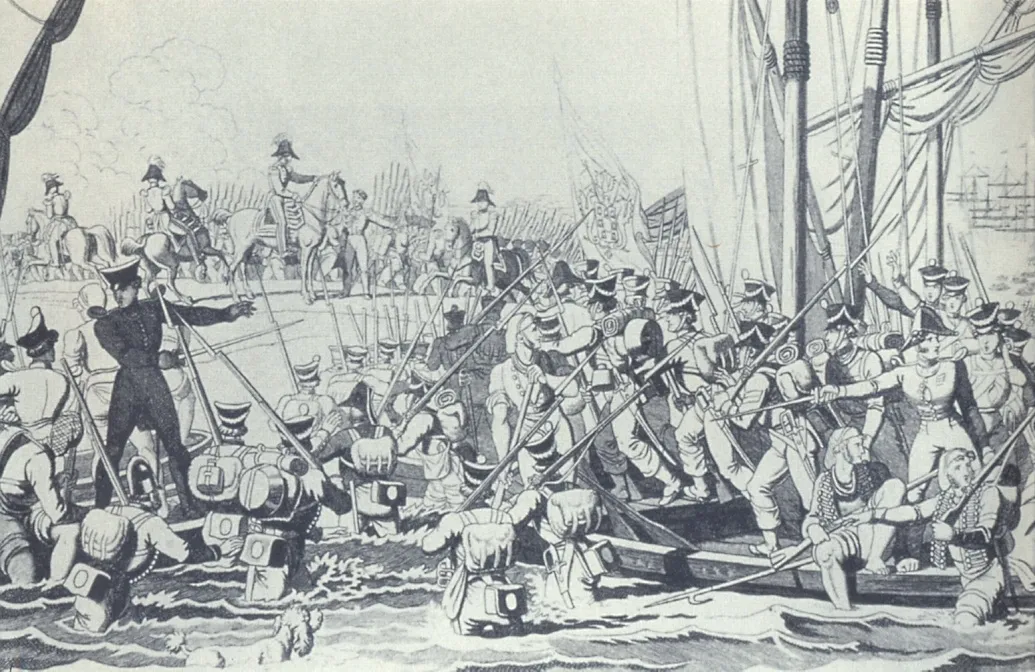
So the army landed as invaders after all. From about two in the afternoon (soon after noon, says Hugh Owen) the schooners and brigs edged in to musket range and the boats began to run troops onto a sandy beach between Porto and Vila do Conde. Captain Charles Shaw of the British battalion said only about fifteen enemy horsemen showed themselves, and they rode off when he sent three skirmishers after them. By nine at night, Soriano wrote, the whole army was ashore without the loss of a single man.
It opened the last phase of Portugal's civil war. The army that came ashore that afternoon, remembered as the “bravos do Mindelo”, would take Porto the next day, be shut up inside it for a year, and end the war in power in 1834.
- Date
- Sunday 8 July 1832, from about 2 pm to 9 pm
- Place
- Beach of Arnosa de Pampelido, between Perafita and Lavra (Matosinhos), now Praia da Memória
- Commander
- Dom Pedro, Duke of Braganza, regent for Queen Maria II; army under the Count of Vila Flor
- Fleet
- 40 to 42 transports escorted by a small squadron under George Rose Sartorius
- Troops
- 7,500 in Pedro's own words; about 7,000 to 8,300 in other contemporary counts of the landing force
- Losses
- None; the landing was unopposed
Two brothers and a girl queen
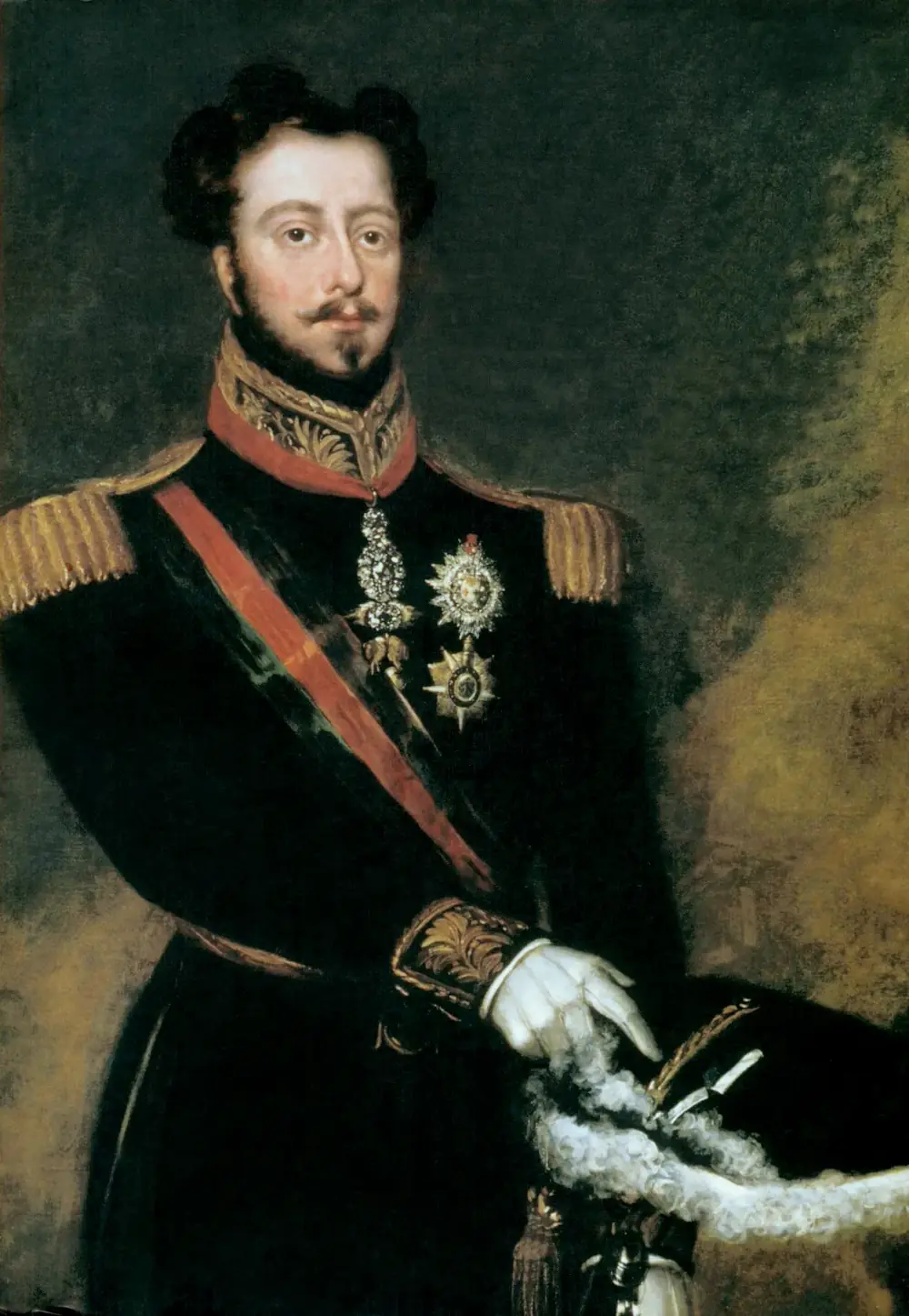
Pedro was 33. Born at the palace of Queluz in 1798, he had grown up in Brazil, where the royal family fled from Napoleon, and in 1822 he made himself emperor of an independent Brazil. When his father, João VI, died in 1826, Pedro inherited Portugal too. He gave the country a constitution, the Constitutional Charter, and then abdicated the Portuguese crown in favour of his seven-year-old daughter, Maria da Glória.
The plan was for Maria to marry Pedro's younger brother, Miguel, who would govern as regent and swear to the Charter. Miguel swore, returned to Lisbon in February 1828, dissolved the Chamber of Deputies and in early July 1828 had himself proclaimed absolute king, taking the oath on 7 July. A liberal revolt that had broken out in Porto on 16 May collapsed at the start of July, and thousands of liberals went to prison or into exile.
One corner of Portugal never accepted Miguel. On Terceira, in the Azores, the 5th Caçadores, a light infantry battalion, held out for Maria. A Miguelist landing at Vila da Praia was beaten off on 11 August 1829, and a liberal regency was set up on the island. In 1831 Pedro lost his own throne: on 7 April he abdicated as emperor in favour of his five-year-old son and sailed for Europe, reaching Cherbourg in June. With nothing left to rule, he took up his daughter's cause.
An army raised on borrowed money
The expedition was bought on credit. After months of failed attempts, the emigrants signed a loan in London with the French bank Ardoin on 23 September 1831. Britain would not help openly, but it let agents buy ships, arms and stores and hire officers and mercenaries, while France let the expedition gather in its ports.
Pedro joined the ships at Belle-Isle, off Brittany, in early February 1832. On board the frigate Rainha de Portugal he signed a manifesto taking the regency in Maria's name and promising Portugal “peace and reconciliation” rather than the horrors of civil war. He sailed on 10 February and landed at Ponta Delgada, on São Miguel, on 22 February. In March, at Angra on Terceira, he swore the constitutional oath and took over the regency.
The islands became a barracks. Oliveira Martins later described Terceira as an encampment “teeming with people”: veterans of the Peninsular War, students straight from Coimbra, poets, adventurers and volunteers from all over Europe. About half the rank and file, Napier noted, had been recruited in the islands or taken from Miguelist garrisons that had surrendered there. Pedro reviewed 6,500 men on São Miguel on 6 June.
| Unit | Men |
|---|---|
| Caçadores (light infantry) nos. 2, 3, 5 and 12 | 3,000 |
| Line infantry nos. 3, 6, 10 and 18 (many of them Miguelist deserters and prisoners taken in the islands) | 2,500 |
| Volunteers of Queen Maria II | 858 |
| Atiradores: French, Italian, Belgian, German and Polish volunteers | 550 |
| British battalion | about 300 |
| Artillery, with six guns | 150 |
| Academic volunteers from Coimbra | 80 |
| Sacred Battalion of officers | 70 |
| Guides and cavalry, without horses | 40 |
| Staff | 35 |
Figures from Fauche as quoted by William Bollaert (1870), who gives the total as 7,775. The items as printed add up to 7,583, so either a figure or the total is wrong. Soriano lists the same corps and puts the whole force, officers' corps and engineers included, at 8,300.
Pedro went aboard his yacht, the Amélia, on 19 June. After a field mass on the Campo do Relvão (on 20 June according to Napier, 23 June according to Soriano), the troops embarked. At about two in the afternoon of 27 June the convoy left Ponta Delgada: some 40 transports, some of them painted with numbers above a hundred, behind Sartorius's flagship, the 46-gun Rainha de Portugal, the frigate Dona Maria II and a handful of brigs and schooners. Most of the crews were British.
Pedro's council had weighed its targets. Lisbon was tempting but heavily fortified, and the Algarve was short of food and transport and far from the capital. Porto, the liberal city of the 1820 revolution, was rich, close to grain and recruits, and expected nothing. How to get ashore was another matter: Shaw, on the flagship, was “persuaded no plan had been made as to landing until we reached the coast”.
Ten hours on the beach
The coast came into view at about ten on the morning of 7 July, off Vila do Conde. That evening the Miguelist signal post at Vilar de Paraíso, south of the Douro, counted 28 mastheads to the north, and at nine the drums beat to arms in Porto. Lieutenant Luís da Silva Mouzinho de Albuquerque, an engineer, went close inshore with Sartorius in a schooner and chose the beach.
The Miguelist general in the north, the Viscount of Santa Marta, had about 12,000 men scattered along some 20 leagues of coast and no idea where the blow would fall. He thought Pedro had 10,000 to 12,000 men; Cardoso's troops, Napier wrote, supposed the fleet carried at least 20,000. Santa Marta sent Cardoso's brigade to Vila do Conde and himself watched from Leça with a militia regiment and about 70 horsemen.
Who landed first is still disputed. Soriano gives the honour to the Portuguese brig Conde de Vila Flor, whose lieutenant, Fernando José de Santa Rita, ran his ship in as far as the depth allowed and put men ashore to raise Maria's blue and white flag. Shaw, who was there, and Napier, writing later, say Colonel George Lloyd Hodges's British grenadiers beat everyone to the sand, to the annoyance of Pedro, who wanted Portuguese troops to land first.
The light battalions fanned out to cover the beachhead: the 5th Caçadores towards Vila do Conde, the British to Perafita, the 2nd and 3rd Caçadores along a ridge running down to Leça. As the landing began, the British frigate Stag, which had shadowed the expedition for four days, fired a royal salute to Pedro's flag. Pedro stepped ashore at about six, or at sunset in Napier's account. His proclamation, handed round the transports as they neared the coast, gave the soldiers a motto as well as a war-cry: protection to the defenceless, generosity to the conquered.
“Soldiers! Let your war-cry be — Long live Donna Maria II. and the Constitutional Charter.”
Into an empty city
Pedro's next move decided the first round without a shot. From Perafita he sent troops on a flanking march towards Pedra Ruiva, which threatened to cut Santa Marta off. Between two and three in the morning of 9 July the Miguelist garrison filed out of Porto, abandoned the forts at Foz and the Queijo, crossed the bridge of boats to Vila Nova de Gaia and cut it behind them. Cardoso slipped away inland and rejoined Santa Marta at Oliveira de Azeméis on 12 July.
The Miguelist magistrates, the bishop, most of the cathedral chapter and the directors of the wine company left with them, taking their cash and papers. In the city a crowd broke open the prison, freed political prisoners held for four years and shot the hangman, João Branco. The gallows that had stood in the Praça Nova since 1828 were torn down.
The 2nd and 3rd Caçadores under Lieutenant-Colonel João Schwalbach marched in first, by the Leça road, to cheers and flowers from the windows of the Rua de Cedofeita. Pedro heard at nine that the city was empty and followed at the head of the rest. He dismounted at the town hall in the Praça Nova and took up quarters in the palace of the Carrancas, which looked across the Douro to Gaia.
“little more than seven thousand bayonets were counted — not a horse was seen to carry a staff-officer: even Don Pedro himself was mounted on a pony, the gift of the day.”
The welcome cooled quickly. Napier, writing later, called it “by no means what was expected”: a few cheers and a few flowers. Notable citizens had fled, those who stayed kept their distance, and nobody of standing joined the cause in public. To Porto's people, Soriano wrote, it seemed impossible that 8,000 men could hold out for long against Miguel's army. Owen put that army at more than 80,000; the 1870 history of William Bollaert, a veteran of the siege, at 82,000.
7 July, c. 10 am
Land sighted off Vila do Conde
7 July, evening
Miguelist signal post at Vilar counts 28 masts; drums beat in Porto at 9 pm
8 July, daybreak
Sá Nogueira summons Cardoso at Vila do Conde and is turned away
8 July, 9 am
Royal standard hoisted and saluted on the Rainha de Portugal
8 July, noon to 2 pm
Landing begins at Arnosa de Pampelido
Owen says soon after noon; Soriano and Bollaert say two o'clock.
8 July, c. 3 pm
The Count of Vila Flor and his staff come ashore
8 July, c. 6 pm or sunset
Dom Pedro lands
8 July, 9 pm
The whole army is ashore, without loss
9 July, 2 to 3 am
Santa Marta's troops leave Porto and cut the bridge of boats
9 July, morning
The 2nd and 3rd Caçadores enter Porto
9 July, noon to 4 pm
Pedro enters Porto
Soriano and Bollaert say about midday, Shaw about three, Napier four in the afternoon.
How many were the bravos?
The famous figure of 7,500 comes from Pedro himself. Opening the Cortes, the parliament, after the war in 1834, he told the deputies he had landed “at the head of 7500 men”. Contemporary writers gave other numbers, and they did not count the same things: some counted only bayonets, some the whole embarked force with its officers' corps, staff and gunners.
The liberal army at Mindelo: contemporary counts
men
Napier's 6,500 is the review on São Miguel a month before sailing. Shaw wrote of “upwards of 8,000 troops on board”. Owen's 8,219 is from his table of army strengths; elsewhere he gives 7,200 and “something less than nine thousand”, and he counted “little more than seven thousand bayonets” entering Porto. Soriano's 8,300 includes the corps of officers and engineers.
Show the data
| Strength given | |
|---|---|
| Napier: review, 6 June | 6,500 |
| Pedro: speech, 1834 | 7,500 |
| Fauche, via Bollaert | 7,775 |
| Shaw: letter, 30 June | 8,000 |
| Owen: landed | 8,219 |
| Soriano: embarked | 8,300 |
Several of the bravos made their names in the war. Sá Nogueira, the envoy turned away at Vila do Conde, lost his right arm in the siege and was known afterwards as Sá da Bandeira. Vila Flor was made Duke of Terceira during the siege. Among the volunteers in the ranks was the 22-year-old Alexandre Herculano, later the leading historian of his generation.
From liberators to besieged
Pedro had told his daughter he hoped to seat her on her throne within two or three months without a drop of blood. The country did not rise and Miguel's regiments did not change sides. On 10 and 11 July Schwalbach's light division crossed the river and took Vila Nova de Gaia and the convent of the Serra do Pilar, the height that commands the city from the south bank.
The liberals then tried to break out. On 17 to 19 July a column took Penafiel, east of Porto, and came back; Shaw saw eleven of his strongest grenadiers reel and drop dead in the heat on a hillside, though a later account quoted by Bollaert blamed wine that the men had been given on the march. On 23 July Pedro beat a larger Miguelist force at Ponte Ferreira, near Valongo, after seven hours' fighting, at a cost, with the skirmish of the day before, of more than 440 killed and wounded.
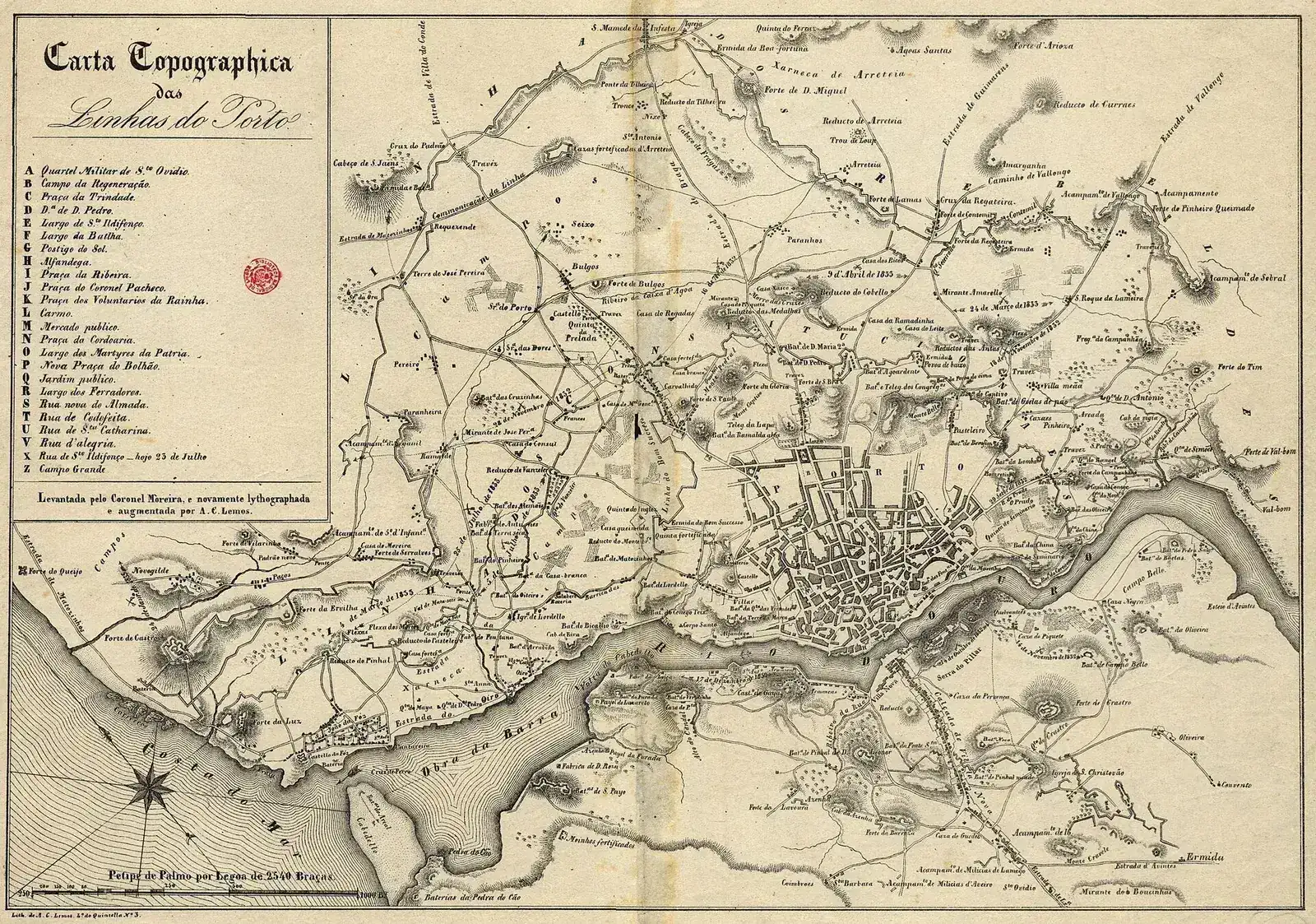
Even after that victory Pedro decided to stop attacking and fortify the city. A sortie south of the Douro on 7 August, against what turned out to be some 9,000 Miguelists, broke and fled back from Souto Redondo. A ring of batteries and trenches went up around Porto, and Miguel's army closed around it. A general assault on 29 September failed. Then came the bombardment: on some days, Pedro wrote to Maria, the enemy poured “140 bombs, not counting rockets and bullets” into Porto (translated from Portuguese).
The winter was worse. Food ran out, and Bollaert recorded dogs, cats, rats and mice being eaten. Cholera reached the city early in 1833. In February Pedro wrote of “plague, hunger and war” and of hospitals where one patient in seven died, “above all women”. He stayed in the city throughout, leading from the front, and his health began to fail.
The way out came by sea. In June 1833 a squadron under Napier brought money and men, and on 21 June an expedition sailed south under Napier and Vila Flor, now Duke of Terceira. It landed in the Algarve on 24 June, Napier defeated Miguel's fleet off Cape St Vincent on 5 July, and Terceira entered Lisbon on 24 July.
In Porto, a last great assault failed on 25 July, and on 18 August General Saldanha's sortie drove the besiegers off. Counted from the entry into Porto, the siege had lasted about 13 months; Bollaert, counting the close siege only, made it 11 months and 22 days.
Why it still matters
The landing gave the liberals a foothold they never lost. The war ended with the surrender of Miguel's army at Evoramonte in May 1834, and Miguel went into exile. Pedro did not live to see much of it: he died at Queluz on 24 September 1834, in the room where he was born, aged 35.
Porto kept the memory. Its resistance earned it the title “Invicta”, unvanquished, by which the city is still known, and a dragon stayed in its coat of arms until 1940. Pedro left his heart to the city in his will. It is kept in the church of Nossa Senhora da Lapa. In August 2022 it went on public display there for the first time, was flown to Brazil for the bicentenary of the independence he had declared, and came back to the Lapa in September.
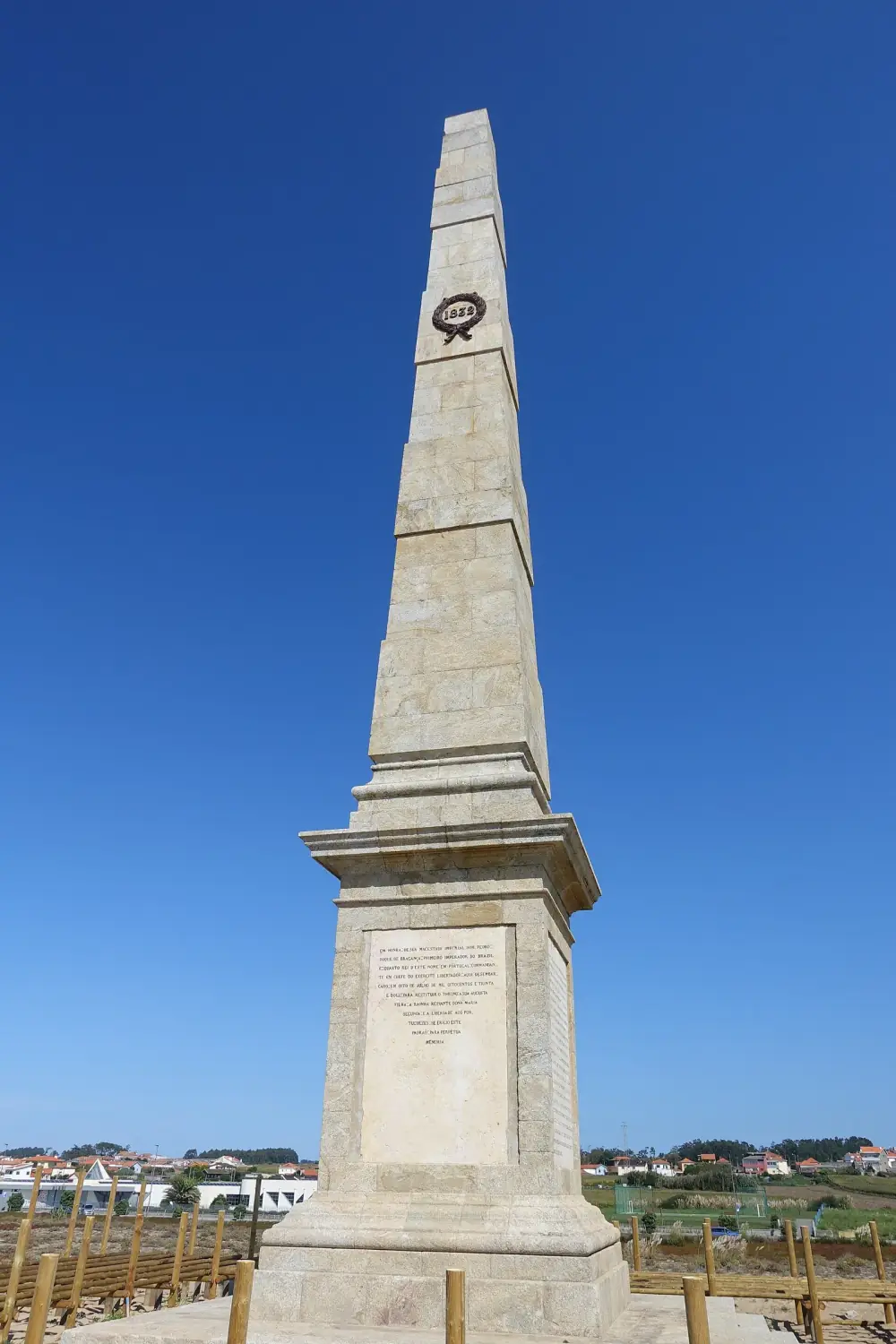
On the beach the liberals marked the spot. The first stone of a granite obelisk was laid on 1 December 1840 at a site identified by veterans of the landing, and it took 24 years to finish. Its panels name the commanders and carry Pedro's proclamation to the soldiers.
FAQs
Where exactly did the Mindelo landing take place?
On the beach of Arnosa de Pampelido, on the boundary of the parishes of Perafita and Lavra in the municipality of Matosinhos, about halfway between Porto and Vila do Conde. The beach is now called Praia da Memória after the obelisk that marks the spot. The village of Mindelo, which gave the landing its name, is a few kilometres to the north.
How many men landed with Dom Pedro?
Pedro himself said 7,500, the figure usually quoted. Contemporary accounts give between 6,500 (Napier, for a review a month earlier) and 8,300 (Soriano, counting every corps embarked); Hugh Owen gives 8,219 landed. Miguel's army was put at more than 80,000.
Who were the 'bravos do Mindelo'?
The name given to the soldiers who landed with Pedro in July 1832: Portuguese exiles, islanders from the Azores, former Miguelist soldiers, students and volunteers from Britain, France and elsewhere. Among them were Bernardo de Sá Nogueira, later Sá da Bandeira, the Count of Vila Flor, later Duke of Terceira, and the young Alexandre Herculano.
How long did the siege of Porto last?
About 13 months from the liberals' entry into Porto on 9 July 1832; they were hemmed in by the end of that summer. The siege was broken on 18 August 1833, after a liberal expedition from Porto had taken Lisbon on 24 July.
Why is Dom Pedro's heart in Porto?
He left it to the city in his will, in thanks for its loyalty during the siege. It is kept in the church of Nossa Senhora da Lapa. In 2022 it was lent to Brazil for the bicentenary of independence and returned to Porto afterwards.
On the timeline
Open the timelineNearby moments from invasions, brazil and the liberal wars (1807–1851).
The botanist Félix de Avelar Brotero dies in Belém, Lisbon. Having fled to Paris when he fell under suspicion of the Inquisition, he returned to teach botany at Coimbra, wrote 'Flora Lusitanica' (1804), the first flora of Portugal, and later took charge of the Ajuda Botanical Garden.
Birth of João de Deus de Nogueira Ramos in São Bartolomeu de Messines, Algarve. The most popular Portuguese poet of his day, he also wrote the 'Cartilha Maternal' (1876), a reading primer used for generations.
Pedro I abdicates the Imperial Crown of Brazil in favour of his five-year-old son Pedro II, adopting the title of Duke of Bragança. He returns to Portugal to lead the liberal cause in the Civil War against his brother Miguel.
The landing at Mindelo
Dom Pedro, the former Emperor of Brazil, lands on the beach of Arnosa de Pampelido, near Mindelo, north of Porto, with some 7,500 men from the Azores. Nobody opposes the landing, his army enters Porto the next day, and the civil war that ends at Evoramonte in 1834 begins in earnest.
During the Liberal Wars, the Liberal squadron under the British-born Charles Napier inflicts a decisive defeat on the Miguelist fleet at the Battle of Cape St. Vincent. With command of the sea, the Duke of Terceira's army, landed in the Algarve on 24 June, marches on Lisbon, which it enters on 24 July.
Battle of Cova da Piedade (or of Cacilhas). The Duke of Terceira's small liberal division, which had marched up from the Algarve through the Alentejo, routs a Miguelist force under General Teles Jordão on the south bank of the Tagus opposite Lisbon. That night Dom Miguel's government abandons the capital, which the liberals enter on 24 July.
The day after the victory at Cova da Piedade, with the Miguelist forces having withdrawn from the capital, the Liberal commander Duke of Terceira enters Lisbon unopposed to the cheers of crowds. Losing the capital is a heavy blow to Dom Miguel, though the civil war goes on until the Concession of Evoramonte in May 1834.
Coming up in history
All long reads 10 July 2016Éder's goal in Saint-Denis: Portugal win Euro 2016, 10 July 2016
 11 July 2018The Aga Khan makes a Lisbon palace the Ismaili Imamat's seat, 2018
 12 July 1780Mouzinho da Silveira and the decrees that ended Portugal's old regime
 13 July 1491A fall by the Tagus: the death of Prince Afonso, 13 July 1491
32 sources
Archives, scholarship and reporting this article was checked against.
- 1
Historia do cerco do Porto, vol. I (Simão José da Luz Soriano, Lisbon, Imprensa Nacional, 1846)Internet Archive (Google Books scan)
- 2
- 3
- 4
- 5
- 6
A «causa» de D. Maria II (1826-1834) (M. Fátima Bonifácio)Análise Social, vol. XXXIX (172), 2004
- 7
8 July 1832: Pedro disembarks in Mindelo, near PortoParques de Sintra, Palácio Nacional de Queluz (D. Pedro IV chronology)
- 8
Obelisk of the Beach of MemoryEixo Atlántico (association of municipalities of Galicia and northern Portugal), Matosinhos resources
- 9Rota pelo Porto liberal que fez a cidade InvictaDiário de Notícias, 25 July 2017
- 10
Memory Obelisk (Padrão da Memória), Praia da Senhora da Guiaviladoconde.com, Vila do Conde visitor guide
- 11
- 12O coração portuense de D. Pedro IVDiário de Notícias, 19 August 2022
- 13
- 14
A Carta Constitucional portuguesa de 1826 (José Miguel Sardica)Historia Constitucional, no. 13 (2012), pp. 527-561, Universidad de Oviedo
- 15
- 16
- 17
- 18
- 19
- 20
- 21
Liberais e absolutistas no Porto (1823-1829) (António Barros Cardoso)Estudos em homenagem ao Professor Doutor José Marques, vol. 1, Faculdade de Letras da Universidade do Porto, 2006, pp. 259-280
- 22
- 23
The Portuguese Navy and the Liberal WarsBiblioteca Central de Marinha (Portuguese Navy), on Google Arts & Culture
- 24
- 25
- 26
- 27
- 28
Herculano, Alexandre (Lisbon, 1810 - Azóia de Baixo, Santarém, 1877) (Arthur Alfaix Assis)Dicionário de Historiadores Portugueses, Biblioteca Nacional de Portugal
- 29
- 30
- 31
- 32
Coração de D. Pedro IV pela primeira vez em exposição no PortoRádio Renascença, 18 August 2022
Image credits
- The liberal army comes ashore north of Porto on 8 July 1832, in a German print by Johann Michael Voltz of about 1833. The mounted officers are artistic licence: no cavalry sailed with the expedition, and an eyewitness saw no staff officer on horseback when it entered Porto. Johann Michael Voltz, Public domain, via Wikimedia Commons.
- Dom Pedro, Duke of Braganza, the title he took after giving up the Brazilian crown. A detail of a portrait by the British painter John Simpson, of about 1834, the year of his death. John Simpson, Public domain, via Wikimedia Commons.
- The Lines of Porto: the liberal defences and the Miguelist positions around them, surveyed by Colonel Francisco Pedro de Arbués Moreira and lithographed anew, with additions, by A. C. Lemos, probably in 1835. The red stamp is the library's. Lemos, A. C., fl. ca 1833-1843; Moreira, Francisco Pedro de Arbués, 1777-1843, ant. bibliog., Public domain, via Wikimedia Commons.
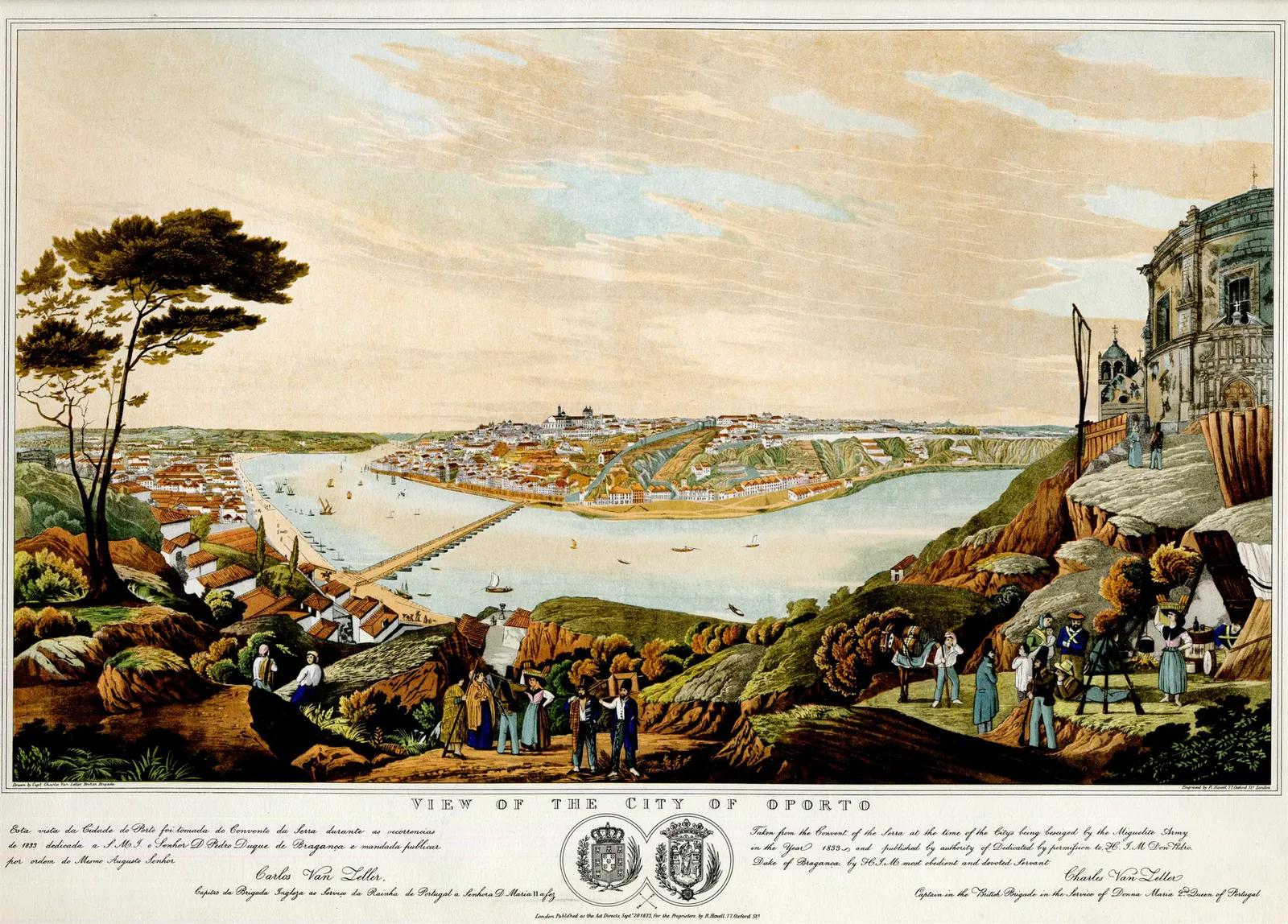
- Porto seen from the Serra do Pilar during the siege, a print drawn by Charles Van Zeller, engraved by Robert Havell and published in 1833 with a dedication to Dom Pedro. The bridge of boats links the city to Vila Nova de Gaia. Charles Van Zeller & Robert Havell, Public domain, via Wikimedia Commons.
- The Obelisco da Memória on Praia da Memória, Matosinhos, in 2021. It marks the place where the liberal army landed on 8 July 1832. Joseolgon, CC BY-SA 4.0, via Wikimedia Commons.