

Jornal de Notícias: the Porto daily first printed on 2 June 1888
A group of monarchist politicians in Porto launched a cheap four-page daily to fight their rivals. By 1899 it was also speaking for the city against the government, and it is still printed more than 135 years later.
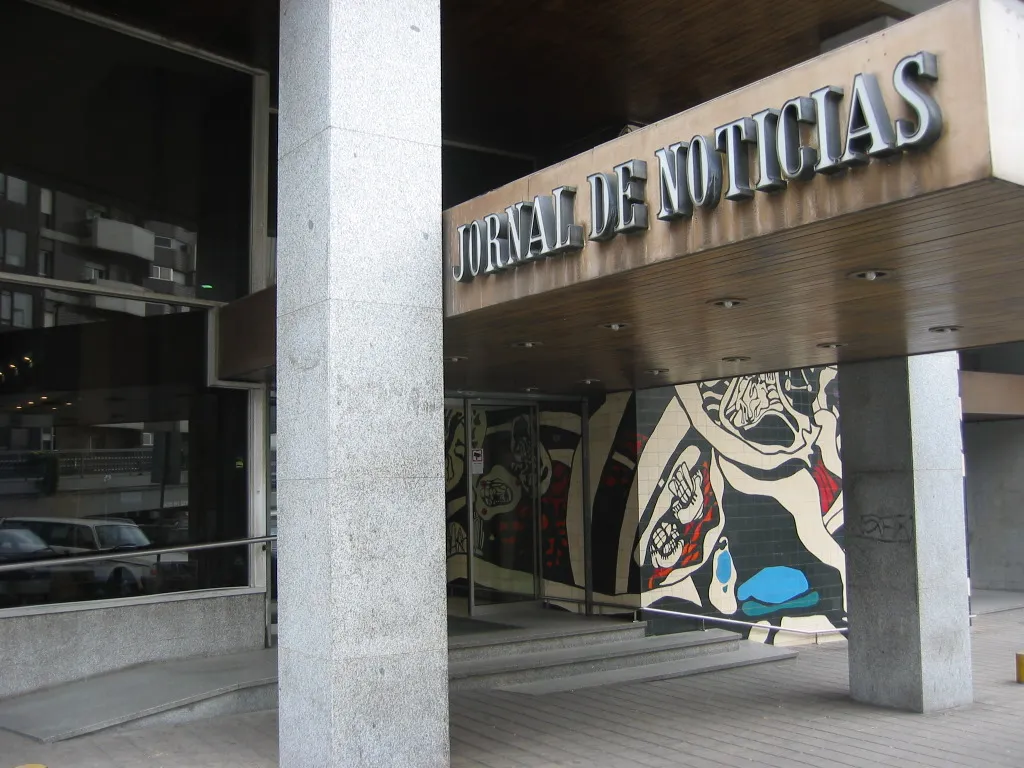
At a glance
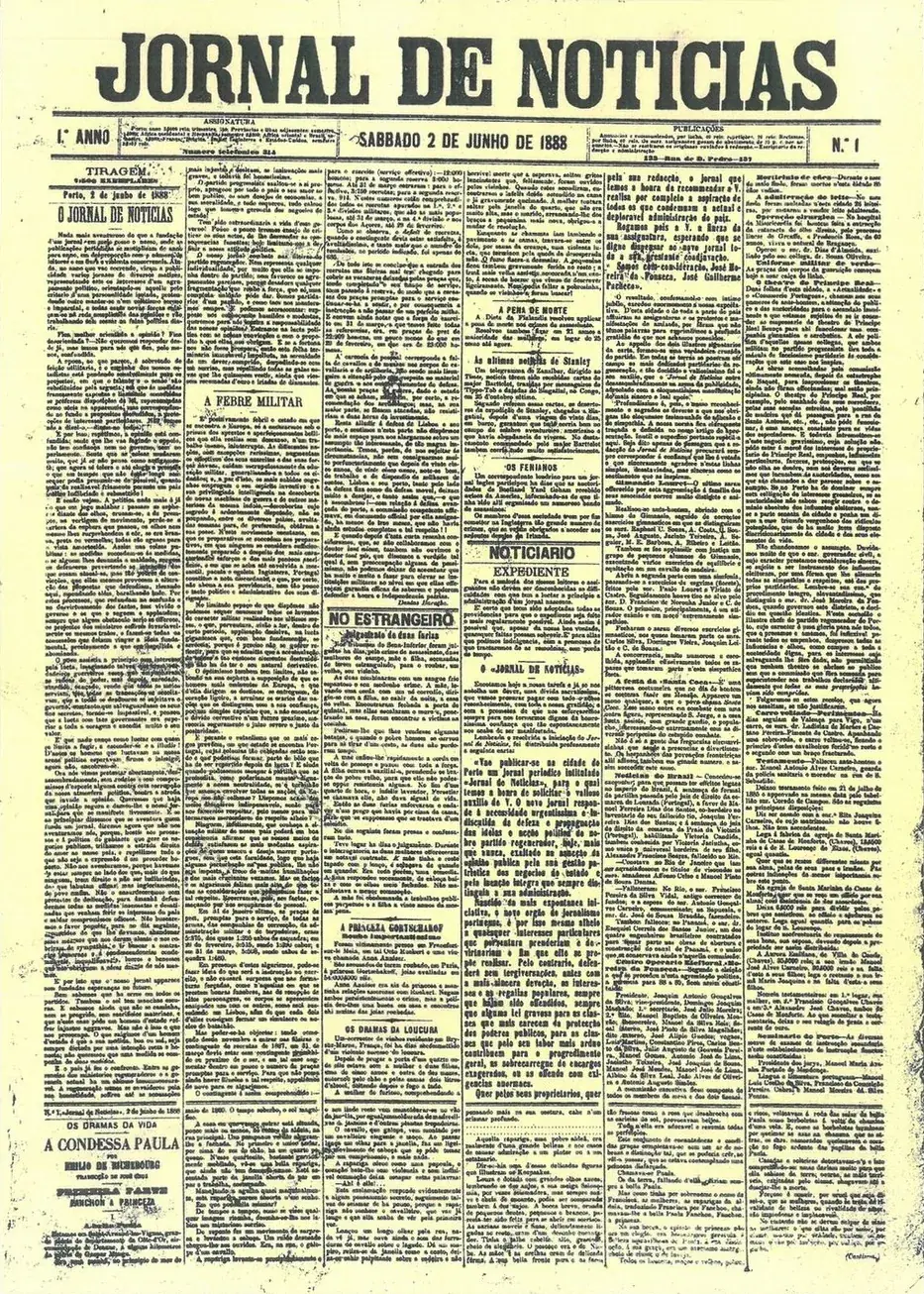
- The first issue of the Jornal de Notícias came out in Porto on Saturday 2 June 1888: four large pages for 10 réis, the price of Lisbon's popular Diário de Notícias.
- It was founded by a group of Porto politicians of the Partido Regenerador, one of the two monarchist parties that took turns in government, and its first editorial said it fought “in the ranks” of that party.
- Its print run doubled to about 16,000 copies by 1890. In 1899 it denied that Porto had bubonic plague and fought the cordon round the city; its print run rose to 22,000, and the authorities suspended it and then its stand-in, Notícias.
- It dropped the party link in 1907, opposed the Republic, backed the dictatorship until the 1940s, and then worked under real censorship until 1974; in 1978 it was the most widely sold paper in Portugal.
- Its audited paid print sale fell from a peak of about 101,000 copies an issue in 2008 to about 15,900 in 2025. Since July 2024 it has belonged to Notícias Ilimitadas, now wholly owned by Verbos Imaculados.
Number one, Rua de D. Pedro
On Saturday 2 June 1888 a new four-page daily came out in Porto, from an office in the Rua de D. Pedro. In its first issue two men, José Moreira Fonseca and José Guilherme Pacheco, put their names to a circular asking readers for a subscription. The paper they recommended, they wrote, answered the wishes of everyone who condemned “the current and deplorable administration of the country”.
The paper was the Jornal de Notícias, numbered 1 on its masthead, and the first column of its front page set out what it was for. Nothing was more adventurous, the editorial began, than founding a newspaper in a country where periodicals multiplied from year to year out of all proportion to the number of readers, in violent competition with one another. Then it said whose side it was on.
“Our paper fights in the ranks of the Regenerador party. It does not represent any individual, however much he may stand out within the party, nor does it favour factions, because it abhors any division that would rob it of the strength that only complete unity can give.”
The front page carried the political leader and, along the bottom, a serial novel, at first translated from foreign authors. Page two was a mix of foreign news, notices and anything else; pages three and four were largely advertisements, which soon filled about half the paper. It cost 10 réis, as Lisbon's Diário de Notícias did, when the dearest papers of the day could cost 30.
A crowded city of newspapers
Portugal in 1888 was a constitutional monarchy. Since 1851 two parties had taken turns in government, a system the Portuguese called rotativismo; by the 1880s they were the Regeneradores and the Progressistas. In 1888 the Progressistas governed under José Luciano de Castro, so the Regeneradores were in opposition and looking for a voice in the country's second city.
Porto was growing fast, from 106,000 people in 1878 to 139,000 in 1890. The city was modernising, with new streets and grand buildings such as the Palácio de Cristal, and São Bento station would follow at the turn of the century. Yet about half the people over the age of seven could not read. In 1890 about 65 per cent of the city's men over the age of seven were literate, and fewer than 37 per cent of its women.
Even so, Porto had too many papers for too few readers. Most were political: a daily was a party's weapon, and it lived as long as its backers paid. Two big dailies had outlasted the rest, O Comércio do Porto and O Primeiro de Janeiro, and the new paper set out to beat them on national and foreign news as well as on politics.
| Measure | Figure |
|---|---|
| Dailies launched in Porto, 1850 to 1890 | At least 68 |
| Dailies being published in 1850 | 5 |
| Dailies being published in 1890 | 18 |
| Average number in print at any one time | About 9 |
| Average life of a daily, leaving out the three still published in 1990 | About 5 years |
| Dailies that did not reach their second anniversary | 29 (12 did not reach their first) |
| Usual price of a four-page daily | 10 réis, sometimes 20 |
From the catalogues of the Biblioteca Pública Municipal do Porto and Pinho Leal's list, as counted by Francisco Ribeiro da Silva (1990). The three long-lived dailies are O Comércio do Porto, O Primeiro de Janeiro and the Jornal de Notícias.
A party paper with a popular touch
Fernando de Sousa, who wrote the paper's centenary history, describes the founders as a group of Regenerador politicians in Porto who wanted a big morning daily: one that would defend the party, but could also compete with O Comércio do Porto and O Primeiro de Janeiro for news. The circular they sent to possible subscribers was signed by José Moreira Fonseca and José Guilherme Pacheco.
“The new paper answers a most urgent and undisputed need for the defence and advocacy of the ideas and political action of the noble Regenerador party. … It will defend without equivocation, and with the most sincere devotion, the interests and rights of the people, whenever they have been offended.”
For almost twenty years it was the Regeneradores' paper in Porto. It campaigned at elections, praised Regenerador governments and attacked Progressista ones, beginning with Luciano de Castro's cabinet, and it fought O Primeiro de Janeiro over the defence of Portugal's African colonies. Sousa wrote that few periods of Portuguese journalism had seen so much abuse and so many insulting epithets.
The paper argued over Africa through the crisis of the British Ultimatum of January 1890, and it reported the failed republican rising in Porto on 31 January 1891. Both have their own articles in this series. Sousa found that its print run had doubled between 1888 and 1890, to about 16,000 copies, and then stayed there for most of the decade.
The rest of the paper was lighter. A Monday literary page carried Pinheiro Chagas, Gomes Leal, Maria Amélia Vaz de Carvalho and Oliveira Martins, and on 11 October 1889 it printed a sonnet by Camilo Castelo Branco, “Scena trivial”. There were joke columns, a fashion chronicle with engravings and comic verse on politics by Acácio Paiva. By the late 1890s it was copying royal gossip and murder trials from the foreign press, the London Daily Telegraph and Tit-Bits among them.
The plague that made its name
In 1899 bubonic plague broke out in Porto, where, Sousa notes, more than a third of the people lived in insanitary conditions. The bacteriologist Ricardo Jorge identified it. The government warned foreign ambassadors and threw a sanitary cordon round the city. Porto's foreign trade was badly hit and its factories closed, and thousands of workers lost their jobs overnight.
The Jornal de Notícias took the city's side against the facts. For months it filled most of its front page under the heading “A insalubridade do Porto”, Porto's unhealthiness, rather than say plague. From August it accused the government and the Lisbon papers of spreading panic and ruining the city; in Sousa's summary, it told the government to stop the comedy and called the plague an invention of the Progressista rabble, even while reprinting Ricardo Jorge's statement to another paper that it was certainly plague.
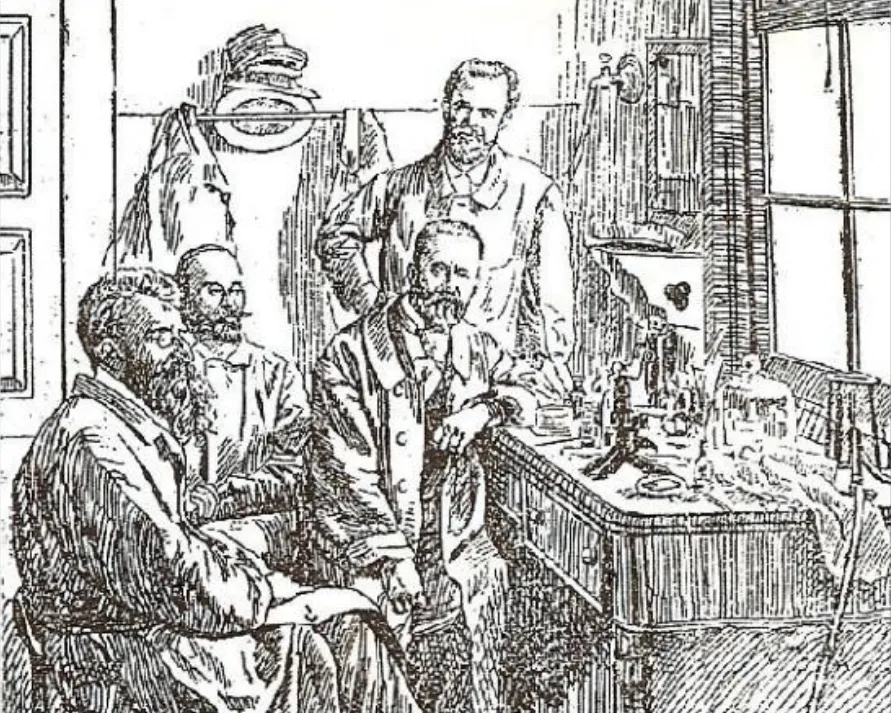
It also printed every job offer and every request for work free of charge. When riots broke out in September, Ricardo Jorge was threatened with death and left for Lisbon. Complaints of abuse of the freedom of the press piled up against the paper, and the authorities suspended it.
Before September 1899
Print run stuck at about 16,000 copies
Early September
Print run reaches 20,000, and 22,000 a few days later
September
Riots in Porto; Ricardo Jorge leaves for Lisbon
18 October
The suspended Jornal de Notícias appears as Notícias
Notícias is suspended in turn.
20 to 27 October
The Diário da Manhã takes its place
28 October
The Jornal de Notícias returns
The authorities warn that after another suspension it may not use the word Notícias in its title.
Medicine proved Ricardo Jorge right, but Porto did not want to hear it. Sousa calls the episode the moment the paper became a symbol of Porto: it had not been the best-informed or best-written daily in the city, he argues, but it was the one that defended Porto most stubbornly. He found that from then on the city's poorer people turned to it in every crisis, and that the New Year carol singers made a point of stopping at its offices.
| Date | Copies printed | Source |
|---|---|---|
| 1888 to 1890 | Doubled, to about 16,000 | Sousa (1991) |
| 1890 to August 1899 | About 16,000 | Sousa (1991) |
| Early September 1899 | 20,000 | Sousa (1991) |
| A few days later, September 1899 | 22,000 | Sousa (1991) |
| 1901 | 22,000 | Lima (2018) |
| 1911 to 1914 | About 42,000 | Sousa (1991) |
These are print runs claimed or recorded at the time, not audited sales. Lima (2018) gives a slower rise, from about 10,000 to 16,000 in a little over a decade and 22,000 in 1901; Sousa (1991) dates the jump to 22,000 to September 1899. Sousa's figure for 1888 is implied by his statement that the run doubled by 1890.
Against the Republic, then for the dictatorship
In 1907 the paper cut its ties to the Regenerador party and called itself independent. Its management and staff stayed monarchist, and when the Republic was proclaimed in October 1910 it became an outspoken critic of the new regime. It had already started printing photographs on its front page for big stories: floods on the riverside, the visit of King Manuel II, and in 1910 the leaders of the revolution.
In September 1911 an attempted military rising in Porto was put down at once, shortly before a monarchist incursion in the north-east, and arrests followed across the city. A Catholic workers' club was burned and the Catholic paper A Palavra attacked; Joaquim Leitão, a journalist on the Jornal de Notícias, had to leave the country. The paper answered with a series of articles headed “Norte e Sul”, North and South, which cast Porto as the honest worker of the nation and Lisbon as the home of placemen and mobs.
“Our mandate is the communion of our thinking with the feelings of the people of the North, a humble family of the exploited and of the vassals of the great castes of the old and the new feudalism.”
The line sold. While other big dailies struggled, Sousa found, the Jornal de Notícias kept a print run of about 42,000 and stayed first among the papers of Porto, with the most advertising in the north. In 1925 to 1927 it built a new headquarters on the Avenida dos Aliados, Porto's main avenue, designed by José Marques da Silva, the architect of São Bento station.
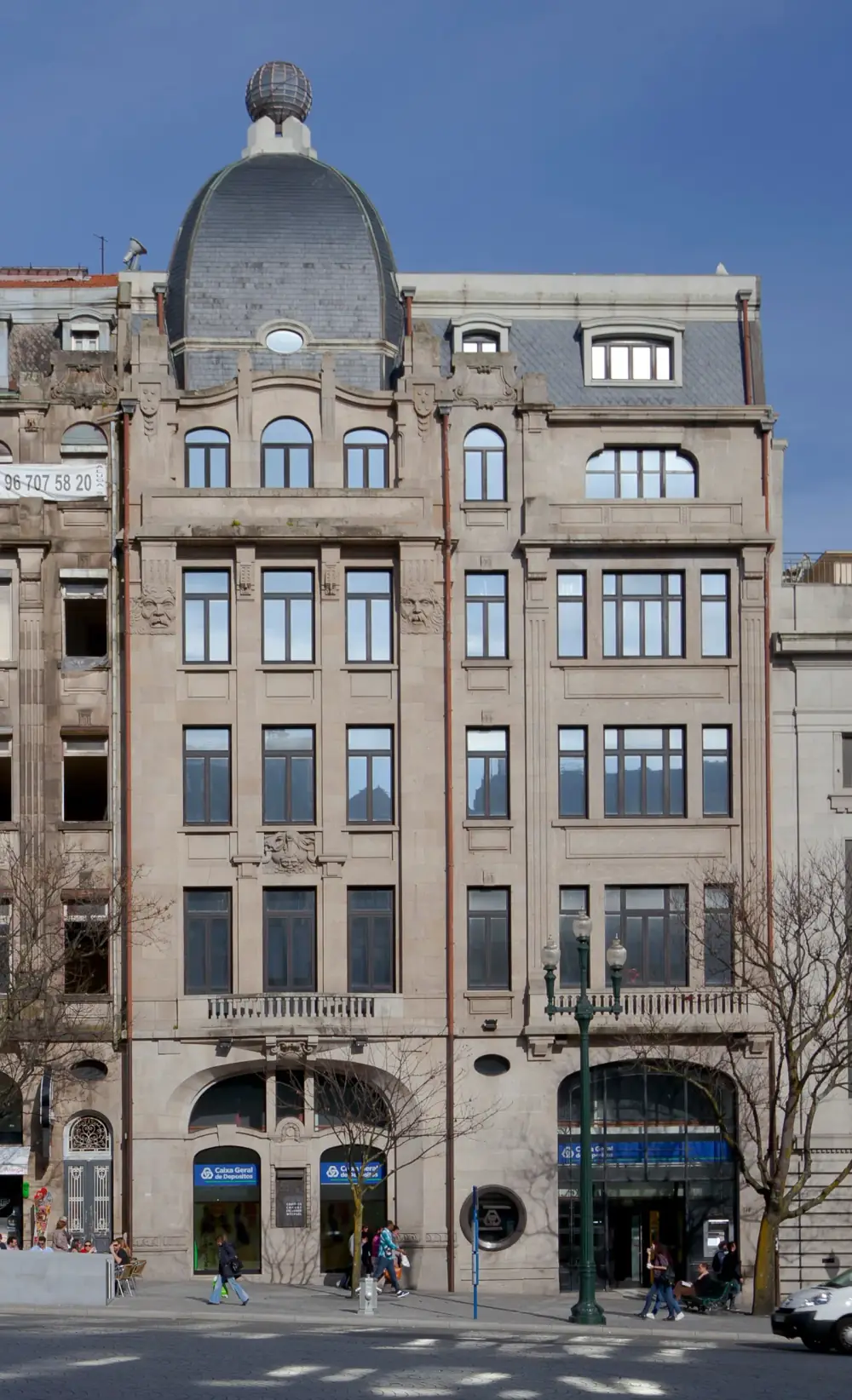
From the early 1920s, Sousa argues, the paper preached tradition, authority and nationalism, and so helped prepare opinion for the military coup of 28 May 1926. Under the dictatorship and Salazar's Estado Novo, the authoritarian regime that followed it, the Jornal de Notícias was a loyal mouthpiece. Its regular writers included nationalists, national-syndicalists and fascists, and until 1942 it showed open sympathy for the totalitarian regimes abroad. It had little trouble with the censors.
Loyalty cost readers. Its readership fell from 1934 and 1935 and reached its lowest point in 1942 and 1943, when the paper lost the first place among northern dailies that it had held since 1900. Meanwhile it opened its first permanent bureaus outside Porto: Lisbon in 1928, Braga in 1933 and Coimbra in 1944.
It also reached further into the north. From 1928 it put up news boards in towns around Porto, such as Santo Tirso, Póvoa de Varzim, Valongo, Famalicão and Espinho, and further away in Régua and Lamego on the Douro and in Coimbra. After the Second World War it covered the Beira Alta and the Bairrada, south of the Douro, and ran a weekly farming page, O Norte Agrícola.
Under the censor, 1945 to 1974
After 1945, Sousa writes, the Jornal de Notícias suffered from censorship like the rest of the Portuguese press, learned to live with it, and then found ways round it as the system slowly loosened. It dropped the writers most closely tied to the regime, brought in a new group of writers and literary critics, and redesigned its pages.
Readers came back. In the 1960s its print run passed O Comércio do Porto's again, and shortly before 25 April 1974 it passed O Primeiro de Janeiro's. It stopped being a paper of opinion, and papers close to the regime came to treat it as an opposition daily. In 1970, according to the historian Rui Ramos on Observador's history podcast, it moved into a purpose-built tower of 14 storeys.
After the revolution
The Carnation Revolution of 25 April 1974 ended censorship. From 1974 to 1976 the paper identified itself with the revolutionary process, Sousa found; afterwards it kept a leaning to the left but presented itself as independent. It grew fast, and in 1978 it was the most widely sold newspaper in Portugal. By its centenary in 1988 it was second only to Correio da Manhã and sold more than O Comércio do Porto and O Primeiro de Janeiro put together.
The revolution also changed who owned it. When the banks and insurance companies were nationalised in 1975, the state came to control, directly or indirectly, the Empresa do Jornal de Notícias and seven other newspaper companies. After the military crisis of 25 November 1975, the Council of the Revolution, the body of officers that then oversaw the government, dismissed all their boards and suspended their papers until the government named new managers, which it was to do within ten days.
It remained a northern paper. In 1988 it had twelve bureaus, and only the one in Lisbon lay south of Coimbra; its two daily pages of regional news were headed “Norte-Sul”. That year, Sousa noted, the three big Porto dailies were the only papers in the city to have appeared without a break for a century. Of the three, only the Jornal de Notícias came through the upheavals in the press at the end of the twentieth century; O Comércio do Porto printed its last issue on 30 July 2005.
Jornal de Notícias: average paid print sale per issue, 2005 to 2025
copies per issue
Audited paid print circulation (subscriptions plus sales) from APCT, the Portuguese circulation audit body. Each year is Lisboeta's mean of APCT's four quarterly figures, rounded. OberCom's annual figures for 2008 to 2014, from the same audits, differ from these by fewer than 90 copies.
Show the data
| Paid print circulation | |
|---|---|
| 2005 | 95,260 |
| 2006 | 95,466 |
| 2007 | 91,812 |
| 2008 | 101,234 |
| 2009 | 89,079 |
| 2010 | 84,673 |
| 2011 | 85,236 |
| 2012 | 72,798 |
| 2013 | 64,212 |
| 2014 | 58,255 |
| 2015 | 53,879 |
| 2016 | 49,596 |
| 2017 | 45,667 |
| 2018 | 42,597 |
| 2019 | 39,313 |
| 2020 | 28,179 |
| 2021 | 23,924 |
| 2022 | 22,198 |
| 2023 | 19,226 |
| 2024 | 17,554 |
| 2025 | 15,936 |
The paper today
The Jornal de Notícias now sells a fraction of what it once did. Its audited paid print sale fell from a peak of about 101,000 copies an issue in 2008 to about 15,900 in 2025. The steepest fall came in 2020, when it lost more than a quarter of its sale. Paid digital copies added between about 3,000 and 4,500 an issue in each quarter from 2022 to 2024, but only about 1,200 to 1,600 in the second half of 2025.
In print it is still second among the audited dailies, behind Correio da Manhã with about 32,400 copies in 2025; counting digital sales, Público, with about 9,100 print and 54,700 digital copies, sells more.
Its ownership has been less steady. The state sold its newspapers under Cavaco Silva's government: in 1991 the film distributor Lusomundo bought the Diário de Notícias and, according to the DN's own history, the Jornal de Notícias as well. Lusomundo sold its media business to Portugal Telecom's PT Multimédia in 2000, and in 2005 PT sold it to Joaquim Oliveira's Controlinveste.
By the 2010s the paper belonged to the Global Media group, alongside the Diário de Notícias and the radio station TSF. In 2023 a Bahamas-based fund, the World Opportunity Fund, became the group's largest indirect shareholder and then refused to put in money. The group struggled to pay its more than 500 staff, and the media regulator ERC opened an inquiry into who really owned the fund.
In February 2024 a group of northern businessmen agreed to buy the Jornal de Notícias, the sports daily O Jogo and TSF, with a journalists' cooperative promised a share. The titles passed to a new company, Notícias Ilimitadas, at the end of July 2024. In March 2026 Global Media sold its remaining 30 per cent, leaving Verbos Imaculados, a company led by Domingos Andrade, as sole owner.
The paper was founded to win votes for a monarchist party, and it grew by speaking for Porto: against the government and the Lisbon press in 1899, and against the Republic's politicians in 1911. A century after the first issue, only one of its twelve bureaus, the one in Lisbon, lay south of Coimbra.
“It is a very newsy paper with a popular manner, much liked in the North, and it has always had a first-rate editorial staff.”
FAQs
When was the Jornal de Notícias founded?
Its first issue, numbered 1 and dated Saturday 2 June 1888, came out in Porto. Helena Lima, who has studied its early years, also dates the first issue to 2 June 1888.
Who founded the Jornal de Notícias?
A group of Porto politicians of the Partido Regenerador, one of the two monarchist parties that alternated in government. The circular announcing the paper was signed by José Moreira Fonseca and José Guilherme Pacheco, and the first editorial said the paper fought in the ranks of the Regenerador party.
Was the Jornal de Notícias censored under Salazar?
Yes, but not evenly. According to its centenary historian Fernando de Sousa, it supported the dictatorship from 1926 to 1945 and had little trouble with the censors, then suffered real censorship from 1945 to 1974 and learned to work around it. By the last years of the regime, papers close to the government regarded it as an opposition daily.
How many copies does the Jornal de Notícias sell?
APCT audits put its average paid print sale at about 15,900 copies an issue in 2025, down from about 101,000 in 2008. Paid digital copies added about 3,300 an issue in the first half of 2025 and about 1,200 to 1,600 in the second. In print it is second among Portugal's audited dailies, after Correio da Manhã.
Who owns the Jornal de Notícias?
Since 30 July 2024 it has belonged to Notícias Ilimitadas, a company formed by a group of northern businessmen to take over the paper, O Jogo and other titles from the troubled Global Media group, which kept a 30 per cent stake. In March 2026 Global Media sold its last stake, and Verbos Imaculados, led by Domingos Andrade, became the sole owner.
On the timeline
Open the timelineNearby moments from regeneration and the last kings (1851–1910).
Birth in Lisbon of Luís Filipe, heir of King Carlos I. In 1907 he became the first heir to the throne to tour the African colonies; less than a year later, on 1 February 1908, he was shot alongside his father in the Lisbon Regicide and died moments after him.
The Associação Académica de Coimbra is founded, the oldest students' union in Portugal. Every student of the University of Coimbra automatically becomes a member, and its football team, Académica, became one of the country's best-loved clubs.
Amadeo de Souza-Cardoso is born at Manhufe, near Amarante. In Paris he befriended Modigliani and in 1913 showed at the Armory Show in New York; his fusion of Cubism, Futurism and Portuguese folk motifs makes him the great pioneer of modern painting in Portugal.
Jornal de Notícias is founded
The newspaper 'Jornal de Notícias' publishes its first edition in Porto. The daily has outlived every regime since to become one of Portugal's longest-running and most widely read papers.
Birth of Fernando Pessoa in Lisbon. Educated in Durban and steeped in English-language literature, he would invent more than a hundred fictitious authors, among them the heteronyms Alberto Caeiro, Ricardo Reis and Álvaro de Campos, and is now considered one of the most significant literary figures of the 20th century. His masterwork 'Livro do Desassossego' was first published as a book in 1982, 47 years after his death.
Death of Eduardo Coelho, the Coimbra-born typesetter turned journalist who in December 1864 co-founded the 'Diário de Notícias' with the printer Tomás Quintino Antunes. He ran it until his death; still published today, the 'DN' is regarded as Portugal's newspaper of record.
King Luís I dies at the Citadel of Cascais at the age of 50. A translator of Shakespeare, he had reigned for almost 28 years and was succeeded by his son Carlos I.
Coming up in history
All long reads 4 June 1927Presença, the Coimbra magazine that printed Pessoa: 4 June 1927
 5 June 1443The Constant Prince: Infante Fernando dies a hostage in Fez, 5 June 1443
 6 June 1801The Treaty of Badajoz, 1801: how Portugal lost Olivença
 7 June 1594Roderigo Lopes: Elizabeth I's Portuguese doctor, hanged at Tyburn in 1594
15 sources
Archives, scholarship and reporting this article was checked against.
- 1
Le Jornal de Notícias et l'identité du Nord du Portugal (1888-1988) (Fernando de Sousa)In L'identité régionale: l'idée de région dans l'Europe du Sud-Ouest, CNRS / Maison des Pays Ibériques, 1991, pp. 263-271
- 2
- 3
A evolução editorial do Jornal de Notícias e a inclusão de elementos de jornalismo popular (Helena Lima)Revista de História da Comunicação, SOPCOM, July 2017
- 4
Jornal de Notícias, year 1, no. 1, Saturday 2 June 1888 (scan of the front page)Wikimedia Commons
- 5
Jornais e revistas do Porto no tempo de Camilo (Francisco Ribeiro da Silva)Faculdade de Letras da Universidade do Porto; first published in Bibliotheca Portucalensis, 2nd series, no. 5, 1990
- 6
Análise simples: circulação paga impressa e digital, all audited titles, 2025 (yearly export)APCT, Associação Portuguesa para o Controlo de Tiragem e Circulação
- 7
Linha 22: redescobrir a arquitetura de Marques da Silva na Baixa portuenseFundação Instituto Arquitecto José Marques da Silva, Universidade do Porto
- 8História dos jornais em Portugal (e suas crises), E o Resto é História (João Miguel Tavares and Rui Ramos)Rádio Observador, 24 January 2024
- 9
Resolução do Conselho da Revolução de 27 de Novembro de 1975 (crise do sector da imprensa)Diário do Governo, 1st series, no. 275, supplement, 27 November 1975, pp. 1912-(4) to 1912-(5)
- 10
A Imprensa em Portugal 2015: performance e indicadores de gestãoOberCom, Observatório da Comunicação, October 2015
- 11DN em luta. 159 anos na vida de PortugalDiário de Notícias, 20 January 2024
- 12Grupo de empresários assinou memorando de entendimento para comprar JN, TSF e JogoObservador, 6 February 2024
- 13Acordo fechado. JN, O Jogo e TSF comprados por grupo de empresários representado por Diogo FreitasECO, 2 February 2024
- 14Conclusão da venda do JN e da TSF marcada para dia 30ECO, 26 July 2024
- 15Global Media vende participações nas empresas donas do JN e da TSFDiário de Notícias, 25 March 2026

Image credits
- The entrance of the Jornal de Notícias building on Rua de Gonçalo Cristóvão, Porto, photographed in 2006. It is a later building than the 1920s headquarters on the Avenida dos Aliados shown further down. Deiz, CC BY-SA 3.0, via Wikimedia Commons.
- The front page of the first issue, Saturday 2 June 1888. The editorial “O Jornal de Noticias” opens the first column; the founders' circular asking readers to subscribe is printed further along the page. Unknown author, Public domain, via Wikimedia Commons.
- Ricardo Jorge and Luís da Câmara Pestana with Albert Calmette and Alessandro Salimbeni of the Pasteur Institute during the Porto plague of 1899, in a drawing of about that year. Unknown author, Public domain, via Wikimedia Commons.
- The former Jornal de Notícias headquarters on the Avenida dos Aliados, Porto, designed by José Marques da Silva and built in 1925 to 1927, photographed in 2012. Poco a poco, derivative work: JotaCartas, CC BY-SA 3.0, via Wikimedia Commons.