It is not easy to explain to a country thirsty for answers that simplifications do not survive the test of circumstances. But that is the challenge: to change Portugal without promising a Portugal that does not exist. Opinion by Martim Avillez Figueiredo
On January 18, Isabel Moreira, a member of the Socialist Party, submitted a report to the Constitutional Affairs Committee for the admission of a petition to potentially ban Chega as a racist and fascist party. Moreira argues that Chega does not respect the essential values and principles of the Portuguese Constitution. The petition currently has 12,000 signatures. Moreira's actions are understood as an attempt to combat Chega's ideas and practices, which dangerously approach the violation of fundamental democratic values. However, it is questionable whether this is the most effective way for Moreira to achieve her goals. Chega is currently the second-largest party in parliament, with André Ventura receiving around 1.7 million votes in the presidential elections. This indicates that there are over 1.7 million Portuguese voters for Chega, encompassing a diverse range of opinions. While some may support Salazarism, others reject it, and there are moderates and disillusioned former socialists and communists within Chega's base. Chega's rise is not solely ideological; many voters are disenchanted with the current system that fails to improve their lives. Moreira's petition will soon be discussed in Parliament, bringing Chega back into the political spotlight. If approved, it will be sent to the Constitutional Court, which has never banned a parliamentary party. While Chega has its share of unsavoury characters, it also includes qualified individuals. Moreira knows Chega is a populist party, but its historical connection to Nazism or Italian fascism is tenuous. The most effective way to combat Chega is to modernise Portuguese society and improve living conditions for its citizens. Moreira has a platform to challenge Chega's ideas, and initiating a ban on a party with 1.7 million votes may be counterproductive.
An opinion poll by Intercampus analysed the 'unpopularity' of world leaders among the Portuguese. 83% of respondents disapprove of Putin's actions, while 70% view Trump negatively.
Is it possible that the leader of Portugal's largest party and the Prime Minister can be neutral on an issue like this? Does he realise what this position reveals about his lack of courage?
Ventura without a permanent microphone is Ventura without fuel. Ventura burdened with institutional duties is Ventura without profitable rebellion. But this requires thinking two moves ahead.
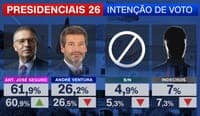
This is the first poll conducted entirely after the televised debate between Seguro and Ventura. The figures bring bitter news for both presidential candidates.
Technical details
Over three days (28, 29 and 30 January 2026) Pitagórica collected a minimum of 202 to 203 interviews per day (depending on quota adjustments) for TVI, CNN Portugal, TSF and JN to ensure a daily sub-sample representative of the Portuguese electoral universe (non-probability). The sampling criteria were gender, three age groups and 20 geographic strata (districts plus Madeira and the Azores).
The aggregation of the last three days of fieldwork resulted in a sample of 608 interviews which, for a confidence level of 95.5%, corresponds to a maximum margin of error of ±4.06%.
Respondents were selected through random generation of mobile phone numbers, maintaining the proportion of the three main mobile operators. When necessary, landline numbers were randomly selected to support the sampling plan. Interviews were conducted by telephone using CATI (Computer Assisted Telephone Interviewing).
The study aims to assess Portuguese voters' opinions on issues related to the Presidential elections, namely the main protagonists, campaign moments and the voting intentions for the various candidates. There were 1,261 contact attempts to achieve 608 completed interviews, giving a response rate of 47.87%.
The allocation of undecided voters is done proportionally.
The technical direction of the study is the responsibility of Rita Marques da Silva. The full technical sheet and all results have been filed with the ERC — the Regulatory Authority for the Media — which will make them available online for consultation.
These presidential elections could be the moment to hear the 'bell' that rings within us, telling us to think for ourselves and not be afraid to take risks.
There are, however, refrains that recur among many: not wanting the PS (Socialist Party) back, not wanting socialism back, and never wanting another 'geringonça' in the country.
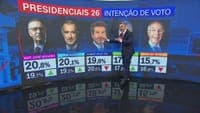
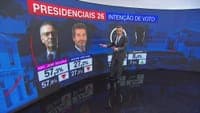
Seguro continues to lead comfortably in voting intentions. Daily polling shows the firmness of voting intentions but also the reasons for mobilisation behind each candidate. See all the data here.
The broadcasts on the three channels were the day's most-watched programmes. The second-round debate recorded the highest viewership in this presidential election.
A majority of Portuguese (62%) agree on the need to further increase spending on defence and security in the country. This is one of the conclusions of an FGS Global analysis, released on Monday exclusively by Politico. Portugal appears aligned with public opinion seen in France, Germany, the Netherlands and Ireland, where more ...
PÚBLICO and RTP publish a poll ahead of the 8 February presidential run-off between António José Seguro and André Ventura. The coverage situates the run-off within broader party shifts evident in recent legislative elections, arguing this realignment may be irreversible and that both the PS and PSD must rethink strategies to stay politically relevant. Commentators note a widespread lack of conviction in either candidate’s stated values — framing abstention as a responsible choice for some voters — and CNN Portugal’s João Marcelino interprets Marques Mendes’s endorsement of Seguro as signalling the PSD leadership’s and prime minister’s tactical aims for the run-off.
Day 6 of the tracking poll reshuffles the leading pack: António Seguro returns to first place, André Ventura is overtaken and drops to third, while João Cotrim de Figueiredo continues to climb and for the first time joins the leading pair in contention for a second-round spot. The instant poll records a five-way technical tie among top contenders, reflecting continued volatility. The aggregated three‑day sample (7–9 Jan 2026) comprises 608 telephone interviews (CATI), drawn via randomly generated mobile numbers with landlines used when necessary; sampling quotas covered gender, three age brackets and 20 geographic strata. At a 95.5% confidence level the maximum margin of error is ±4.06%; 1,201 contact attempts produced a 50.62% response rate and undecided voters were distributed proportionally. Campaigns responded briskly: Mendes’s team dismisses the polls, insisting he will finish first and advance to the second round, while Rangel predicted a surprise from Mendes; columnist Miguel Esteves Cardoso noted an unpredictable, anti‑poll restlessness among voters. Technical direction was by Rita Marques da Silva and the full technical sheet has been deposited with ERC for consultation.
A new IPPS/ISCTE opinion poll finds that almost half of Portuguese expect 2026 to bring continuity at the national level, with a majority forecasting political stability next year. Respondents were asked about expectations for their families, the nation and the international situation: while domestic outlooks skew towards stability and steady consumption confidence, many express concern about a possible deterioration in international affairs. The results highlight a cautious public mood—optimistic about internal political continuity but wary of external risks.