Europe: Inflation in Portugal
Latest news and stories about inflation in europe in Portugal for expats and residents.

War seems far away until the day you feel it at the fuel pump, in the supermarket, or in your mortgage payment. Ignoring the signs comes at a high price.

Economist Luís Aguiar-Conraria analyzes the potential economic fallout of the Middle East conflict, emphasizing that global recession risks depend heavily on policy responses and the stability of oil transport routes.
![If there is an impediment to oil transport [in the strait], it is almost as if 20% of global reserves disappeared](/_next/image?url=https%3A%2F%2Fimg.iol.pt%2Fimage%2Fid%2F69b73b3ed34edcee7c61e93d%2F200.jpg&w=3840&q=75)
The offensive by the US and Israel against Iran has led to the suspension of maritime traffic through the Strait of Hormuz.

The secret to the economic impact of the war in Iran lies in its duration. If the Strait of Hormuz remains closed for a long time, it could lead to recession and rising inflation, points out Sree Kochugovindan.

The effects of the crisis in the Middle East have already started to be felt in fuel prices, but from there on, everything will be impacted, explains CNN Portugal executive editor Vítor Costa.


The IMF's warning goes beyond the current conflict. What is at stake is an increasingly visible pattern in the global economy.

Beyond the death and destruction in Iran, the primary danger of the war launched by Donald Trump against the country is the perpetuation of the conflict. US Congress members are already admitting the possibility of deploying ground troops. This is how 'endless' wars always begin: first, precision and restraint are promised, then the geographical expansion, the multiplication of targets, and the dilution of any red lines are normalised. The next step toward the global precipice will be the multiplication of enemies, the formation of alliances, and the declaration of ruptures between countries, leading to the end—a world war with nuclear weapons at the ready. With insanity reigning, this is, unfortunately, a viable prediction. The second danger is the global economic shock, which is already here. The Strait of Hormuz, closed by Iran, is a vital artery through which about 20 million barrels per day transit, a quarter of the world's maritime oil trade. A significant portion of liquefied natural gas also passes through this corridor. With the war, Washington decided to release 172 million barrels from its strategic reserve, and the International Energy Agency moved toward a record coordinated release. For an energy-importing Europe preparing emergency reserves, for poor countries crushed by external bills, and for families already pressured by inflation, Trump's war has turned into a planetary tax on fuel, transport, and food. We have already begun paying this cost, which will push us into misery. The third danger is the end of International Law, which has saved so many lives in the past. When the world's greatest power normalises a preventive war with shifting motivations, it offers others a moral licence to do the same. With this war, the world is pushed into the jungle of 'might makes right'. The fourth danger is, ironically, the reinforcement of nuclear proliferation. Before the attacks, negotiations were underway between Washington and Tehran, mediated by Oman, and the IAEA itself was preparing additional technical discussions in Vienna regarding safeguards and verification of Iran's nuclear programme. The war destroyed the mechanisms that allowed us to know what the Iranians were doing. The signal many regimes take from this is simple: those without a nuclear weapon can be attacked; those who have one gain a life insurance policy. Few ideas are more dangerous for the 21st century than this. Meanwhile, the argument gains strength that to solve the energy problem, we must build more nuclear power plants—more potentially lethal 'Chernobyls' and 'Fukushimas'. The fifth danger is political and civilisational. The war provides fuel for all authoritarian currents that thrive on humiliation, resentment, bloc logic, xenophobia, and fanatical-religious conflict. In the Middle East, it multiplies radicalisation. In the West, it strengthens governments that demand more military spending and less democratic scrutiny. In the global economy, it creates conditions for energy-exporting states and rival powers to capitalise on the chaos. In the European Union, it gives space for the strong to command the weak and for the end of the unanimity rule among member states on central issues. In Portugal, the Government is positioning us as potential military targets for Trump's enemies. How do we stop this madness?

Conflicts in the Middle East have already caused oil prices to soar. Even from so far away, how do they influence the economy and our daily lives?

Oil has been hovering around 90 dollars, a level that threatens to accelerate global inflation and stall growth.

The escalation of the conflict in the Middle East, with the outbreak of war in Iran, has once again placed geopolitics at the centre of global economic concerns. The recent experience of the invasion of Ukraine reminds us that geopolitical shocks in strategically important energy regions tend to translate quickly into inflation. The world may, therefore, once again face a phenomenon...

The fear that we may be entering a new inflationary crisis is increasing expectations of an interest rate hike by the ECB. And the cost at which states finance themselves has already risen.

The guest for this episode, João Carvalho, director of the Department of Economics and Management at the Portucalense University, predicts a rise in all prices if the war does not end in the coming days.

The article does not pertain to Portugal; instead, it reports that Christine Lagarde, President of the European Central Bank (ECB), assures that inflation will be kept under control amid the ongoing Middle East conflict. Lagarde emphasized the ECB's commitment to preventing inflation surges similar to those experienced in 2022 and 2023, caused partly by Russia's invasion of Ukraine. She highlighted the current high uncertainty and volatility in global markets, referencing recent oil price fluctuations. Recent Eurostat data shows inflation in the eurozone decreased to 1.7% in January 2026, below the ECB's 2% target, with core inflation at 2.2%. Lagarde did not specify potential interest rate hikes but reaffirmed the ECB's focus on maintaining price stability despite geopolitical tensions.

Rising energy prices worry Europeans.

ADMIRABLE TRUMP WORLD NEWSLETTER • DAILY EDITION WITH UPDATES ON THE US AND ISRAELI ATTACK ON IRAN

European Central Bank (Banco Central Europeu or BCE) President Christine Lagarde has promised to do “whatever is necessary” to keep inflation under control. Lagarde noted that while the current situation differs from the 2022 energy crisis, the conflict in the Middle East poses risks to price stability. Taxpayers should be aware that the bank remains vigilant against sudden spikes in energy costs that could impact the cost of living.
Christine Lagarde is President of the European Central Bank since November 2019 and was Managing Director of the IMF from 2011 to 2019. Her decisions and public statements influence ECB monetary policy, which affects euro interest rates, mortgages and inflation across the euro area.

The war in the Middle East region has driven up energy prices, leading the market to fear an increase in inflation, which would cause the ECB to intervene to try to control the price hikes.

The article does not focus on Portugal but reports on statements by Christine Lagarde, President of the European Central Bank, regarding the ECB's commitment to controlling inflation amid rising energy prices caused by the Middle East conflict. It highlights the geopolitical tensions involving Iran, the US, and Israel, including military actions and regional retaliations. The piece also mentions recent regional incidents and other international news, but there is no specific information about Portugal.

The article discusses the European Central Bank's (BCE) commitment to controlling inflation amid rising energy prices caused by geopolitical tensions in the Middle East. President Christine Lagarde emphasized that the BCE will do whatever is necessary to prevent inflation from escalating, similar to the spikes experienced in 2022 and 2023 due to the Ukraine war. She highlighted that current inflation levels are under control and economic growth remains resilient in the eurozone, contrasting with the situation in 2022. However, she noted increased uncertainty and volatility in energy markets, with oil prices fluctuating sharply amid regional conflicts involving Iran, Israel, and the US. The BCE's next monetary policy decision is scheduled for March 19, amid global geopolitical tensions.

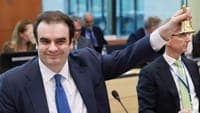
The warning was issued by the president of the Eurogroup, Kyriakos Pierrakakis.