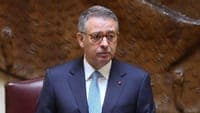
- Former President of Portugal (2016–2026)
- Party: Independent (formerly Social Democratic Party, PSD)
Electoral Mandate and Democratic Consensus:
Marcelo Rebelo de Sousa was elected President of Portugal on January 24, 2016, winning 52.0% of the vote in the first round—a decisive victory in a fragmented field. He campaigned as an independent, positioning himself as a unifying figure after years of austerity from Portugal's 2011–14 bailout, promising to repair political divisions and restore national confidence. His campaign emphasized moderation and cross-party consensus, a departure from his decades-long association with the center-right Social Democratic Party (PSD). Upon taking office on March 9, 2016, he suspended his party membership for the duration of his presidency.
His 2021 re-election proved extraordinary: Rebelo de Sousa secured 60.7% of the vote—the third-highest margin in Portuguese presidential electoral history since the 1974 Carnation Revolution. Historically, he became the first candidate ever to win in all 308 municipalities and the vast majority of parishes, ranging from 51.3% in Beja District to 72.16% in Madeira. This unprecedented sweep reflected his broad appeal across social, geographic, and ideological divides.
Constitutional Role and Crisis Leadership:
Portugal operates as a semi-presidential system where the president, while largely ceremonial, exercises meaningful influence over national security, foreign policy, and military affairs as Supreme Commander of the Armed Forces. Rebelo de Sousa leveraged this authority during Portugal's response to the COVID-19 pandemic. In March 2020, he requested parliamentary authorization for a state of emergency—the first nationwide declaration in 46 years of democratic history—to contain the crisis. He voluntarily quarantined after potential COVID-19 exposure in March 2020, and later tested positive in January 2021 while remaining asymptomatic. His measured handling of the pandemic, balancing public health with institutional continuity, contributed to his landslide 2021 re-election.
Diplomatic Engagement and International Presence:
Rebelo de Sousa has conducted extensive state visits representing Portugal's interests across diverse regions: the Vatican, Spain, Mozambique, Morocco, Brazil, Switzerland, Cuba, the United Kingdom, Greece, the United States, and Angola. A notable diplomatic highlight occurred in 2019 when he joined President Emmanuel Macron at the Bastille Day military parade in Paris, representing European military cooperation and the European Intervention Initiative. These engagements positioned Portugal as an active participant in global affairs, particularly regarding colonial history and Atlantic security partnerships.
Colonial Legacy and Historical Accountability:
During his presidency, Rebelo de Sousa has publicly supported making restitution and acknowledging abuses committed during Portugal's colonial history and the country's role in the Atlantic slave trade. This position marked a significant policy shift, as Portugal historically avoided confronting its imperial past compared to other European powers. His stance reflected evolving attitudes within Portuguese society toward historical accountability.
Controversies and Public Criticism:
Rebelo de Sousa's presidency has not been without controversy. In 2023, allegations emerged that he had intervened to expedite treatment for Brazilian twins with Zolgensma, an expensive rare disease medication, raising questions about presidential influence and potential corruption. These claims implicated his son and generated criticism across Portuguese political and media sectors. Additionally, in April 2024, Rebelo de Sousa made controversial remarks comparing the speed of Prime Ministers António Costa and Luís Montenegro using orientalist language that drew public rebuke. In August 2025, he called U.S. President Donald Trump a "Russian asset" at a PSD event, demonstrating his willingness to make provocative foreign policy statements.
Constitutional Constraints and Legacy:
Under Portugal's constitution, Rebelo de Sousa is barred from running for a third consecutive term, meaning his presidency concludes with elections scheduled for January 18, 2026. His decade-long tenure has established him as one of Portugal's most popular recent heads of state, characterized by broad consensus-building and institutional stability. Whether future presidents can replicate his cross-party appeal remains an open question for Portuguese democracy as it enters a new era.