Limits
We hope that the decision to allow for exceptions to remuneration limits will also be authorised for the PJ.

Latest news and stories about public sector in Portugal for expats and residents.
This page has only 1 story and is not indexed by search engines.
We hope that the decision to allow for exceptions to remuneration limits will also be authorised for the PJ.

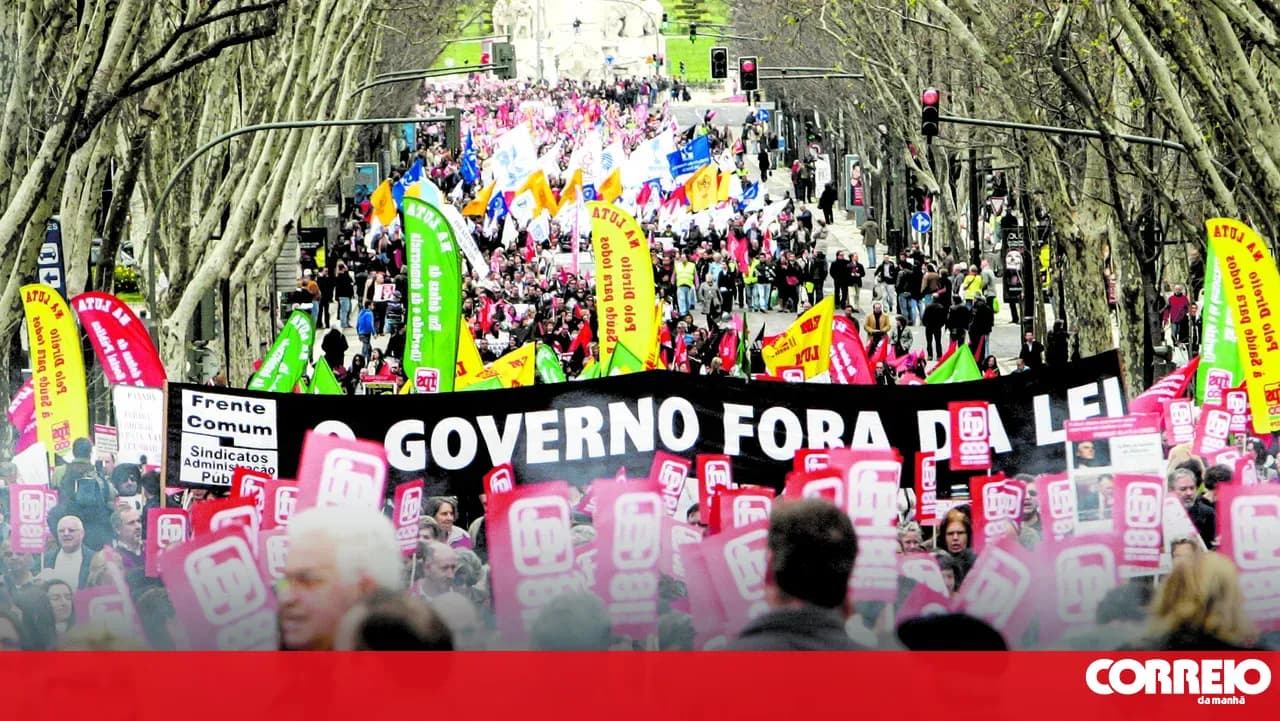
Approximately 500 people protested in Lisbon this Friday demanding salary increases in the public administration following the Ministry of Finance's failure to respond to the demands of the Common Front of Public Administration Unions. The protest began at Praça da Figueira and moved to the Ministry of Finance. Demonstrators carried banners calling for better working conditions and the valorisation of public sector workers. Sebastião Santana, coordinator of the Common Front, criticised Finance Minister Joaquim Miranda Sarmento for the lack of response to a negotiation request submitted in January. The union is demanding a 15% salary increase with a minimum of 150 euros to combat the loss of purchasing power. Tiago Oliveira, secretary-general of the CGTP, also attended, criticising the government of Luís Montenegro for its approach to labour relations and its handling of other sectors, such as the Lusa news agency.

The protest comes after the Ministry of Finance failed to respond to the demands of the public administration.

Portuguese nursing and medical unions have called a general assembly at the Lisbon Western Local Health Unit (ULSLO) for Monday, March 16, following a computer system error that caused thousands of hours of unpaid overtime to disappear from staff records. While the hospital administration attributes the issue to a software migration and guarantees that all data will be recovered, union leaders remain skeptical and are demanding urgent clarification, warning that they are prepared to organize protests if workers' rights are not fully protected.

Workers consider that the proposal translates into a salary reduction and an attack on hard-won rights.

For decades, the answer to the question of who decides in the State was reduced to a civil servant, a leader, or a minister, but today algorithms can increasingly be included. Algorithmic systems and Artificial Intelligence are already helping to define priorities in inspections, detect fraud, organise waiting lists, allocate support, or signal risks. These are useful tools that influence people's lives, and anything that affects rights, opportunities, or duties should be subject to public scrutiny. Hence the importance of a Public Register of Algorithmic Systems and AI in the Public Sector. This is not a technological whim or bureaucratic excess, but democratic transparency applied to the 21st century. Its purpose is to allow any citizen to know which systems are being used by the State, what they are for, on what legal basis they operate, what types of data they use, and what effects they produce. If an algorithm contributes to deciding who is audited or who receives support, that cannot be an administrative secret. However, transparency does not mean irresponsible exposure, as a well-designed register distinguishes what should be public from what should be reserved. Citizens should know the purpose of the system, the responsible entity, the degree of automation, the existence of human intervention, the categories of data used, and the mechanisms for contestation. Sensitive technical details, vulnerabilities, or legitimate trade secrets should remain accessible only to control and audit entities. It is also important to explain that not all algorithms are the same. Some systems only support human decisions, others classify or prioritise processes, and others can produce automated decisions. The register should clarify the degree of human intervention involved, as a citizen has the right to know whether they are facing a technical recommendation or an automated decision. Another essential point is risk assessment. A system that organises internal schedules does not have the same impact as one that influences access to social benefits. The register should indicate the level of risk assigned and summarise impact assessments, including data protection assessments, and make public the main mitigation measures. The issue of data also requires clarity. It is not about publishing databases, but indicating which categories are used (such as tax, identification, or health data, among others), what the legal basis for processing is, and what the retention periods are. This reinforces trust and allows for informed scrutiny. Furthermore, systems are not static. They evolve, are updated, and may reveal flaws or biases. The register should include information about versions, audits conducted, aggregated performance metrics, and relevant incidents. If a significant error or important correction occurred, the public should be informed. Creating such a register is not a technical mystery. It requires a central database, a searchable portal, submission mechanisms by public entities, and legal and technical validation before publication. It requires integration with public procurement registers and inventories of personal data processing. And it requires clear governance rules to know who registers, who validates, and who oversees. But the essential aspect is not the technology; it is the democratic culture that gives it meaning. In a rule of law, power, even when exercised by code, must be visible, explainable, and contestable. Therefore, transparency today must also encompass the systems that structure decisions. Public trust arises from clarity and transparency; thus, in the age of Artificial Intelligence, democracy begins with knowing which algorithms govern us and how they do so. For all these reasons, a workshop reflecting on The Transparency of Artificial Intelligence in the Public Sector is currently taking place at Campus XXI in Lisbon, organised by APDSI - Association for the Promotion and Development of the Information Society, with the support of ARTE - Agency for the Technological Reform of the State, as part of the III Open Administration Plan.

The Government approved on Thursday, at the Council of Ministers, pay rises for the public service and an increase in the meal allowance of €0.15 per year until 2029. The measure follows the multi-year agreement signed with trade union federations affiliated to the UGT (Fesap and STE), announced the Minister of the Presidency, António Leitão.

Without pay and without retirement for months. A teacher who postponed her retirement to respond to a Government request has been living in limbo for five months. The process was overlooked, and despite a shortage of teachers at her school and pupils needing special education, she is prevented from working.

André Ventura reacted to the letter from 'non-socialist' figures in support of António José Seguro, claiming a political victory: that it had forced the 'alleged system of interests' to reveal itself. The presidential candidate rejects the thesis that this election pits democracy against authoritarianism, arguing instead that the real contest in the run-off is between 'those who want to end the sinecures in the country' and those who wish to maintain them.

The trade union centre received a proposal from the Government, but the changes are not considered sufficient to call off the strike and it will reply. For now, negotiations are at a standstill.

The daily amount will become €6.30 from next week.

FESAP and STE, public-sector unions that today signed the agreement with the Government to improve workers' conditions, highlighted the 'predictability' it provides while saying they remain willing to continue negotiating.
The Government and UGT-affiliated unions Fesap and STE will sign an agreement raising the State minimum wage (Public Administration Remuneration Base, BRAP) to €1,116.55 in 2029 — effectively €1,117. The deal, due to be signed on Wednesday, formalises a planned uplift for public-sector pay that will interact with cost-of-living pressures and broader labour-market indicators, signalling the state’s approach to wage policy ahead of 2029.

CGTP, Portugal's largest trade union federation, warns of further industrial action, while rival union UGT has accepted a salary agreement.

The agreement covers the entire legislative term and will be signed this Wednesday at the prime minister's official residence. The Frente Comum, affiliated with the CGTP, will not sign.

The Government will sign a multi-year agreement with public-sector unions on Wednesday, a deal that will run until 2029.

The Government will sign on Wednesday with public service unions the 2026–2029 Multi-year Agreement to enhance the status and conditions of public administration workers, the executive announced today.

The meeting takes place as part of the ongoing negotiation process, which contemplates a possible extension of the current agreement.

In the race to lead in artificial intelligence (AI), the European Commission took a decisive step in October by presenting the Apply AI strategy. The initiative aims to accelerate AI adoption in SMEs and public bodies by using a new governance model that brings together industry, academia, the public sector and a European AI observatory. ...

The technician altered the status of cases relating to unemployment benefit payments, which were partially credited to her account. She was also ordered to pay a fine of €12,000.

Refers to policies or initiatives that extend beyond basic salary—such as benefits, working conditions or other non-wage measures.
The Socialist Party wants an open competition launched to recruit civil servants that gives priority to the experience of those working within the Recovery and Resilience Plan (PRR). In a draft resolution seen by ECO, the socialists ask the Government to 'conclude, within 30 days, ...'

Amendments to the class statute were published in the Government Employment Bulletin following an agreement.

In the Civil Service, the base salary is often just the starting point. Between allowances and overtime, how much does the State actually end up paying every month? Listen to the new episode of Economia dia a dia, Expresso's daily podcast, hosted by Juliana Simões.