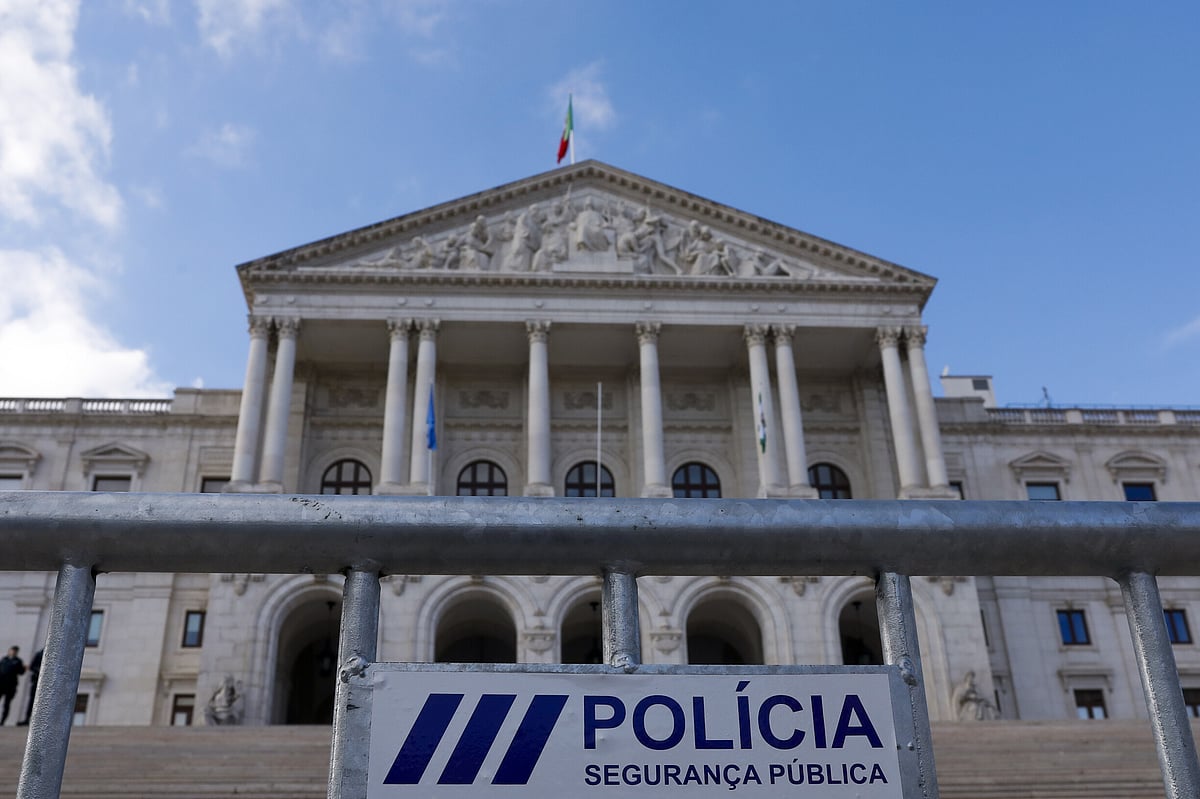
PSP arrests six protesters and identifies "several" others following clashes with police near the Assembly…
Those arrested face charges of resisting police action, disobedience, and setting fire to street furniture

Latest news and stories about protest in Portugal for expats and residents.
Those arrested face charges of resisting police action, disobedience, and setting fire to street furniture
Thousands of teachers marched in Lisbon today in a protest organized by the National Federation of Teachers (Federação Nacional dos Professores or Fenprof). The demonstrators expressed opposition to the government's proposed labour package and the revision of the Teaching Career Statute (Estatuto da Carreira Docente), while also announcing their participation in a general strike scheduled for June 3rd.
Update: Teachers confirm participation in June 3rd general strike
Thousands of teachers gathered in Lisbon this Saturday to protest against the government's proposed labour reforms and the revision of the Teaching Career Statute. During the demonstration, Fenprof officially confirmed that teachers will join the national general strike scheduled for June 3rd.
Fenprof is the National Federation of Teachers (Federação Nacional dos Professores), the main public‑school teachers' union in Portugal that represents teachers in pay, working conditions and education reforms. Its criticism matters because Fenprof can organize strikes and mobilise teachers, which directly affects school operations and the implementation of government changes — something families and expat educators should monitor.
The Teaching Career Statute (Estatuto da Carreira Docente) is the law that sets how teachers are recruited, evaluated, promoted and dismissed in Portugal. The proposed revision matters because it would introduce a centralised national competition for entry, a one-year trial period and an exceptional route for teachers without formal qualifications, changes that affect job access and stability for current and future teachers.

The Permanent Coordinating Commission (CCP), representing major security force unions including the Public Security Police (Polícia de Segurança Pública or PSP) and the National Republican Guard (Guarda Nacional Republicana or GNR), has announced a national protest for April 16. The demonstration will take place in front of the Prime Minister's residence in Lisbon to oppose legislative changes since 2005 that have reduced pension values for security personnel.

The PSP (Polícia de Segurança Pública) is Portugal's national civilian police force, founded in 1867. Responsible for defending Republican democracy and safeguarding internal security and citizens' rights, the PSP polices major cities—Lisbon, Porto, Faro—and large urban areas, covering only 4% of Portugal's territory but roughly half the population. Led by a National Director under the Ministry of Internal Affairs, its approximately 21,500 officers handle preventive policing, crime investigation, public order, airport security, diplomatic protection, private security regulation, firearms licensing, and border control (since 2023).
PSP vs. GNR: The PSP is civilian with police-focused training and urban jurisdiction, while the GNR (Guarda Nacional Republicana) is military (gendarmerie) with military training, covering 96% of Portugal's rural and suburban territory. Both share core public safety missions but differ fundamentally in nature, training, and geographic responsibility.

The GNR (Guarda Nacional Republicana) is Portugal's national gendarmerie—a military police force founded in 1911, with origins dating to 1801. With over 22,600 personnel, GNR patrols 94-96% of Portuguese territory, covering rural areas, medium towns, and highways. Members are military personnel subject to military law, responsible for public order, customs, coastal control, environmental protection (SEPNA), firefighting/rescue (GIPS), border control, and ceremonial guards. GNR vs. PSP: The PSP (Polícia de Segurança Pública) is Portugal's civilian police force, covering major cities (Lisbon, Porto, Faro) and large urban areas—only 4% of territory but roughly half the population. PSP handles airport security, diplomatic protection, and private security regulation. Both share core missions (public order, crime prevention), but differ in nature: GNR is military with military training; PSP is civilian with police-focused training.
Demonstrations took place this Saturday in several cities across the country against the Government's housing measures.
Update: Protests spread to 16 cities amid rising costs
Demonstrators in 16 cities criticized the government for failing to curb real estate inflation, citing an 18% rise in house prices during the final months of 2023. Protesters highlighted the extreme difficulty of finding affordable housing, with some reporting room rentals costing as much as €500 per month.
More than 100 collectives have organized a series of protests under the slogan “It's not enough” (Já não dá) to demand better access to affordable housing. The demonstrations, scheduled for the coming weekend in several cities, show the growing gap between wages and rental prices. Organizers argue that recent government measures have failed to protect tenants from irregular rent increases and precarious living conditions. Tenants and those seeking housing should be aware of the protests in major urban centers.