Latest news and stories about sns in daily life in Portugal for expats and residents.
Two of the maternity hospitals with the highest number of births in Portugal are private institutions, a shift that analysts link to the country’s rising caesarean rate, now at a record high. The expansion of deliveries in the private sector appears to be a key driver of growing caesarean use nationally, while within the SNS the public unit with the most births is Maternidade Alfredo da Costa. The pattern raises questions about clinical practice variation between sectors, implications for maternal and neonatal outcomes, and the need for policy and oversight to address incentives and standardise care.

This is what the official SNS website indicates for this weekend. Also in this edition: an interview with Mário Centeno for Observador about the ECB, and coverage of the EU's agreement with Mercosur.

Presidential candidate Catarina Martins said today that the Prime Minister, Luís Montenegro, knows the reality of the problems in the National Health Service (SNS) but 'chooses to lie', insisting that the sector's deterioration is intentional.
Survey-based reporting finds an increasing share of people no longer rely solely on the National Health Service and are turning to private healthcare providers; analysts say access difficulties in the SNS are a key driver and that wealthier patients who switch rarely return to public care. Residents who depend on the SNS should plan for longer waits for some services and weigh private options if timely access is critical.
Nova SBE (Nova School of Business and Economics) is the business school of Universidade Nova de Lisboa, based in Carcavelos; it has a modern campus opened in 2018 and is one of Portugal’s leading business schools. Its surveys and research—like the healthcare access study cited in the news—are often used in public policy debates, so expats will see Nova SBE data quoted in media and policy discussions.
Portugal recently revised its return legislation to replace the phrase 'voluntary abandonment' with a formal 'duty to abandon', aligning national rules with EU return standards and making an obligation to leave explicit for third‑country nationals subject to removal decisions. For migrants this clarifies legal responsibilities and can affect the timing and procedures of removals, including when assisted or enforced return measures may be used.

Difficulties accessing the National Health Service (SNS) are driving patients away from exclusive reliance on public care and toward private healthcare. More than half of people report self-medicating and the majority do not inform their doctor, while those who can afford private care rarely revert to the SNS once they switch. The trend suggests growing segmentation in access and a potential long-term shift of wealthier patients out of the public system.

In Campo Maior, during a visit to an IPSS (private social solidarity institution), António Filipe criticised the prime minister's latest remarks, in which he said 'there is a perception of chaos in the SNS'.
Nurses' and diagnostic technicians' unions warn that limits on hiring staff will lead to a further deterioration of the National Health Service.

Álvaro Almeida says the SNS Executive Directorate monitors the data daily and that the essential task is to establish the causes of the excess mortality. More detailed analyses, he adds, will only be carried out once winter is over. For now, he urges caution.

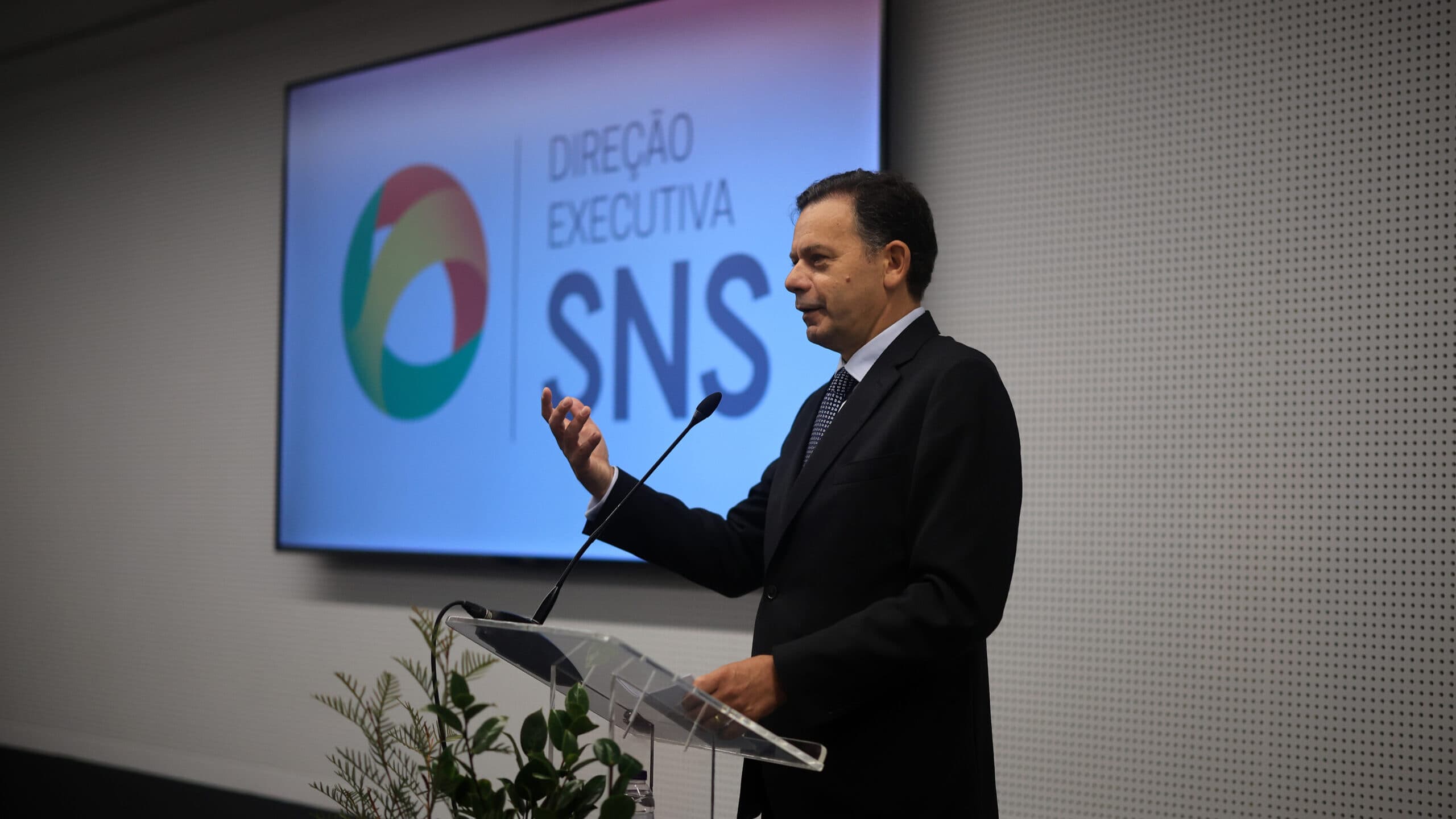
The prime minister said on Monday there is a 'perception of chaos' in the National Health Service (SNS) but insisted that 'this is not reality', arguing that hospital waiting times 'are the best of the last five years'. Speaking in Porto at the inauguration of the SNS Executive Directorate's headquarters, Luís Montenegro recognised that ...

The chief executive of the National Health Service (SNS), Álvaro Almeida, spoke to journalists at the opening of the SNS executive directorate's headquarters in Porto on Monday.

The president of the Portuguese Order of Nurses says he is concerned about limits on hiring new staff, adding that Portugal’s National Health Service (SNS) is short by about 14,000 nurses.
Speaking at the inauguration of the SNS Executive Directorate headquarters in Porto, the prime minister described 'a strange time' in which, in his view, there is an 'absolute disproportion' between the work of healthcare professionals in hospital units and the media coverage.
The new headquarters is located on Rua Direito do Viso in Porto, and the ceremony was attended by the Prime Minister and the Minister of Health. Also, Braga and Viana do Castelo are under a yellow weather warning due to rain.

André Pestana says he is the only candidate for the Presidency of the Republic concerned with halting the transfer of half the SNS budget to private providers.

Data from the SNS Executive Directorate show that the overwhelming majority of scheduled operations were postponed. Hospital administrators say resumption of the delayed activity may take months.

Bioethics expert Rui Nunes emphasises that the sector's problem is not, 'and never was', a shortage of resources, but rather a 'systemic issue of management and organisation'. To resolve the crisis, it is necessary to 'retain doctors in the SNS (Portugal's National Health Service), because they exist in Portugal — they are just not in the places where they are needed'.

Xavier Barreto, president of the Association of Hospital Administrators, analyses the latest measures presented by Luís Montenegro to tackle the crisis in the SNS.

The Prime Minister says the Minister of Health will remain in post and announces 'the largest investment in the last decade' for INEM (National Institute of Medical Emergency). He also insists: 'It is incorrect to say that the SNS (Portugal's National Health Service) is collapsing.'

The candidate says it is impossible that what is happening in the National Health Service is merely the government's incompetence.
A 78-year-old man died after three hours waiting for help. The president of INEM (National Institute of Medical Emergency) blames hospitals for the delays. Workers reject being made the 'scapegoat' for the failings of the SNS (National Health Service).

Parliamentary parties reacted to the death of a man in Seixal and asked the Health Minister for explanations. Chega also wants to question the SNS executive director and the president of INEM.

Since the start of the seasonal vaccination campaign in September, 2,507,573 people have been vaccinated against the flu, of whom 1,341,224 were vaccinated at National Health Service facilities and 1,163,852 in pharmacies.

In response to an ERS warning about diagnostic delays, the association of private hospitals says it has the capacity to meet the SNS’s demand but is urging the Government to guarantee the resources, contracts and regulatory clarity needed to mobilise that capacity. The claim highlights a policy tension over using private provision to reduce diagnostic backlogs while ensuring adequate public funding and oversight.