Transport operators' association expresses solidarity with TVDE drivers planning to protest next week
The association says that 'TVDE drivers' earnings are insufficient and have been steadily deteriorating.'

TVDE drivers to strike over 'lack of regulation'
Across the country, drivers for the Uber and Bolt platforms will take turns switching off their apps between 19 and 24 January. Self-employed workers are calling for the sector's legislation to be reviewed.

TVDE drivers plan app‑switch action during morning peaks
Private‑hire drivers plan to alternate switching off Uber and Bolt apps during morning peak hours between 19 and 24 January in a protest organised by the Somos TVDE civic movement. Organisers say drivers will still be free to work but will turn off one platform at a time to disrupt supply and press for clearer regulation; they accuse the platforms of operating like sector employers. Commuters and those booking rides in peak mornings next week should expect possible delays or reduced availability.
TVDE refers to app‑based private‑hire ride services; the acronym stands for Transporte em Veículos Descaracterizados a partir de Plataforma Eletrónica and covers drivers working for platforms like Uber and Bolt. Drivers are using temporary app shutdowns as a protest over what they say is inadequate regulation and working conditions, so commuters who rely on ride‑hailing during peak hours should expect possible service disruptions next week.
Somos TVDE (We Are TVDE) is a civic movement and drivers’ organisation representing TVDE drivers that organises collective actions and campaigns for stronger regulation, better pay and working conditions. It is coordinating the alternating shutdowns of Uber and Bolt apps in morning peak hours, so those using app‑based taxis should be aware of potential reduced availability and plan alternatives.

Trying to "break taboos", Catarina Martins rejects "cities for tourists" and "low wages"
The candidate for Belém sought to show that people's “mobilisation” “works”, whether to save a music school in Lisbon or to block the Government's labour package.

"Are you all right, António?": Catarina Martins and António Filipe cross paths in the fight against the labour package
Presidential candidates joined the demonstration called by CGTP‑IN in Lisbon to denounce an “assault on the rights of those who work” and warned about candidates who are “in favour of the media winds” and do not have “a lifelong conviction” in the struggle for workers' rights.

CGTP marches in Lisbon against labour package
Under the slogan “demand the withdrawal of the labour package”, the demonstration set off at 14:55 from Luís de Camões Square and finishes at the Assembly of the Republic in Lisbon.

Government pulls out of meeting organised with trades union confederation
In another example of the centre-right government’s ‘re-packaging’ of events and scenarios, the meeting tomorrow with trades union confederation CGTP has been postponed (for a second time). This time the The post Government pulls out of meeting organised with trades union confederation appeared first on Portugal Resident.

Salaries of food distribution workers to increase by an average of 5.1%
Workers in the food retail and distribution sector will see their wages rise by an average of 5.1% this year compared with 2025. The increase is part of an agreement signed by the Association of Food Product Distributors (ADIPA) and the Union of Workers in the Services Sector (SITESE). "ADIPA and SITESE ...

Labour Minister: CGTP 'has withdrawn from the negotiations'
Rosário Palma Ramalho wants to know 'what the CGTP wants' ahead of Tuesday's protest. The social dialogue meeting will be scheduled 'shortly' after having been postponed at the request of some partners.

CGTP 'removed itself from negotiations' on labour reform, says minister
The Minister of Labour, Rosário Palma Ramalho, said today that the CGTP, which has demonstrations scheduled for this afternoon, 'removed itself' from the negotiations on the labour reform, 'unlike the UGT'. 'The right to protest is a fundamental right and, therefore, any organisation may exercise it, the CGTP included,' Minister Rosário Palma Ramalho stressed in ...

CGTP protests in Lisbon and submits petition against labour package
Trade union centre mobilises thousands in a new action against the government's labour reform
Five things that will shape the day
This Tuesday, the day on which the evolution of prices for 2025 will be released, the CGTP will demonstrate in the streets against the labour package, European Commissioner Maria Luís Albuquerque will go to Parliament to speak about the European Commission’s work programme for 2026, and the Municipal Assembly of Lisbon will vote on the budget proposal. Meanwhile ...

Four-hour CGTP demonstration to demand the withdrawal of the labour package
A four-hour protest organised by the General Confederation of Portuguese Workers (CGTP) calling for the withdrawal of a labour package they oppose.

One-hour CGTP demonstration this Tuesday to demand withdrawal of the labour package
The CGTP is holding a one-hour protest this Tuesday to demand the withdrawal of the government's labour package.
Prime Minister's meeting with CGTP postponed again
The meeting was originally scheduled for 7 January, then rescheduled to 14 January, but has been postponed again and is now scheduled for 20 January at 15:30.

Trades union movement expects “large demonstration in Lisbon tomorrow”
CGTP, Portugal’s trades union confederation, is limbering up for a major demonstration against the government’s labour reform in Lisbon tomorrow. The focus is on forcing the executive of Luís Montenegro The post Trades union movement expects “large demonstration in Lisbon tomorrow” appeared first on Portugal Resident.

PSP union demands urgent IGAI meeting over staffing
The PSP union has written to the Inspectorate-General of Internal Administration (Inspeção-Geral da Administração Interna or IGAI), copying the Ministry of Internal Administration and the PSP National Directorate, warning of staff shortages and an ageing, exhausted, demotivated police force and requesting an urgent meeting. The union framed the problem as deteriorating human-resources management that risks operational capacity. Expats should be aware staffing pressures could affect routine police responsiveness in some areas and may prompt recruitment or deployment changes in coming weeks.

The PSP (Polícia de Segurança Pública) is Portugal's national civilian police force, founded in 1867. Responsible for defending Republican democracy and safeguarding internal security and citizens' rights, the PSP polices major cities—Lisbon, Porto, Faro—and large urban areas, covering only 4% of Portugal's territory but roughly half the population. Led by a National Director under the Ministry of Internal Affairs, its approximately 21,500 officers handle preventive policing, crime investigation, public order, airport security, diplomatic protection, private security regulation, firearms licensing, and border control (since 2023).
PSP vs. GNR: The PSP is civilian with police-focused training and urban jurisdiction, while the GNR (Guarda Nacional Republicana) is military (gendarmerie) with military training, covering 96% of Portugal's rural and suburban territory. Both share core public safety missions but differ fundamentally in nature, training, and geographic responsibility.
IGAI stands for the Inspectorate‑General of Internal Administration (Inspeção‑Geral da Administração Interna), an independent oversight body that inspects police forces, civil protection and local administration for legality and performance. For expats dealing with police staffing or conduct issues, IGAI is the body unions and officials may ask to review problems and recommend changes.

Estabelecimento Prisional do Linhó de volta à normalidade após greve dos guardas prisionais
Frederico Morais, of the National Prison Guards' Union, reflects on the 13-month strike and on the agreement that “will bring safety and efficiency” to the Linhó Prison Facility.

CGTP expects a 'large' demonstration in Lisbon and will deliver a petition to São Bento
The CGTP trade union confederation predicts a major protest in Lisbon and says it will hand an 'abaixo-assinado' (petition) to São Bento, the seat of government in Portugal.

CGTP expects a 'large' demonstration in Lisbon and will deliver a petition to São Bento
A protest called for Tuesday will begin at 14:30 at Praça Luís de Camões and march to São Bento with the aim of 'demanding the withdrawal of the labour package'.
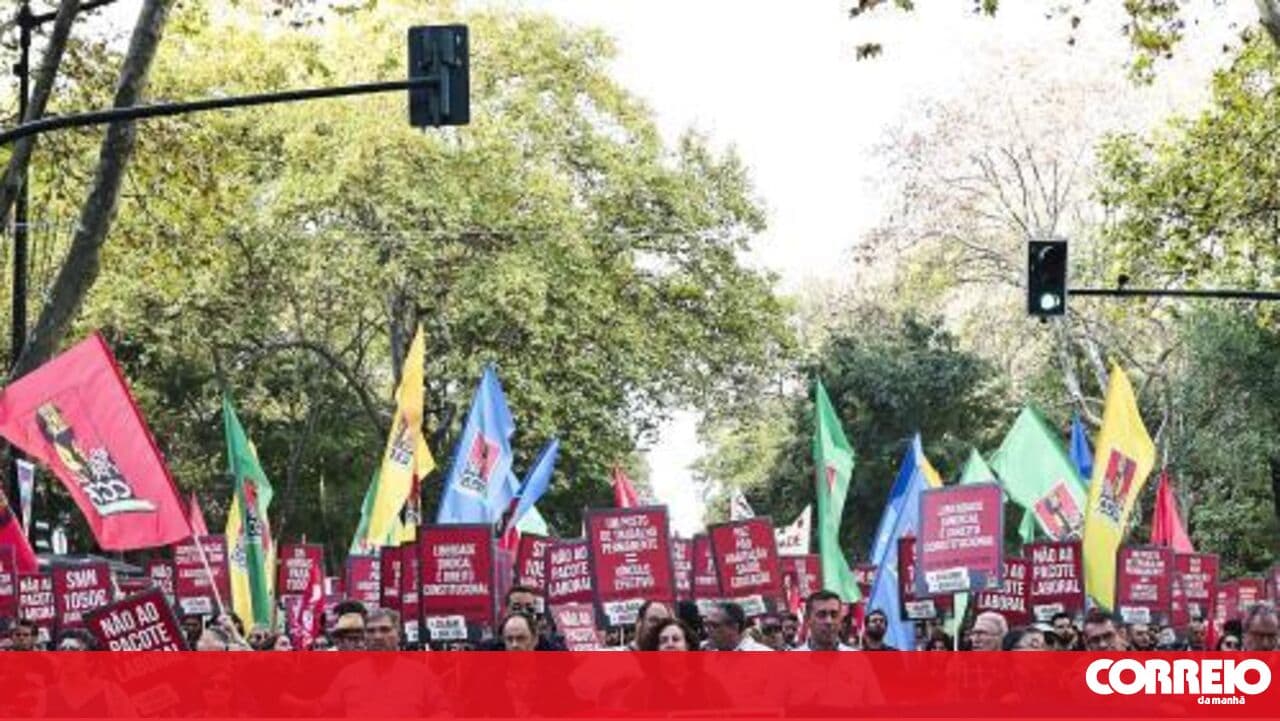
Labour package: CGTP does not rule out a new strike
Portugal's main trade union confederation, CGTP, says it does not rule out calling another strike over the labour package.
Let's face the new year with optimism
This analytical piece urges readers to adopt an optimistic stance for the new year and to move past complaints about the recent increase in the retirement age. It explains that demographic shifts and the strain on social security systems underpin the policy change, outlines labour and legal implications for workers — including expatriates — and argues that better communication, phased implementation, retraining and age-friendly workplace measures would protect wellbeing while ensuring fiscal sustainability.

4h. Montenegro: labour reform guarantees 'decent wages'
The Prime Minister has defended a government labour reform aimed at guaranteeing ‘decent wages’ by promoting better jobs and stronger pay protections, framing the measure as central to improving employment quality. Separately, António José Seguro urged an urgent restoration of social cohesion in Portugal, stressing that community rebuilding is necessary alongside policy reforms to address economic and social challenges.