Latest news and stories about general strike in Portugal for expats and residents.
This page has only 1 story and is not indexed by search engines.
The meeting is expected to include André Gomes, the new president of FNAM.

It will be very difficult for social harmony to be maintained at our universities and research institutes.

The Associação Portuguesa de Transportadores em Automóveis Descaracterizados (APTAD) has expressed solidarity with TVDE drivers planning a protest next week, criticising declining driver incomes. The association says TVDE drivers' earnings are insufficient and have steadily worsened; drivers have discussed a planned “desliga” (platform logout) action. Riders and passengers should expect possible service disruption if drivers proceed with the protest.
TVDE refers to app‑based private‑hire ride services; the acronym stands for Transporte em Veículos Descaracterizados a partir de Plataforma Eletrónica and covers drivers working for platforms like Uber and Bolt. Drivers are using temporary app shutdowns as a protest over what they say is inadequate regulation and working conditions, so commuters who rely on ride‑hailing during peak hours should expect possible service disruptions next week.
The Associação Portuguesa de Transportadores em Automóveis Descaracterizados (Portuguese Association of Transporters in Unmarked Vehicles) is an association that represents drivers who work in TVDE services (ride‑hailing platforms such as Uber and Bolt). It commonly organises negotiations and protests on behalf of drivers, so travellers and platform workers should watch its announcements because they can affect service availability and regulatory discussions.

Across the country, drivers for the Uber and Bolt platforms will take turns switching off their apps between 19 and 24 January. Self-employed workers are calling for the sector's legislation to be reviewed.

Private‑hire drivers plan to alternate switching off Uber and Bolt apps during morning peak hours between 19 and 24 January in a protest organised by the Somos TVDE civic movement. Organisers say drivers will still be free to work but will turn off one platform at a time to disrupt supply and press for clearer regulation; they accuse the platforms of operating like sector employers. Commuters and those booking rides in peak mornings next week should expect possible delays or reduced availability.
TVDE refers to app‑based private‑hire ride services; the acronym stands for Transporte em Veículos Descaracterizados a partir de Plataforma Eletrónica and covers drivers working for platforms like Uber and Bolt. Drivers are using temporary app shutdowns as a protest over what they say is inadequate regulation and working conditions, so commuters who rely on ride‑hailing during peak hours should expect possible service disruptions next week.
Somos TVDE (We Are TVDE) is a civic movement and drivers’ organisation representing TVDE drivers that organises collective actions and campaigns for stronger regulation, better pay and working conditions. It is coordinating the alternating shutdowns of Uber and Bolt apps in morning peak hours, so those using app‑based taxis should be aware of potential reduced availability and plan alternatives.

The effects of the strike may still be felt for a few more days.

A police union (ASPP/PSP) has scheduled a protest rally at Lisbon Airport on 29 January, warning the day could be disruptive for travellers. The announcement flags the risk of delays or congestion on a date several outlets identify as likely to affect passenger journeys. Those travelling through the capital on or around 29 January should check airline and airport notices and consider alternate dates or extra time for transfers.

The PSP (Polícia de Segurança Pública) is Portugal's national civilian police force, founded in 1867. Responsible for defending Republican democracy and safeguarding internal security and citizens' rights, the PSP polices major cities—Lisbon, Porto, Faro—and large urban areas, covering only 4% of Portugal's territory but roughly half the population. Led by a National Director under the Ministry of Internal Affairs, its approximately 21,500 officers handle preventive policing, crime investigation, public order, airport security, diplomatic protection, private security regulation, firearms licensing, and border control (since 2023).
PSP vs. GNR: The PSP is civilian with police-focused training and urban jurisdiction, while the GNR (Guarda Nacional Republicana) is military (gendarmerie) with military training, covering 96% of Portugal's rural and suburban territory. Both share core public safety missions but differ fundamentally in nature, training, and geographic responsibility.

The meeting takes place as part of the ongoing negotiation process, which contemplates a possible extension of the current agreement.

On the day the INE (National Statistics Institute) publishes data on how the construction sector has evolved, the Government will again meet with public service unions. The deadline for candidates to withdraw their presidential bids also expires. Brussels will approve Portugal's plan for defence loans and present the official proposal on the loan of ...

A petition with more than 190,000 signatures was delivered to the Prime Minister's official residence.

They think differently, but they marched side by side in defence of workers. Jorge Pinto was in the Alentejo and, despite the geographical distance, made a point of expressing solidarity with the protest.

Presidential candidate António Filipe said today that the labour package 'doesn't have a single redeeming point,' urged its rejection and said that election Sunday should also be a day of protest against the government's proposal.

The coordinator of the Left Bloc today appealed for unity between the two trade union centres against the proposed changes to labour law that “reduce wages and the time people have to live”, and accused the Government of ostracising parts of the trade union movement.

Presidential candidate Catarina Martins took part today in the CGTP demonstration against the labour package, which she described as “an assault on workers' rights”, and she said she would veto the Government's proposed amendments to the law if elected.

General Secretary Tiago Oliveira accuses the Minister of Labour of selective memory and hands over a petition to oppose the labour package. Also, the number of deaths in Iran continues to rise.

The Left Bloc took part in Tuesday's demonstration and said that only with 'a very strong movement' can the government led by Montenegro be challenged in discussions over the labour package.

At the end of the demonstration in Lisbon, a CGTP delegation will go to São Bento to deliver a petition demanding the withdrawal of the draft bill to revise labour legislation.

Two presidential candidates were among participants at a CGTP (General Confederation of Portuguese Workers) demonstration protesting the government's labour package.

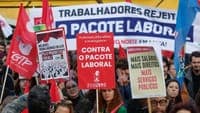
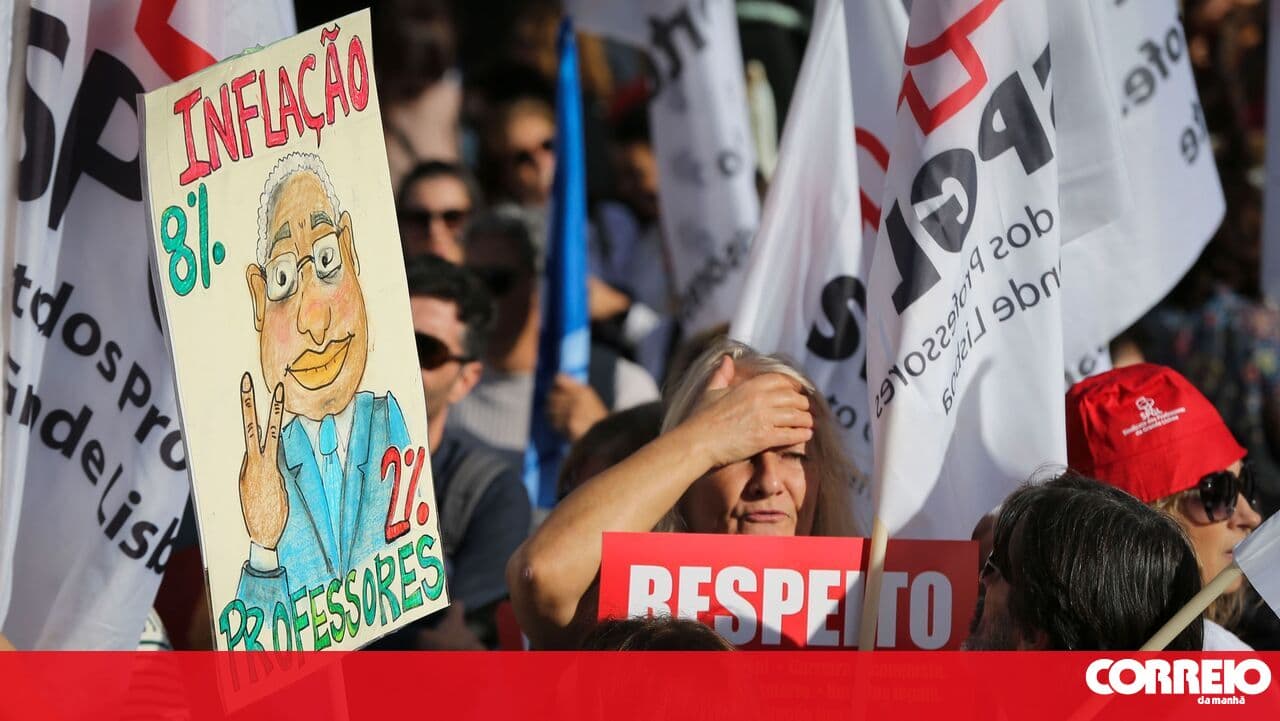
CGTP and UGT held a general strike on 11 December 2025 against the Government's proposal, the fifth to bring together the two trade union centres.

The CGTP has called a demonstration in Lisbon for this afternoon against the labour package. Presidential candidates Catarina Martins and António Filipe will be present, as will José Manuel Pureza, leader of the Left Bloc.

The CGTP trade-union confederation expects a large demonstration in Lisbon on Tuesday, starting at Praça Luís de Camões and heading to the Prime Minister's Office (São Bento), where it plans to deliver a petition with tens of thousands of signatures demanding withdrawal of the government's labour package. The protest happens on the eve of a requested meeting at São Bento with the Prime Minister and the Labour Minister, underlining continued union pressure after last December’s strike. For expats who work in affected areas, expect central-Lisbon disruption around 14:30 and possible concentrated media attention on any government response that could influence labour-policy timing.
Update: Multiple outlets reported that presidential candidates Catarina Martins and António Filipe attended the CGTP demonstration in Lisbon, joining the rally against the government's labour package and increasing political visibility at the event.
CGTP is the General Confederation of the Portuguese Workers (Confederação Geral dos Trabalhadores Portugueses – Intersindical Nacional), Portugal’s largest trade-union federation that organises strikes and national demonstrations. For expats, CGTP actions (like the Lisbon protest) can disrupt public transport, public services and workplaces and may involve petitions with tens of thousands of signatures.
São Bento refers to São Bento Palace (Palácio de São Bento), the historic building in Lisbon that houses the Assembly of the Republic (Portugal’s parliament) and is often used in the media as a shorthand for the national government. For expats, protests directed at São Bento signal demonstrations at the seat of political power and can cause road closures and increased police presence in central Lisbon.

Luís Filipe Montenegro Cardoso de Morais Esteves (born February 16, 1973, in Porto) is a Portuguese lawyer and center‑right politician who has served as Prime Minister of Portugal since April 2, 2024. A long‑time member of the Social Democratic Party (PSD), he is the leading figure of the post‑Troika generation of Portuguese conservatives. Montenegro was elected to the Assembly of the Republic in 2002 for the Aveiro district and remained an MP for 16 years, becoming PSD parliamentary leader from 2011 to 2017 during the bailout and austerity period under Prime Minister Pedro Passos Coelho. He was a prominent defender of strict austerity measures, arguing in 2014 that “the life of the people is no better, but the life of the country is a lot better,” a phrase that has followed his public image since. After an unsuccessful leadership bid against Rui Rio in 2020, Montenegro won the PSD leadership in 2022. He then forged the centre‑right Democratic Alliance (PSD–CDS‑PP and allies), which won a plurality of seats in the 2024 legislative election. Refusing to partner with the far‑right Chega, which he has called “often xenophobic, racist, populist and excessively demagogic,” he formed a minority government as head of the XXIV Constitutional Government on April 2, 2024. His first government fell in March 2025 after a no‑confidence vote linked to a conflict‑of‑interest affair, but fresh elections saw the Democratic Alliance increase its seat share, allowing Montenegro to return as prime minister leading the XXV Constitutional Government. His importance to Portugal lies in attempting to re‑center the traditional centre‑right after the crisis years, defending liberal‑conservative economics and EU alignment while drawing a sharp line against formal cooperation with the radical right, thus shaping how Portuguese democracy manages its new multi‑party era.
Rosário Palma Ramalho is Portugal’s Minister of Labour, responsible for labour policy, workplace regulation and negotiations with trade unions. Her statements today about the CGTP withdrawing from labour reform talks matter because they affect negotiation dynamics and can influence strikes or demonstrations that may disrupt public services and workplaces.

Catarina Soares Martins (born September 7, 1973, in Porto) is a former actress and theatre co-founder who became Portugal's most prominent left-wing leader. First elected to parliament in 2009 representing the Left Bloc (BE), she rose to party coordinator in 2012 and sole national coordinator in 2014, holding the position for 11 years—the longest tenure in BE history. Under her leadership, BE achieved its best-ever result in 2015 with 19 MPs and 10% of votes, becoming critical parliamentary support for Prime Minister António Costa's Socialist government, shifting policy leftward on labour rights, pensions, and public services. After BE's collapse to 5 MPs in 2022, Martins stepped down as leader in May 2023 and left parliament.
Current role:
In 2024, she was elected to the European Parliament, where she advocates for social justice, climate action, and human rights. Her significance lies in consolidating BE as a stable parliamentary force and normalizing leftist government cooperation in Portugal.

The coordinator of INEM’s Workers’ Committee acknowledged failings in how minimum-service requirements were communicated during the late‑2024 strike, saying the institution’s president had conveyed that minimum services were not required during overtime hours. The admission raises operational and public‑safety concerns, highlights potential legal and labour‑relations implications, and underscores the need for clearer protocols, stronger internal communication and contingency planning to protect emergency healthcare delivery during industrial action.


Portugal Resident •