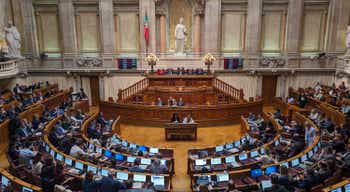
Parliament will hold its final global vote on the 2027 State Budget (Orçamento do Estado) on Tuesday following heated debates over opposition-approved tax adjustments. While the government maintained that broader cuts to personal income tax (Imposto sobre o Rendimento das Pessoas Singulares or IRS) depend on economic growth, opposition parties passed separate tax changes criticized by the Prime Minister as incoherent. The governing Social Democratic Party (Partido Social Democrata or PSD) accused rivals of risking fiscal balance, while the Socialist Party (Partido Socialista or PS) dismissed claims of destabilizing public accounts. Protests organized by the General Confederation of Portuguese Workers (Confederação Geral dos Trabalhadores Portugueses or CGTP) also took place in Lisbon over wages and living costs.
Parties Clash as Final 2027 Budget Vote Approaches

Context & Explainers
The IRS withholding tables (tabelas de retenção na fonte) are government-published schedules that determine how much personal income tax (Imposto sobre o Rendimento das Pessoas Singulares — IRS) employers must deduct from each paycheck. They take into account gross pay, marital status, number of dependents, and disability status.
The tables are updated annually (and sometimes mid-year when budgets change), directly affecting monthly take-home pay. When tables are revised downward, workers see more in their pay packet; when raised, less. Any difference between amounts withheld and the actual tax owed is settled when the annual IRS return (Modelo 3) is filed, typically between April and June.
Employees and pensioners should check the current tables — published by the Autoridade Tributária e Aduaneira (AT) — whenever they change, as the impact on net income can be significant.
Portugal's overall tax burden (carga fiscal) sits at roughly 35.8% of GDP, which is below the European Union average of about 40%. It is lower than peer nations such as France (46%) and Germany (41%), but higher than the United Kingdom (around 33.5%) and the United States (around 27%). While the total ratio is moderate by European standards, personal income tax rates in Portugal climb quickly, hitting top brackets at substantially lower salary levels than in northern Europe.

The Social Democratic Party ('Partido Social Democrata' or 'PSD') is a liberal-conservative political party in Portugal that is the leading partner of the The Democratic Alliance (AD) which is the country's ruling party, with Prime Minister Luís Montenegro.
The Social Democratic Party, despite its name, occupies the centre-right of Portugal's political spectrum. Luís Montenegro, who became Prime Minister in April 2024, leads Portugal's current minority government. The PSD has been one of Portugal's two dominant parties since 1974, having formed nine governments including four with absolute majorities. Montenegro, a former party leader from 1996-1999, was elected with the highest approval rating among party leaders at 10.7 points out of 20.
The Democratic Alliance is a centre-right coalition that includes the smaller CDS – People's Party, a Christian democratic party that has historically been the PSD's coalition partner. Together, they govern without a parliamentary majority, requiring case-by-case support from opposition parties to pass legislation.
Socialist Party (PS)
- Leader: José Luís Carneiro (since June 2025)
- Ideology: Center-left, Social democracy, pro-Europeanism
Portugal's other traditional major party suffered a historic collapse in the 2025 election, dropping from 78 to 58 seats and falling to third place for the first time in democratic history. The party was led by Pedro Nuno Santos from January 2024 until his resignation following the May 2025 defeat. José Luís Carneiro, a 53-year-old former Minister of Internal Administration known for his moderate positioning within the party, was elected unopposed as the new Secretary-General with 95% of votes in June 2025. The Socialist Party governed Portugal from 2015 to 2024, including an absolute majority from 2022 to 2024 under António Costa, who resigned in November 2023 amid a corruption investigation. The PS previously led the innovative "Geringonça" (contraption) coalition government from 2015-2019, a minority government supported by the Left Bloc and Portuguese Communist Party that reversed austerity measures and presided over economic recovery.

The General Confederation of the Portuguese Workers (CGTP – Confederação Geral dos Trabalhadores Portugueses) is Portugal’s largest trade-union confederation, grouping most unions in manufacturing, public services and many other sectors.
Founded clandestinely in 1970 as “Intersindical” under the dictatorship, it emerged publicly after the 1974 Carnation Revolution and was legalised in 1975. It has been central to virtually all major labour struggles since then, from defending collective bargaining and the 40‑hour week to leading general strikes against austerity and labour‑law rollbacks.
CGTP is historically close to the Portuguese Communist Party and has a class‑struggle, anti‑neoliberal profile, strongly critical of EU and government policies seen as undermining workers’ rights. It favours grassroots mobilisation and strikes over compromise, often refusing national social‑pact deals that the more centrist UGT is willing to sign.
In today’s Portugal, CGTP remains a key actor in wage bargaining, labour‑law debates and national protests; together with UGT it called the first joint general strike in years in December 2025, signalling its continuing capacity to organise mass action.
9 sources
- Future income tax cuts in Portugal remain uncertain for 2027The Portugal News ·
- Thousands march in Lisbon against rising living costs and housing crisisRoya News ·
- PS rejects responsibility and claims to be available to avoid a 'path to the abyss'cnnportugal.iol.pt ·
- PS rejects responsibility and declares availability to avoid a "path to the abyss"cmjornal.pt ·
- Three-way war over the State Budget: PSD attacks the 'gerinsonsa', Chega and PS respond that Montenegro needs to stop with the 'dramatics'expresso.pt ·
- Lisbon: Chega councillors reject a favourable vote on the budget, which will dictate the party's stance in the Municipal Assemblydn.pt ·
- PS is prepared to avoid a 'path to the abyss'observador.pt ·
- ECO of the Week: 2027 State Budget, Costa's proposal for the EU, and Black Fridayeco.sapo.pt ·
- Thousands march in Portugal as living costs fuel angerDenver Gazette ·