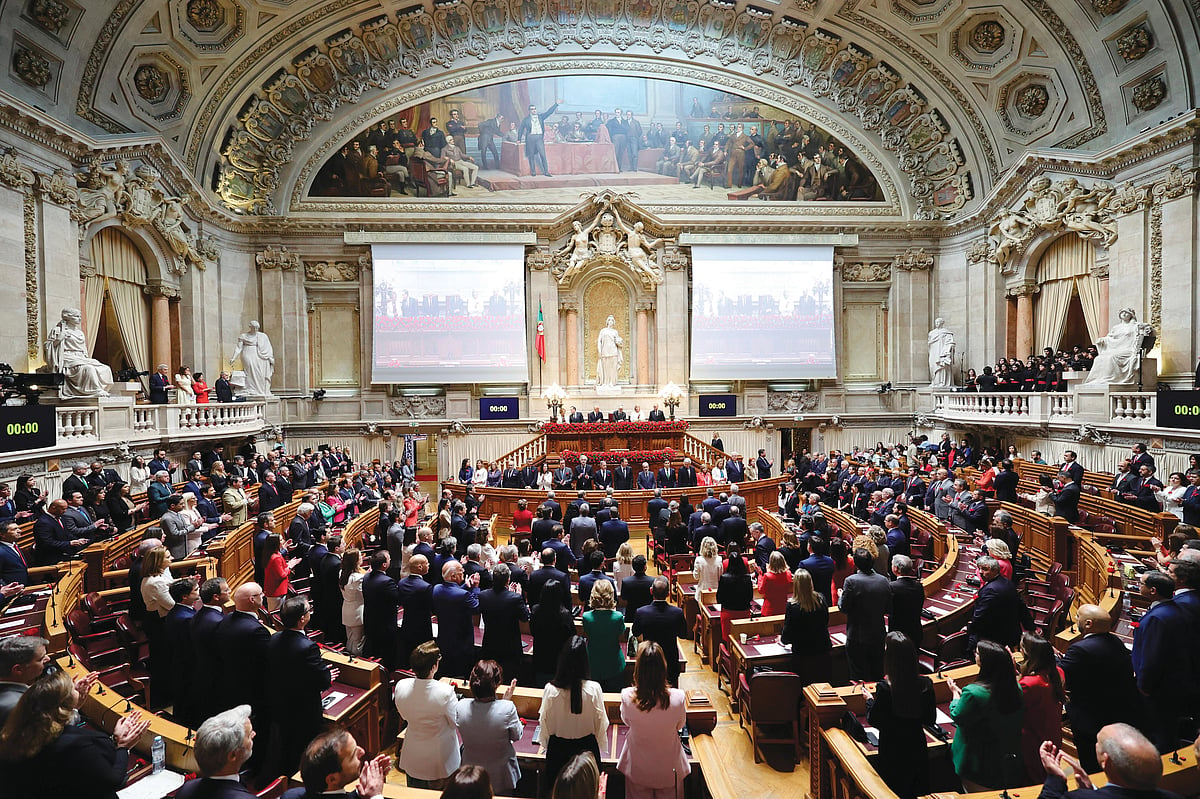
The leader of the Portuguese Communist Party (Partido Comunista Português or PCP), Paulo Raimundo, has challenged the government to withdraw its proposed labour reform to avoid a general strike scheduled for June 3rd. The General Confederation of the Portuguese Workers (Confederação Geral dos Trabalhadores Portugueses or CGTP) has indicated it may call off the strike if the government drops the proposal.
PCP leader challenges government to drop labour reform
Saturday, 2 May 2026AI summary

Context & Explainers
António Filipe is a long-serving member of parliament for the PCP (Partido Comunista Português) and a specialist in constitutional law, who has served as a vice-president of the Assembly of the Republic. He was the PCP-backed candidate in the 2026 presidential election.

The General Confederation of the Portuguese Workers (CGTP – Confederação Geral dos Trabalhadores Portugueses) is Portugal’s largest trade-union confederation, grouping most unions in manufacturing, public services and many other sectors.
Founded clandestinely in 1970 as “Intersindical” under the dictatorship, it emerged publicly after the 1974 Carnation Revolution and was legalised in 1975. It has been central to virtually all major labour struggles since then, from defending collective bargaining and the 40‑hour week to leading general strikes against austerity and labour‑law rollbacks.
CGTP is historically close to the Portuguese Communist Party and has a class‑struggle, anti‑neoliberal profile, strongly critical of EU and government policies seen as undermining workers’ rights. It favours grassroots mobilisation and strikes over compromise, often refusing national social‑pact deals that the more centrist UGT is willing to sign.
In today’s Portugal, CGTP remains a key actor in wage bargaining, labour‑law debates and national protests; together with UGT it called the first joint general strike in years in December 2025, signalling its continuing capacity to organise mass action.