CGTP calls for general strike on June 3rd
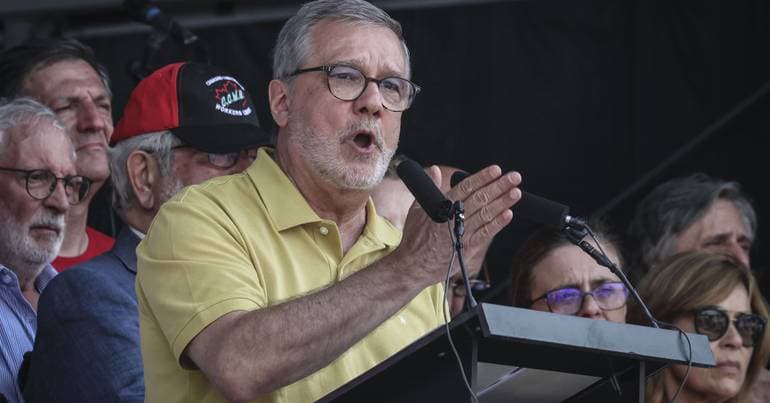
The General Confederation of the Portuguese Workers (CGTP) has announced a general strike for June 3rd to protest the government's proposed labour reform package. While the CGTP secretary-general Tiago Oliveira described the reform as a major attack on workers, the General Union of Workers (UGT) has also expressed strong opposition to the government's core pillars of the proposal, though it is not currently joining the CGTP-led strike.
Update: UGT considers joining CGTP general strike
The UGT has indicated it may join the strike, though a final decision depends on the outcome of the next social concertation (Concertação Social) meeting scheduled for next Thursday. Meanwhile, the Portuguese Communist Party (Partido Comunista Português or PCP) has officially called for all workers to mobilize for the June 3rd action.
António Filipe is a politician from the PCP (Partido Comunista Português) who, in this story, acknowledged that his election results fell short and said the party would join forces to oppose what it called a 'serious threat to democracy'. His remarks indicate the PCP intends to be active in post-election alliances rather than withdrawing from national debates. Voters and those following left-wing politics should pay attention to his and the PCP's next moves.

The General Confederation of the Portuguese Workers (CGTP – Confederação Geral dos Trabalhadores Portugueses) is Portugal’s largest trade-union confederation, grouping most unions in manufacturing, public services and many other sectors.
Founded clandestinely in 1970 as “Intersindical” under the dictatorship, it emerged publicly after the 1974 Carnation Revolution and was legalised in 1975. It has been central to virtually all major labour struggles since then, from defending collective bargaining and the 40‑hour week to leading general strikes against austerity and labour‑law rollbacks.
CGTP is historically close to the Portuguese Communist Party and has a class‑struggle, anti‑neoliberal profile, strongly critical of EU and government policies seen as undermining workers’ rights. It favours grassroots mobilisation and strikes over compromise, often refusing national social‑pact deals that the more centrist UGT is willing to sign.
In today’s Portugal, CGTP remains a key actor in wage bargaining, labour‑law debates and national protests; together with UGT it called the first joint general strike in years in December 2025, signalling its continuing capacity to organise mass action.

The General Union of Workers (UGT – União Geral de Trabalhadores) is one of Portugal’s two main national trade union confederations. Founded in Lisbon on 28 October 1978, it was created as a social‑democratic alternative to the more communist‑aligned CGTP after the 1974 Revolution, grouping unions close to the Socialist Party and moderate centre‑right currents.
UGT represents around 400,000 workers and is affiliated to the European Trade Union Confederation and International Trade Union Confederation, giving Portuguese labour a voice at EU and global level. Its principles stress union independence from the state, employers, churches and parties, internal democracy and active worker participation.
Historically, UGT’s hallmark has been “propositive” social dialogue: it is usually more willing than CGTP to sign tripartite agreements on wages, labour law and social policy with governments and employers, shaping minimum wage increases, working‑time rules and social protection reforms. This makes UGT a key centrist actor in Portugal’s industrial relations, often mediating between left and right while defending collective bargaining and incremental improvements to labour rights.
Social Concertation (Concertação Social) is Portugal's tripartite dialogue between the government, trade unions and employer associations to negotiate labour, social and economic policies. Its agreements often shape government proposals but are not binding, so if talks fail the government can still submit the labour-law revision to Parliament and will need to secure votes there, potentially relying on support from opposition parties such as Chega.