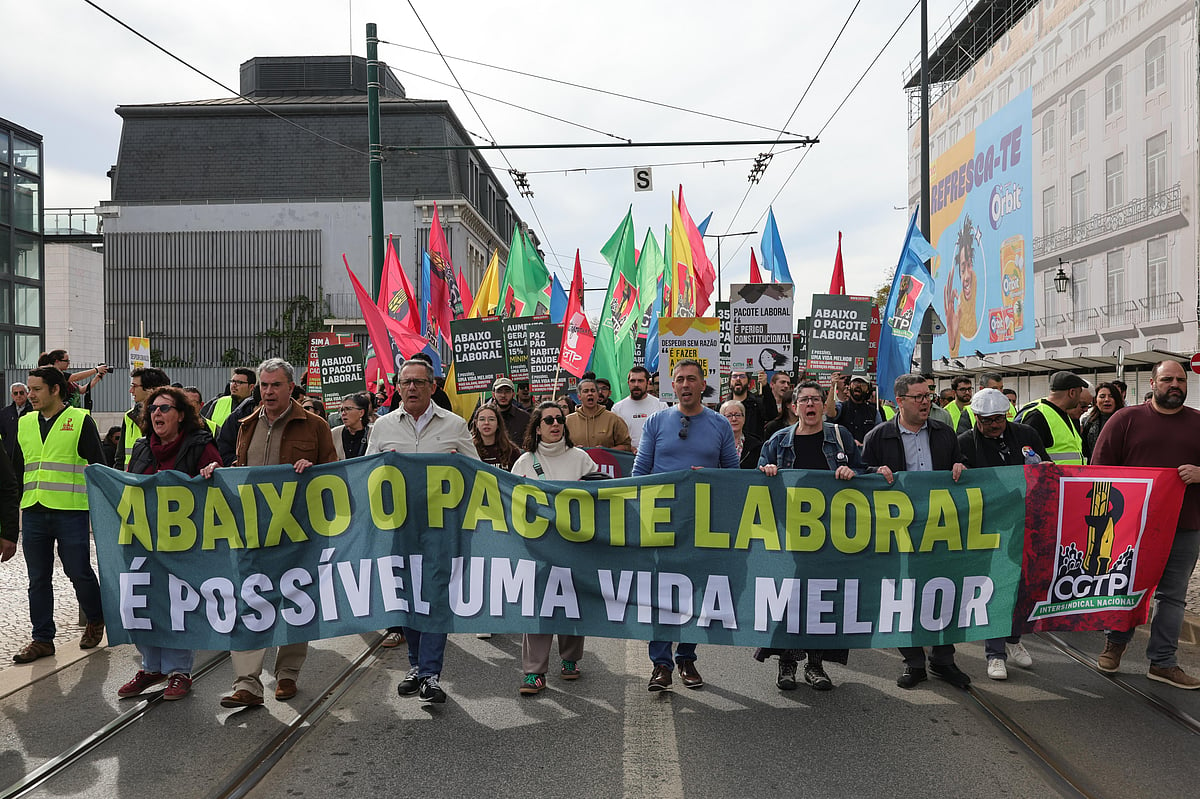
The Minister of Labour will meet on Monday, 23rd, with UGT and four employer confederations to discuss changes to the labour law, in a meeting without the participation of CGTP. The meeting is scheduled for 9:30 AM at the Ministry of Labour, Solidarity and Social Security (MTSSS) in Lisbon. This gathering aims to assess the technical meetings that have taken place between the government, employer confederations, and UGT regarding the labour law changes being discussed in the Social Concertation framework, where CGTP is also represented. Last week, the Minister had called UGT and employer confederations for a meeting, but it was held without union representatives as CGTP was not invited and UGT announced it would not participate, deeming the meeting 'untimely'. An official source from the ministry indicated that 'UGT was invited and did not show availability at any time this week', but the government remains open to discussions with the union. In UGT's absence, employer confederations expressed their 'interest' in reaching an agreement on the labour law, stating that without the union's presence, 'in practice, there was no meeting' and they are willing to negotiate with the union starting this week. This was noted by Francisco Calheiros, president of the Tourism Confederation of Portugal (CTP), who spoke on behalf of the other three employer confederations. When asked about CGTP's absence, Calheiros declined to comment. The Secretary-General of CGTP accused the government of trying to exclude the inter-union from discussions on labour law changes and using methods of discussion 'completely outside' the usual negotiation processes. The draft reform, called 'Trabalho XXI', was presented by the government of Luís Montenegro (PSD and CDS-PP) on July 24, 2025, and the Minister has indicated the intention to submit the bill to parliament, although no date has been committed to. The changes proposed by the government in July were rejected by the unions, who view the changes as an attack on workers' rights. The opposition led CGTP and UGT to jointly call for a general strike on December 11, 2025. Employer confederations welcomed the reform but stated there is room for improvement. In response to criticisms from CGTP and UGT, the government presented a new proposal to UGT with some concessions but reiterated that it is not willing to withdraw the entire initiative or abandon the core elements of the announced changes. UGT submitted a counterproposal to the government on February 4 and indicated it has red lines on issues such as fixed-term contracts and outsourcing, which it considers 'unacceptable'.
Government meets today with employers and UGT to discuss changes to labour law

Context & Explainers

The General Union of Workers (UGT – União Geral de Trabalhadores) is one of Portugal’s two main national trade union confederations. Founded in Lisbon on 28 October 1978, it was created as a social‑democratic alternative to the more communist‑aligned CGTP after the 1974 Revolution, grouping unions close to the Socialist Party and moderate centre‑right currents.
UGT represents around 400,000 workers and is affiliated to the European Trade Union Confederation and International Trade Union Confederation, giving Portuguese labour a voice at EU and global level. Its principles stress union independence from the state, employers, churches and parties, internal democracy and active worker participation.
Historically, UGT’s hallmark has been “propositive” social dialogue: it is usually more willing than CGTP to sign tripartite agreements on wages, labour law and social policy with governments and employers, shaping minimum wage increases, working‑time rules and social protection reforms. This makes UGT a key centrist actor in Portugal’s industrial relations, often mediating between left and right while defending collective bargaining and incremental improvements to labour rights.
The Ministry of Labour, Solidarity and Social Security (Ministério do Trabalho, Solidariedade e Segurança Social) is the Portuguese government department responsible for labour policy, social welfare and pensions. It sets and enforces labour rules, negotiates with unions and employers, and is where the meeting on Monday the 23rd at 9:30 AM with UGT and employer confederations will take place, so workers and employers should note any changes discussed there.
The CGTP study is a report published by the General Confederation of Portuguese Workers (Confederação Geral dos Trabalhadores Portugueses), Portugal's largest trade-union centre. Such studies typically analyse pay, working conditions and public-sector cuts and are used by unions to justify strike actions and policy demands.
Parental leave (licença parental) in Portugal includes paid leave around childbirth that can be shared between parents plus a separate paternity quota, with eligibility usually tied to social‑security contributions or residency. Payments and administration go through Social Security (Segurança Social), so expat parents should check their contribution record, employment contract and register with Segurança Social to claim benefits and confirm exact leave length and pay rates.
Social Concertation (Concertação Social) is Portugal's tripartite dialogue between the government, trade unions and employer associations to negotiate labour, social and economic policies. Its agreements often shape government proposals but are not binding, so if talks fail the government can still submit the labour-law revision to Parliament and will need to secure votes there, potentially relying on support from opposition parties such as Chega.