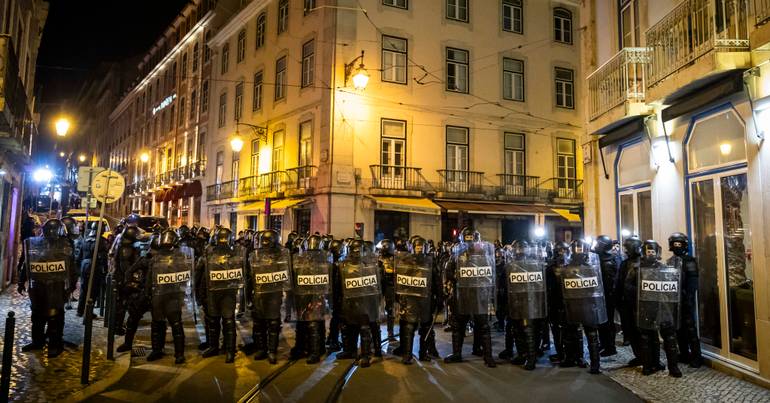
A report by the Ombudsman's National Preventive Mechanism concluded that Public Security Police (Polícia de Segurança Pública or PSP) officers used batons in an excessive manner, striking high-risk body areas during the clearance of a housing protest camp in Rossio, Lisbon. The PSP rejected the findings, stating that baton use was restricted to necessary situations and did not impede medical assistance to demonstrators. Left-wing parties, including the Left Bloc (Bloco de Esquerda) and Livre, called on the government to take responsibility, while the Ministry of Internal Administration said it would review the report.
Ombudsman Criticizes Police Baton Use at Lisbon Housing Encampment
Thursday, 19 November 2026AI summary
Context & Explainers

The PSP (Polícia de Segurança Pública) is Portugal's national civilian police force, founded in 1867. Responsible for defending Republican democracy and safeguarding internal security and citizens' rights, the PSP polices major cities—Lisbon, Porto, Faro—and large urban areas, covering only 4% of Portugal's territory but roughly half the population. Led by a National Director under the Ministry of Internal Affairs, its approximately 21,500 officers handle preventive policing, crime investigation, public order, airport security, diplomatic protection, private security regulation, firearms licensing, and border control (since 2023).
PSP vs. GNR: The PSP is civilian with police-focused training and urban jurisdiction, while the GNR (Guarda Nacional Republicana) is military (gendarmerie) with military training, covering 96% of Portugal's rural and suburban territory. Both share core public safety missions but differ fundamentally in nature, training, and geographic responsibility.

- Leader: Currently vacant (Mariana Mortágua resigned October 2025)
- Ideology: Democratic socialism, eco-socialism, feminism
- Founded: 1999
The Left Bloc (Bloco de Esquerda, BE) is a Portuguese left-wing party founded in 1999 as a coalition of far-left movements (UDP, PSR, and Política XXI). It positioned itself as a modern, progressive alternative to the traditional left, attracting younger urban voters with campaigns on social justice, LGBTQ+ rights, drug policy reform, housing, and labor protections.
The party's peak influence came during the 2015–2019 Geringonça ("contraption") government, when it supported António Costa's PS minority administration alongside the PCP. This arrangement reversed austerity measures and presided over economic recovery, giving BE significant policy leverage.
Since then, the party has suffered a sharp electoral decline — from 19 seats in 2015 to just 1 seat in the May 2025 election, its worst result in history. Leader Mariana Mortágua resigned in October 2025 after failing to reverse the slide. The party is currently undergoing a leadership contest and internal debate about its future direction, squeezed between the PS on one side and Livre on the other.
6 sources
- Ministry of Internal Administration to review report on police conduct during Lisbon protest camp with 'due attention'cmjornal.pt ·
- Bloco demands guarantees that "peaceful protesters are never again attacked in Portugal under government orders"Esquerda.net ·
- Union calls for "moderation" from the Ombudsman and lawyer claims to have witnessed baton chargesrtp.pt ·
- Ombudsman report states there was clearly excessive forcecnnportugal.iol.pt ·
- “Government must take responsibility” for “extremely serious” police action – housing encampmentportugalresident.com ·
- PSP rejects generalised use of batons during protestsobservador.pt ·