Government declares alert status as wildfire risk increases

Thursday, 2 July 2026AI summary
Government declares alert status as wildfire risk increases
Photo: Dinheiro Vivo

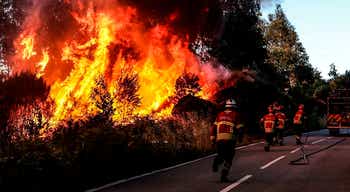
The Portuguese government has declared a state of alert across the mainland from midnight on Friday, July 3, until 23:59 on Monday, July 6. This measure, prompted by severe weather forecasts and high wildfire risk, restricts activities such as accessing forest areas and using heavy machinery. Emergency services, including the National Republican Guard (Guarda Nacional Republicana or GNR) and the Public Security Police (Polícia de Segurança Pública or PSP), have intensified surveillance and patrols.

Update: Wildfires intensify in Vouzela as heatwave persists

A wildfire in Vouzela has escalated to five active fronts, causing seven injuries and forcing the protection of nearby villages. The Portuguese Institute for Sea and Atmosphere (Instituto Português do Mar e da Atmosfera or IPMA) has placed almost the entire country under maximum or very high fire risk, with most of the mainland under a red alert for extreme heat until Sunday.

Context & Explainers

GNR (Guarda Nacional Republicana)

The GNR (Guarda Nacional Republicana) is Portugal's national gendarmerie—a military police force founded in 1911, with origins dating to 1801. With over 22,600 personnel, GNR patrols 94-96% of Portuguese territory, covering rural areas, medium towns, and highways. Members are military personnel subject to military law, responsible for public order, customs, coastal control, environmental protection (SEPNA), firefighting/rescue (GIPS), border control, and ceremonial guards. ​ GNR vs. PSP: The PSP (Polícia de Segurança Pública) is Portugal's civilian police force, covering major cities (Lisbon, Porto, Faro) and large urban areas—only 4% of territory but roughly half the population. PSP handles airport security, diplomatic protection, and private security regulation. Both share core missions (public order, crime prevention), but differ in nature: GNR is military with military training; PSP is civilian with police-focused training.

PSP (Polícia de Segurança Pública)

The PSP (Polícia de Segurança Pública) is Portugal's national civilian police force, founded in 1867. Responsible for defending Republican democracy and safeguarding internal security and citizens' rights, the PSP polices major cities—Lisbon, Porto, Faro—and large urban areas, covering only 4% of Portugal's territory but roughly half the population. Led by a National Director under the Ministry of Internal Affairs, its approximately 21,500 officers handle preventive policing, crime investigation, public order, airport security, diplomatic protection, private security regulation, firearms licensing, and border control (since 2023).​

PSP vs. GNR: The PSP is civilian with police-focused training and urban jurisdiction, while the GNR (Guarda Nacional Republicana) is military (gendarmerie) with military training, covering 96% of Portugal's rural and suburban territory. Both share core public safety missions but differ fundamentally in nature, training, and geographic responsibility.

A red warning is the highest alert level issued by Portugal's weather agency, the Portuguese Institute for the Sea and the Atmosphere (Instituto Português do Mar e da Atmosfera or IPMA), used when conditions pose a very high risk to life and property. Under a red warning authorities may close roads, suspend transport and advise people to avoid coastal and flood‑prone areas, so follow civil protection instructions during the Friday–Saturday storm period.