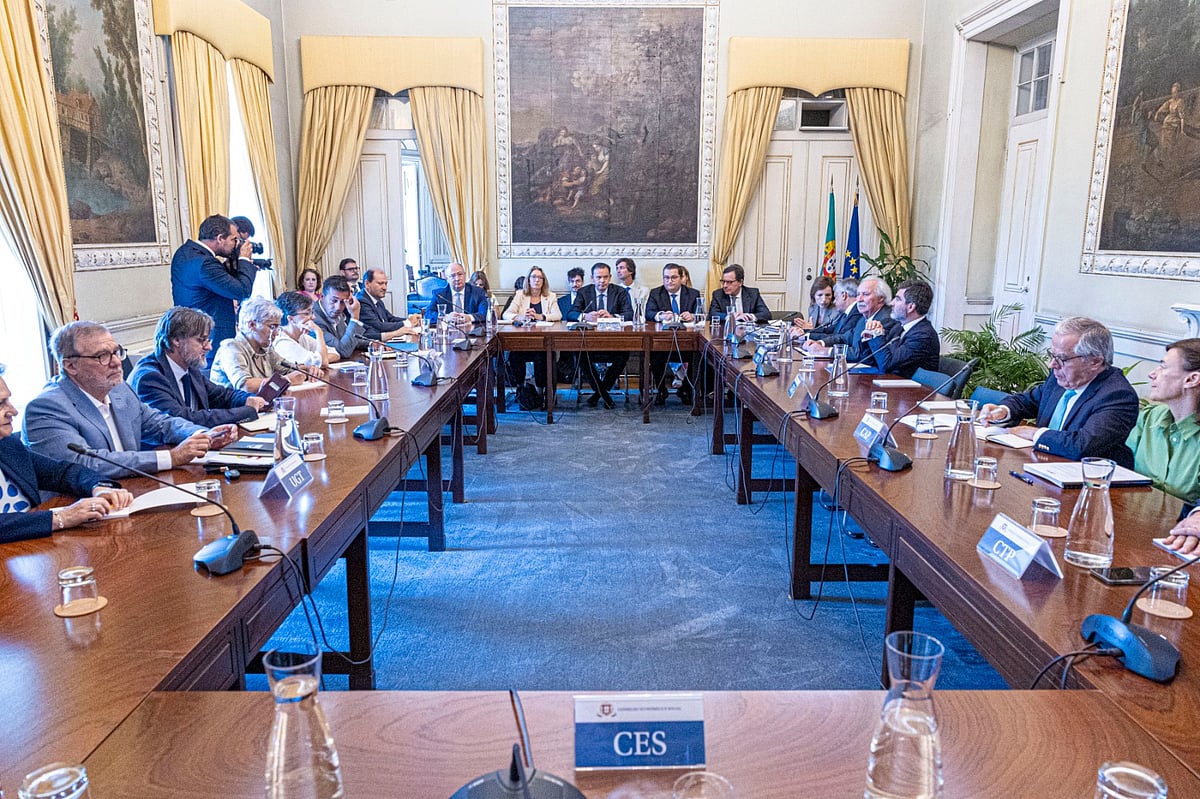
Negotiations between the Government, business confederations, and the UGT trade union regarding labour law reform resume this Monday. The UGT remains hopeful that the Government will incorporate contributions made by President António José Seguro, who has warned he may veto the current draft. While tensions remain high and business confederations have expressed frustration, the UGT continues to push for changes to individual working hour banks, fixed-term contracts, and dismissal regulations, seeking a more balanced agreement.
UGT hopes the Government will heed Seguro's requests regarding labour law
Sunday, 15 March 2026RSS
Context & Explainers

The General Union of Workers (UGT – União Geral de Trabalhadores) is one of Portugal’s two main national trade union confederations. Founded in Lisbon on 28 October 1978, it was created as a social‑democratic alternative to the more communist‑aligned CGTP after the 1974 Revolution, grouping unions close to the Socialist Party and moderate centre‑right currents.
UGT represents around 400,000 workers and is affiliated to the European Trade Union Confederation and International Trade Union Confederation, giving Portuguese labour a voice at EU and global level. Its principles stress union independence from the state, employers, churches and parties, internal democracy and active worker participation.
Historically, UGT’s hallmark has been “propositive” social dialogue: it is usually more willing than CGTP to sign tripartite agreements on wages, labour law and social policy with governments and employers, shaping minimum wage increases, working‑time rules and social protection reforms. This makes UGT a key centrist actor in Portugal’s industrial relations, often mediating between left and right while defending collective bargaining and incremental improvements to labour rights.
CGTP (Confederação Geral dos Trabalhadores Portugueses – Intersindical Nacional) regularly publishes studies and proposals on labor market conditions, wages, working time, and employment rights. These reports are used to support the union confederation's negotiating positions with the government and employers.
CGTP studies typically cover topics such as minimum wage adequacy, working hours reform, collective bargaining trends, social security sustainability, and the impact of proposed labor law changes on workers. The confederation uses this research to advocate for positions in tripartite social dialogue (Concertação Social) alongside the UGT union confederation and employer groups.
These publications are significant because they often shape public debate ahead of labor reforms and can influence the pace and direction of legislative changes.

- Prime Minister, Portugal: 2024 - Present
- Party: Social Democratic Party (PSD)
Luís Filipe Montenegro Cardoso de Morais Esteves (born February 16, 1973, in Porto) is a Portuguese lawyer and center‑right politician who has served as Prime Minister of Portugal since April 2, 2024. A long‑time member of the Social Democratic Party (PSD), he is the leading figure of the post‑Troika generation of Portuguese conservatives. Montenegro was elected to the Assembly of the Republic in 2002 for the Aveiro district and remained an MP for 16 years, becoming PSD parliamentary leader from 2011 to 2017 during the bailout and austerity period under Prime Minister Pedro Passos Coelho. He was a prominent defender of strict austerity measures, arguing in 2014 that “the life of the people is no better, but the life of the country is a lot better,” a phrase that has followed his public image since. After an unsuccessful leadership bid against Rui Rio in 2020, Montenegro won the PSD leadership in 2022. He then forged the centre‑right Democratic Alliance (PSD–CDS‑PP and allies), which won a plurality of seats in the 2024 legislative election. Refusing to partner with the far‑right Chega, which he has called “often xenophobic, racist, populist and excessively demagogic,” he formed a minority government as head of the XXIV Constitutional Government on April 2, 2024. His first government fell in March 2025 after a no‑confidence vote linked to a conflict‑of‑interest affair, but fresh elections saw the Democratic Alliance increase its seat share, allowing Montenegro to return as prime minister leading the XXV Constitutional Government. His importance to Portugal lies in attempting to re‑center the traditional centre‑right after the crisis years, defending liberal‑conservative economics and EU alignment while drawing a sharp line against formal cooperation with the radical right, thus shaping how Portuguese democracy manages its new multi‑party era.
AI Summary AvailableLabour law negotiations resume amid union and government tensionRead the synthesized summary with context and explainers
View full article on dn.ptRSS source
Other news coverage of this topic
- Government, business leaders and UGT return to labour law negotiations following announced breakdown • ECO
- Minister meets today with PSP unions and GNR associations for the first time • RTP Notícias
- Government meets today with UGT and employers to resume labour law negotiations • RTP Notícias
- Government meets today with UGT and employers to resume negotiations on labour law • CNN Portugal
- For the UGT to be in its current position, labour legislation must be very bad, because the UGT's tradition is to sign every agreement • CNN Portugal
- I am convinced that it is an eminently political issue that leads the UGT to have the attitude of absolute irreversibility that it has had • CNN Portugal
- There has been a lot of pressure on the UGT, which is starting to feel the strain and refuses to be alone without the CGTP • CNN Portugal
- Labour law revision negotiations resume this Monday • RTP Notícias
- What remains and what changes in the labour package, but it was still not enough for the UGT • Público
- Paulo Raimundo says CGTP is "doing right" by going to the ministry to "demand on behalf of the workers" • Correio da Manhã
- PCP says CGTP is "doing well" to discuss labour package • Observador
- CGTP is 'right' to go to the ministry to 'demand on behalf of the workers' - PCP leader • RTP Notícias