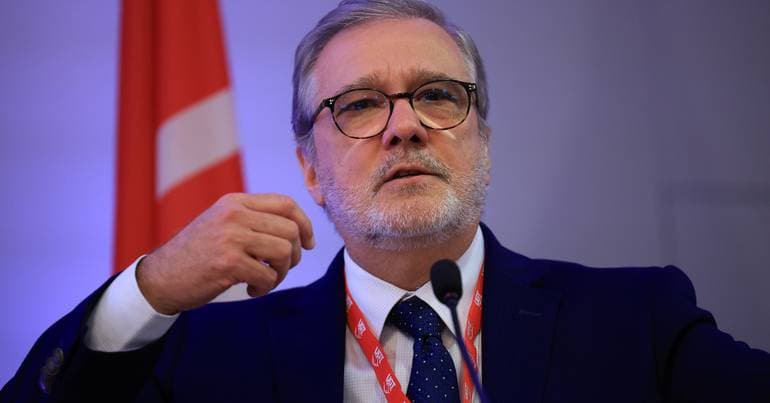
Government meets today with UGT and employers to resume negotiations on labour law
The government wants to “exhaust all possibilities for reaching an agreement,” although it signals that it does not intend to “prolong the discussion indefinitely.”

Latest news and stories about employment in Portugal for expats and residents.
The government wants to “exhaust all possibilities for reaching an agreement,” although it signals that it does not intend to “prolong the discussion indefinitely.”

Representatives from employers' associations, the UGT trade union, and the Government are holding a new round of talks to discuss labour legislation.

Negotiations for the labour law (lei laboral) revision resume today between the government, employer confederations, and the General Workers' Union (União Geral de Trabalhadores or UGT). Prime Minister Luís Montenegro stated that over 70 norms have been agreed upon, though key disagreements remain over the individual bank of hours (banco de horas) and rules regarding unlawful dismissal. Workers should note that the General Confederation of Portuguese Workers (Confederação Geral dos Trabalhadores Portugueses or CGTP) plans to attend despite not being officially invited.

The General Union of Workers (UGT – União Geral de Trabalhadores) is one of Portugal’s two main national trade union confederations. Founded in Lisbon on 28 October 1978, it was created as a social‑democratic alternative to the more communist‑aligned CGTP after the 1974 Revolution, grouping unions close to the Socialist Party and moderate centre‑right currents.
UGT represents around 400,000 workers and is affiliated to the European Trade Union Confederation and International Trade Union Confederation, giving Portuguese labour a voice at EU and global level. Its principles stress union independence from the state, employers, churches and parties, internal democracy and active worker participation.
Historically, UGT’s hallmark has been “propositive” social dialogue: it is usually more willing than CGTP to sign tripartite agreements on wages, labour law and social policy with governments and employers, shaping minimum wage increases, working‑time rules and social protection reforms. This makes UGT a key centrist actor in Portugal’s industrial relations, often mediating between left and right while defending collective bargaining and incremental improvements to labour rights.
The CGTP study is a report published by the General Confederation of Portuguese Workers (Confederação Geral dos Trabalhadores Portugueses), Portugal's largest trade-union centre. Such studies typically analyse pay, working conditions and public-sector cuts and are used by unions to justify strike actions and policy demands.

Luís Filipe Montenegro Cardoso de Morais Esteves (born February 16, 1973, in Porto) is a Portuguese lawyer and center‑right politician who has served as Prime Minister of Portugal since April 2, 2024. A long‑time member of the Social Democratic Party (PSD), he is the leading figure of the post‑Troika generation of Portuguese conservatives. Montenegro was elected to the Assembly of the Republic in 2002 for the Aveiro district and remained an MP for 16 years, becoming PSD parliamentary leader from 2011 to 2017 during the bailout and austerity period under Prime Minister Pedro Passos Coelho. He was a prominent defender of strict austerity measures, arguing in 2014 that “the life of the people is no better, but the life of the country is a lot better,” a phrase that has followed his public image since. After an unsuccessful leadership bid against Rui Rio in 2020, Montenegro won the PSD leadership in 2022. He then forged the centre‑right Democratic Alliance (PSD–CDS‑PP and allies), which won a plurality of seats in the 2024 legislative election. Refusing to partner with the far‑right Chega, which he has called “often xenophobic, racist, populist and excessively demagogic,” he formed a minority government as head of the XXIV Constitutional Government on April 2, 2024. His first government fell in March 2025 after a no‑confidence vote linked to a conflict‑of‑interest affair, but fresh elections saw the Democratic Alliance increase its seat share, allowing Montenegro to return as prime minister leading the XXV Constitutional Government. His importance to Portugal lies in attempting to re‑center the traditional centre‑right after the crisis years, defending liberal‑conservative economics and EU alignment while drawing a sharp line against formal cooperation with the radical right, thus shaping how Portuguese democracy manages its new multi‑party era.

Has the Government already realised that a labour reform is unlikely to happen?

Time banks, dismissals, holidays, and even the right to disconnect. These are some of the issues on which the Government, business confederations, and the UGT remain (very) far apart within the scope of the labour law reform, which are thus preventing a potential agreement in the Social Concertation. However, the social partners show openness to...

The last time hiring competition was held, some 22,500 applied. This time it's much higher.
Sérgio Monte, deputy secretary-general of the UGT, provides an update on the status of labour law negotiations within the social dialogue council.

Outsourcing, individual time banks and dismissals, but also the right to disconnect and even holidays prevented a consensus between employers, the UGT and the Government on the revision of labour law. The future of the Trabalho XXI draft bill remains an unknown.
The PS secretary-general argued this Tuesday, March 10, that the Prime Minister must explain himself “if he is unable to promote fundamental agreements” for the country, and considered that the “labour proposals presented by the Government represented a choice for inhumanity.” Speaking to journalists in Lisbon, José Luís Carneiro addressed the lack of agreement between the Government and social partners regarding the labour package, stating that the Prime Minister, Luís Montenegro, owes the country an explanation. Carneiro emphasized that the PS will not support proposals that increase precariousness and noted that the President of the Republic, António José Seguro, had previously indicated he would veto the package if it remained in its initial form.

The inauguration programme for António José Seguro as President of the Republic continues this Tuesday in Arganil, Guimarães, and Porto. The official ceremonies took place on Monday, the first day of the new president's term.
The Portuguese government’s proposed labor reforms have been heavily criticized by PS Secretary-General José Luís Carneiro, who described them as a “choice for inhumanity” due to their negative impact on workers, especially youth and women. Carneiro emphasized that if the same proposals are presented to the Assembly, they will not receive PS support. He called on Prime Minister Luís Montenegro to explain the government's stance and highlighted the lack of social consensus, noting that negotiations with social partners ended without agreement, with accusations exchanged between unions and employers. The President of the Republic also urged for a balanced and fair labor law agreement. Overall, the government faces significant opposition from political and social sectors over its labor reform proposals.

The General Workers' Union (UGT) remains dissatisfied with the latest labour legislation.

Negotiations for a new labour reform package ended without an agreement between the government, the General Workers' Union (União Geral de Trabalhadores or UGT), and employer confederations. The Business Confederation of Portugal (Confederação Empresarial de Portugal or CIP) stated that 12 points remain unresolved after seven months of debate, including last-minute demands that hindered a consensus. While the government blamed the UGT for being “intransigent,” the union argued the proposals were structurally inadequate and failed to meet necessary conditions. Workers should note that current labour laws remain in place as the future of the reform package is now uncertain.
Update: Opposition leader criticizes government's "lack of humility"
The Secretary-General of the Socialist Party (Partido Socialista or PS), José Luís Carneiro, accused the government of a “lack of democratic humility” following the collapse of labor negotiations. Carneiro argued that the failure to reach an agreement with social partners harms the country's competitiveness and urged Prime Minister Luís Montenegro to resume dialogue on more acceptable terms.

The General Union of Workers (UGT – União Geral de Trabalhadores) is one of Portugal’s two main national trade union confederations. Founded in Lisbon on 28 October 1978, it was created as a social‑democratic alternative to the more communist‑aligned CGTP after the 1974 Revolution, grouping unions close to the Socialist Party and moderate centre‑right currents.
UGT represents around 400,000 workers and is affiliated to the European Trade Union Confederation and International Trade Union Confederation, giving Portuguese labour a voice at EU and global level. Its principles stress union independence from the state, employers, churches and parties, internal democracy and active worker participation.
Historically, UGT’s hallmark has been “propositive” social dialogue: it is usually more willing than CGTP to sign tripartite agreements on wages, labour law and social policy with governments and employers, shaping minimum wage increases, working‑time rules and social protection reforms. This makes UGT a key centrist actor in Portugal’s industrial relations, often mediating between left and right while defending collective bargaining and incremental improvements to labour rights.
CIP is the Confederation of Portuguese Business (Confederação Empresarial de Portugal), the main employers’ association that represents companies and sector groups in Portugal. It lobbies government on economic and labour policy and its statements are watched by investors, employers and workers when debates arise over funding rules and labour reforms.

Socialist Party (PS)
Portugal's other traditional major party suffered a historic collapse in the 2025 election, dropping from 78 to 58 seats and falling to third place for the first time in democratic history. The party was led by Pedro Nuno Santos from January 2024 until his resignation following the May 2025 defeat. José Luís Carneiro, a 53-year-old former Minister of Internal Administration known for his moderate positioning within the party, was elected unopposed as the new Secretary-General with 95% of votes in June 2025. The Socialist Party governed Portugal from 2015 to 2024, including an absolute majority from 2022 to 2024 under António Costa, who resigned in November 2023 amid a corruption investigation. The PS previously led the innovative "Geringonça" (contraption) coalition government from 2015-2019, a minority government supported by the Left Bloc and Portuguese Communist Party that reversed austerity measures and presided over economic recovery.

Supermarket chain Apolónia Supermercados is once again opening its doors to job seekers with a new round of recruitment open days across the Algarve, offering 80 vacancies for both seasonal The post Apolónia supermarkets launch recruitment drive with 80 vacancies appeared first on Portugal Resident.

A recent study on Portugal's financial sector reveals significant trends in employment and salaries, highlighting a drastic reduction in bank branches and the high qualifications of workers. Despite higher average salaries compared to the national average, the study points out disparities with Spain and raises concerns about the future of employment if proposed reforms are enacted.

The article discusses Portugal's dynamic startup ecosystem, which has seen significant growth and internationalization, with over 5,000 active startups by 2025 generating €2.85 billion in turnover and employing around 28,000 people. Key factors driving this growth include a skilled workforce, government incentives like the Tech Visa, and support from institutions such as Startup Portugal and AICEP. The venture capital landscape is improving, and Portugal is emerging as a competitive innovation hub in Europe, particularly in sectors like IT, fintech, and renewable energy.

Portugal's tight labour market and historic employment levels are forcing companies to tap the over-55 workforce, particularly in food, manufacturing, hospitality, logistics and contact centres. Eurofirms reports increased demand for senior profiles, greater openness to flexible hours to improve work–life balance, and a mix of domestic and foreign hires (34% of 216 active outsourced employees are foreign, 63 are over 55). The shift is seen as essential for business growth amid sectoral shortages; Eurofirms recorded a 13% revenue increase to €619 million in the last fiscal year.

The new labour law in Portugal is expected to influence salary improvements, but it may not be the sole factor determining salary increases. In a recent podcast, the president of the Confederation of Commerce and Services of Portugal expressed that the government's expectations regarding the law's impact might have been overly optimistic.

Isabel Roseiro, head of Randstad Portugal, emphasizes the tangible social and economic value of placing people in work, saying: “There is nothing that can make a bigger difference than giving a job to someone who doesn't have one and wants to work.” Analytically, her account frames recruitment not merely as a business function but as a lever for individual dignity, labour-market activation and broader economic activity; she also reflects on unexpected insights from the role and the practical challenges of creating lasting value in people’s working lives.

Julien Jarjoura, an investor based in Switzerland, has acquired Claire’s European business, preserving roughly 200 jobs in Portugal and maintaining the brand’s retail footprint across Europe. The purchase effectively separates the continental operation from insolvency proceedings affecting Claire’s in the United States, the United Kingdom and Ireland, stabilising local employment and stores while broader group restructuring and creditor processes continue.