Latest news and stories about opinion poll in Portugal for expats and residents.
This page has only 1 story and is not indexed by search engines.
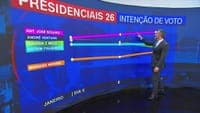
The final poll of the election campaign ended much the same as the first. The statistical tie for the lead initially involved five candidates, but now it is down to three: Seguro, Ventura and Cotrim.

A daily poll, with an increased number of interviews, shows a further decline for Marques Mendes and Gouveia e Melo. Cotrim stands out among former AD voters on the day undecided voters fall again.

A recent opinion poll indicates Ventura and Seguro are level in support in the presidential election.

The latest poll places Cotrim fighting for a place in the second round, behind André Ventura and António José Seguro.

Mendes and Melo record the biggest falls and are in fourth place in the Católica poll. Cotrim picks up almost as many AD voting intentions as Mendes. Seguro is better placed for the run-off.

The daily poll shows for the first time a four-way tie rather than a five-way tie: at the moment Mendes is not winning — nor is he now the one most expected to win, a place that has been taken by André Ventura. At the front, Cotrim continues to accelerate and is already filling Seguro's rear-view mirror. Technical details Over three days (8, 9 and 10 January 2026) Pitagórica collected daily, for TVI, CNN Portugal, TSF and JN, a minimum of 202 to 203 interviews (depending on quota adjustments) to ensure a daily sub-sample representative of the Portuguese electoral universe (non-probability). Sampling criteria were sex, three age bands and 20 geographic strata (Districts plus Madeira and the Azores). The results from the last three days of fieldwork produced a sample of 608 interviews which, for a confidence level of 95.5%, corresponds to a maximum margin of error of ±4.06%. Respondents were selected by random generation of mobile phone numbers while maintaining the market share proportion of the three main mobile operators. Where necessary, fixed-line numbers were randomly selected to support the sampling plan. Interviews were conducted by telephone (CATI — Computer Assisted Telephone Interviewing). The study aims to evaluate the opinions of Portuguese voters on issues related to the Presidential election, namely the main protagonists, moments of the campaign and the voting intentions for the various candidates. There were 1,225 contact attempts to obtain 608 completed interviews, giving a response rate of 49.63%. Undecided voters were distributed proportionally. The technical direction of the study is by Rita Marques da Silva. The full technical sheet and all results have been filed with ERC — Entidade Reguladora da Comunicação Social, which will make them available for online consultation.

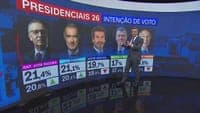
According to today’s poll, André Ventura leads with 20.5%, followed by António José Seguro with 20.1%. Cotrim de Figueiredo retains third place, ahead of Gouveia e Melo and Marques Mendes.

António José Seguro’s lead is reinforced on the third day of Pitagórica’s tracking poll for CNN Portugal, TVI, JN and TSF. André Ventura remains in second place — rising by 1.2 percentage points. Cotrim de Figueiredo, despite a small decline, increases his advantage over Henrique Gouveia e Melo, who records the largest loss of votes among all candidates. Meanwhile, Luís Marques Mendes achieves his highest level since these polls began. Technical details Over three days (2, 3 and 4 January 2026) Pitagórica collected daily for TVI, CNN Portugal, TSF and JN a minimum of 202 to 203 interviews (depending on quota fulfilments) to ensure a daily subsample representative of the Portuguese electorate (non-probabilistic). Sampling criteria were gender, three age brackets and 20 geographic divisions (districts, Madeira and the Azores). The compilation of the last three working days of fieldwork resulted in a sample of 608 interviews which, for a confidence level of 95.5%, corresponds to a maximum margin of error of ±4.06%. Respondents were selected via random generation of mobile phone numbers, maintaining the proportion of the three main mobile operators. Where necessary, landline numbers were randomly selected to support compliance with the sampling plan. Interviews were conducted by telephone (CATI – Computer Assisted Telephone Interviewing). The study aims to assess the opinions of Portuguese voters on issues related to the presidential elections, namely the main protagonists, moments of the campaign, and voting intention for the various candidates. There were 1,244 contact attempts to obtain 608 effective interviews, giving a response rate of 48.87%. The distribution of undecided voters is done proportionally. The technical direction of the study is the responsibility of Rita Marques da Silva. The complete technical sheet, and all results, have been filed with the ERC – Entidade Reguladora da Comunicação Social (Media Regulatory Authority), which will make them available for online consultation.

The largest proportion of respondents (30%) gives the leader of Chega the highest rating, ahead of Marques Mendes and Cotrim.