'Os Domingos'. Long live great Spanish cinema!
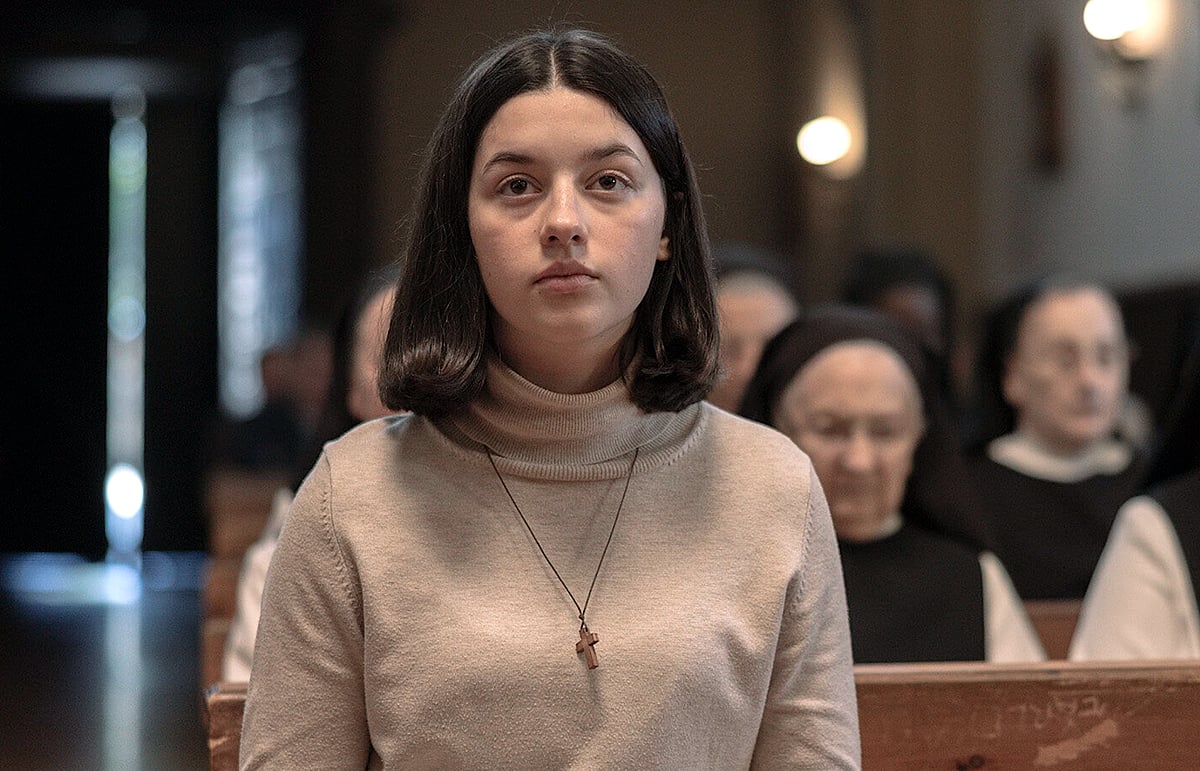
This is a film that does us good. Why? Because, with infinite subtlety, Os Domingos tells a story crossed by a complex and disturbing theme: the calling one feels to abandon the convulsions of 'normal' social life, dedicating oneself, for life, to a religious vocation of assumed enclosure. At the same time, it is a film that does not give in to media conveniences where everything is exhausted in simplistic dichotomies—nothing to do, therefore, with television forms that want to convince us that human beings are mere prototypes of categories (social, emotional, etc.) always reducible to crude and moralistic schemes. Let us say, then, that in Os Domingos everything is transparent—and the more transparent, the more labyrinthine, the more difficult to explain. Ainara (Blanca Soroa, a remarkable revelation) is a 17-year-old girl who no longer has a mother, although she lives in a family marked by a contagious affective exuberance. Even so, her father, Iñaki (Miguel Garcés), and her aunt, Maite (Patricia López Arnaiz), view the fact that Ainara is developing a special interest in the life of the nuns at a convent where she, along with some classmates, went through a spiritual retreat, in very different ways. Until, one day, Ainara declares she wants to go through a process of 'vocational discernment' that could confirm her desire to commit to a religious life. We are not dealing with one of those 'illustrative' objects (films or series) in which, to account for the convulsions of their existence, the characters speak and behave as if they were 'messengers' of codified and unalterable ideas or points of view. Hence, it may be useful to underline that Os Domingos is not a film 'for' or 'against' the Catholic religion—reducing it to such schematism will only serve to fuel mediocre television discussions. It is, rather, a narrative of methodical and uncompromising observation (of beings and their environments) that brings to the stage a fabric of relationships (familial and social, public and private), lived in a context punctuated by elements inseparable from Catholicism, its history, and values. Director Alauda Ruiz de Azúa, also the author of the screenplay, achieves the very special feat of recovering and revitalizing the values of a Spanish cinema that does not depend on any 'mandatory' affiliation with the surreal symbolism of Luis Buñuel or the psychological baroque of Pedro Almodóvar (which, obviously, does not mean a rejection of their works). If we need some references, which will not be direct influences, to situate Os Domingos, perhaps we can evoke the realistic variations of the classic Carlos Saura (let us remember Cría Cuervos, 1976), or more recent experiences, also touched by some desire for realism, as is the case with the work of a filmmaker like Icíar Bollaín (author of that film as unusual as it is unclassifiable, Take My Eyes, 2003). What is the sacred? In its austere realism—which is not foreign to a cinematic rigor that, ironically, one feels like calling 'theatrical'—Os Domingos is a film capable of dealing with the most radical, and undoubtedly most secret, question of the spiritual identity of each human being. In its delicacy of detail, including the moments of silence, Alauda Ruiz de Azúa's screenplay knows how to 'show' the intersections of religious surrender and the knowledge (or recognition) of each person's sexual identity. In this perspective, this is a film that touches a contemporary wound that exceeds the borders of Catholicism. Namely: the crushing of the sacred by the values and practices of our blindly 'liberal' societies. In short, let us not forget that none of this is foreign to the revaluation of a cinema that dispenses with moralistic 'typologies', celebrating instead the irreducibility of each character—and, therefore, the work of the actors. In addition to Blanca Soroa, the immense talent of Patricia López Arnaiz (we saw her in Schoolgirls, by Pilar Palomero) should be highlighted, one of those distinguished with the five Goya awards won by Os Domingos, including Best Spanish Film of 2025.