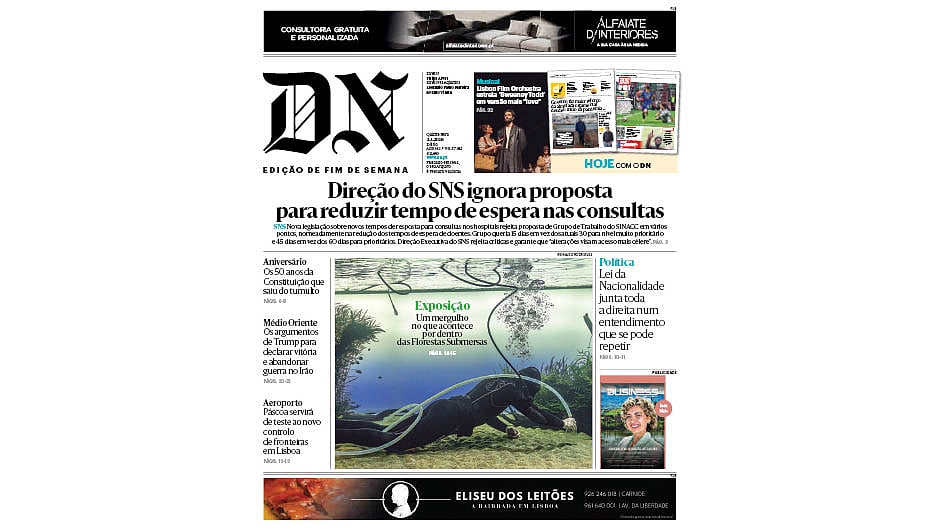
The Executive Board of the National Health Service (Serviço Nacional de Saúde or SNS) has rejected recommendations from the SINACC working group to shorten maximum response times for hospital appointments. The new regulations extend waiting periods for priority patients and omit a proposed seven-day triage window, drawing criticism from experts who warn of increased pressure on emergency departments. The SNS board maintains that the new rules are an improvement over previous legislation.
NHS board rejects hospital waiting time reduction proposal
Wednesday, 1 April 2026AI summary
Context & Explainers
The Alfredo da Costa Maternity Hospital (Maternidade Alfredo da Costa, commonly known as MAC) is Lisbon's principal public maternity facility and one of the busiest maternity units in Portugal's National Health Service (Serviço Nacional de Saúde).
Located in central Lisbon, the MAC is a referral center for high-risk pregnancies and complex neonatal care. It handles a large volume of births annually and serves as a teaching hospital affiliated with Lisbon's medical schools.
The MAC has been at the center of recurring debates about maternity ward closures and staffing shortages across Portugal's public health system. Expectant parents in the Lisbon area may be referred to the MAC for specialist care or diverted there when other maternity units temporarily close due to staff shortages.
SINACC (Sistema Nacional de Acesso a Consultas e Cirurgias—National System for Access to Consultations and Surgeries) is Portugal's new digital healthcare management platform replacing the outdated SIGIC system, created in 2004. Approved by the government on October 24, 2025, SINACC became operational in late 2025, with President Marcelo promulgating it on January 8, 2026.
The system is fully computerized, requiring all patient referrals to be electronic, eliminating paper-based processes. Patients can track their position on waiting lists in real time via app, website, or SNS contact center and choose between public, private, or social-sector hospitals when reaching 75% of guaranteed maximum response times for surgery. The platform uses artificial intelligence to identify anomalies—unusual pricing or suspicious list growth—addressing perverse incentives in SIGIC where longer waiting lists generated more additional-surgery revenue.
SIGIC permitted doctors in private/social sectors to refer SNS patients then operate on them in public hospitals. SINACC's strengthened incompatibility regime prevents this conflict of interest. The system also prevents physicians from cherry-picking additional surgeries, eliminating a distortion where hospitals profited from maintaining long queues.
Financed by Portugal's Recovery and Resilience Plan (PRR) with €5 million for phase one, SINACC aims to reduce patients exceeding maximum waiting times and increase operational transparency. Implementation delays occurred due to insufficient staff training across health units, though testing in Coimbra, Alto Ave ULS, and Lisbon's Oncology Institute proceeded smoothly. The system represents a major modernization of Portugal's surgical-access governance.