Driving and owning a car in Portugal: licences, importing, IUC and the rules of the road
Whether you can keep driving on your licence depends on where it was issued, how old it is and how old you are. Bringing a car is usually expensive and sometimes free. Here is what the law says, what it costs, and what changes in 2027.
Driving in Portugal in five sentences
- EU licences are valid until expiry (register your address with IMT within 60 days), and UK licences are recognised until expiry under a 2023 agreement.
- US, Canadian, Australian, Brazilian and other OECD or CPLP licences stay valid for residents only while you are under 60 and the licence was issued or renewed within 15 years; exchanging needs no test.
- Other licences must be exchanged within 90 days of your residence permit to keep driving, and need a practical test after two years.
- Importing a car means registration tax (ISV) and, from outside the EU, customs duty and VAT, unless you qualify for the transfer-of-residence exemption: six months living abroad and six months owning the car.
- The annual car tax (IUC) moves to fixed dates from 2027: April, plus July and October for larger bills, with a one-off October payment for most cars in 2027.
What changed since the last review
- Guide published from the consolidated Código da Estrada, the UK-Portugal licence agreement, IMT guidance, the ISV and IUC codes (including the 2027 payment change in Decreto-Lei 161/2026) and the 2026 inspection prices.
The rules for driving in Portugal sit in the Código da Estrada (the highway code, which also covers licences), while cars are taxed twice: once on first registration (ISV) and every year after that (IUC). IMT, the transport regulator, handles licences and vehicle approval; the tax authority handles ISV and IUC.
This guide is for residents. If you are visiting, an EU, UK, OECD or road-convention licence lets you drive for your stay as a tourist, for up to 185 days on a convention licence.
Driving on a foreign licence: it depends where it was issued
EU and EEA licences are valid until the expiry date printed on them. Once you live in Portugal you must register your residence with IMT within 60 days; it is free and done in person at an IMT counter. Exchanging for a Portuguese licence is optional. A licence with no expiry date (some older EU licences are valid for life) is accepted for two years from the day you settle; after that it must be revalidated under Portuguese rules, so contact IMT before the two years are up.
UK and Gibraltar licences are recognised until they expire under the UK-Portugal agreement in force since 31 December 2023, and can be exchanged at any time without a test. Licences from Jersey, Guernsey and the Isle of Man are not covered and should be exchanged.
Licences from OECD and CPLP countries, including the US (every state), Canada, Australia, New Zealand, Japan, Switzerland and Brazil, stay valid for residents only if three conditions all hold: the country is party to the 1949 or 1968 road convention or has a bilateral deal, the licence was issued or last renewed no more than 15 years ago, and you are under 60.
Licences from other convention or bilateral-agreement countries run on a clock that starts when your residence permit is issued: for 90 days you may drive but must apply to exchange; from 90 days to two years you may still exchange without a test for cars, but not drive; after two years you need a practical test. Licences from countries outside the conventions are not valid at all, and exchanging them needs theory and practical tests.
| Licence issued in | Can you drive on it? | Exchange | Test on exchange |
|---|---|---|---|
| EU or EEA | Yes, until it expires (no expiry date: 2 years from settling) | Optional; register your address with IMT within 60 days; revalidate a lifetime licence within 2 years | No |
| UK or Gibraltar | Yes, until it expires | Optional | No |
| Jersey, Guernsey, Isle of Man | Exchange advised | Yes | Not stated |
| US, Canada, Australia, Brazil and other OECD or CPLP | Yes, if you are under 60 and it was issued or renewed within 15 years | Optional while those hold | No, for any category |
| Other convention or bilateral countries | For 90 days after your residence permit is issued | Required | None for cars within 2 years; practical test after |
| Countries outside the conventions | No | Required | Theory and practical, €30 per test |
Código da Estrada arts. 125 and 128 as amended by Decreto-Lei 46/2022, IMT guidance and the 2023 UK-Portugal agreement. Driving in breach of these rules on an otherwise valid licence carries a fine of €300 to €1,500.
Myth vs reality
Myth: Americans never need to exchange
Only while all three conditions hold. A US licence holder who turns 60, or whose licence was issued or renewed more than 15 years ago, falls outside the exemption. If you are in your late fifties, exchange while it is still a simple paperwork process with no test.
Watch out
UK drivers aged 60 or over
The 2023 agreement recognises UK licences 'for the term of validity', with no age condition, and the UK government says you can drive until it expires. IMT's general page for OECD licences still lists the UK alongside the age and 15-year conditions, so if you are 60 or over, check with IMT or exchange.
Myth vs reality
Myth: only some US states have an agreement with Portugal
IMT lists the United States as a whole among the OECD countries whose licences are recognised and exchanged without a test. We found nothing in Portuguese law or IMT guidance that distinguishes between states.
Exchanging your licence: documents, cost and timing
You apply online on IMT's A Minha Carta de Condução portal, logging in with your Cartão de Cidadão, Chave Móvel Digital or tax portal password, and only once you are resident. Your doctor sends an electronic medical certificate directly to the system. The fee is €30, with 10% off online, paid by Multibanco reference.
For a non-EU licence you also need a certificate of authenticity from the issuing authority or a consulate, showing which categories were obtained by exam. UK licence holders can give a DVLA or DVA check code instead. If the licence is not in Portuguese, French, English or Spanish, add a certified consular translation.
After approval you choose an IMT counter, where non-Portuguese nationals hand over the original licence and give biometrics. UK licences are sent back to the DVLA. The Portuguese licence arrives in 60 days on average, and in the meantime a temporary permit (guia provisória) lets you drive; if it expires first, email aminhacarta@imt-ip.pt.
Watch out
Two deadlines that close your file without a refund
If IMT asks for more information and you do not answer within 30 days, the request is closed and the fee is not refunded. The same happens if you do not go to the counter within 180 days of approval.
Tip
Need a truck licence or want to drive for Uber or Bolt?
OECD and convention licence holders must exchange first before adding categories, Group 2 (needed for ride-hailing) or professional qualifications. Ride-hailing drivers are also held to the 0.2 g/l alcohol limit.
Checklist
- ✓Residence permit or registration certificate, and passport
- ✓Your foreign licence (originals are surrendered at the counter)
- ✓Electronic medical certificate, sent by your doctor
- ✓Certificate of authenticity from the issuing authority, or a DVLA/DVA check code for UK licences
- ✓Certified translation if the licence is not in Portuguese, French, English or Spanish
- ✓Psychological certificate if you hold truck or bus categories
- ✓Tax-domicile certificate if your address is not on your residence document
Renewing a Portuguese licence, and the points system
A car licence issued since 30 July 2016 is renewed every 15 years until 60, then every five years, and every two years from 70; older licences follow earlier schedules. From 60 you need a medical certificate, which your doctor sends electronically. Renewal costs €30, or €15 from 70, with 10% off online, and can be done in the six months before expiry.
Category B drivers up to 50 with an active Chave Móvel Digital are renewed automatically through the ID.GOV app, with an SMS about five months before expiry. Driving on an expired licence is an offence, and a licence expired for more than two years needs a special driving test to revive.
Every licence holder starts with 12 points. Serious offences cost two points, or three for drink-driving or using a phone; very serious ones cost four or five; a court driving ban costs six. At five points you must take a road-safety course, at three a theory test, and at zero the licence is revoked for two years. Three clean years add three points, up to 15.
New drivers are on probation for three years, with a lower alcohol limit. This does not apply to a licence obtained by exchanging one you had held for more than three years.
Rules of the road: speed, alcohol, roundabouts and documents
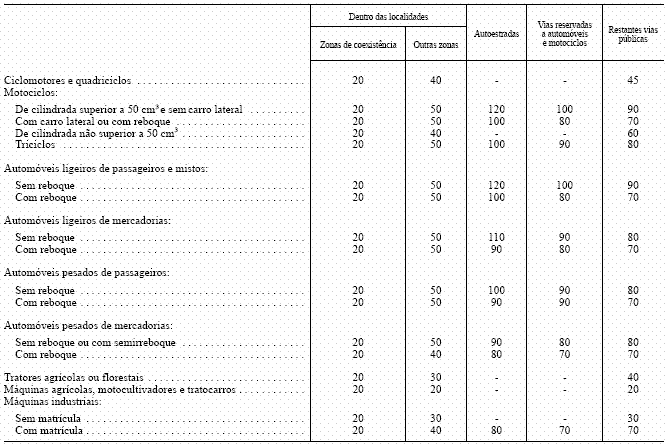
For cars without a trailer the limits are 50 km/h in towns, 90 km/h on ordinary roads, 100 km/h on roads reserved for motor vehicles and 120 km/h on motorways, where there is also a 50 km/h minimum. Average-speed cameras count.
The alcohol limit is 0.5 g/l of blood, and 0.2 g/l for drivers in their first three years and for taxi, ride-hailing, heavy-vehicle, school-transport and emergency drivers. Between 0.5 and 0.8 g/l the fine is €250 to €1,250; between 0.8 and 1.2 g/l it is €500 to €2,500, and from 1.2 g/l it is a crime.
On roundabouts, give way to traffic already on them. For the first exit use the right lane; for later exits, move to the right lane only after passing the exit before yours.
Carry your ID, licence, insurance certificate and registration document (DUA), or show them in the official id.gov app. If you cannot show them on the spot you have five days to present them; otherwise the fine is €60 to €300.
| Road | Limit (km/h) | With a trailer |
|---|---|---|
| Built-up area | 50 | 50 |
| Ordinary road | 90 | 70 |
| Road reserved for motor vehicles | 100 | 80 |
| Motorway | 120 (minimum 50) | 100 |
| Shared-space zone | 20 | 20 |
Speeding fines for cars: up to 20 km/h over in town (30 out of town) €60 to €300; up to 40 (60) over €120 to €600; up to 60 (80) over €300 to €1,500; more than that €500 to €2,500.
Buying a car in Portugal
A change of owner must be registered within 60 days. The buyer can do it online on Automóvel Online with a Cartão de Cidadão and card reader, 15% cheaper, or at a Registo Automóvel office or Loja do Cidadão. A used-car transfer costs €65, and registering late costs the fee again on top.
Before you pay, get the certidão permanente for the plate: €10 online, available to anyone, showing the registered owner, any loan or lien on the car and pending requests in real time. The registration document (DUA) shows the owner and any encumbrances too; a new one is issued when the owner changes.
Buying from a dealer gives you a legal guarantee of three years against defects. For used cars the dealer can agree with you to cut it to 18 months, unless the car is sold as refurbished. A private sale carries no such statutory guarantee.
IUC is owed by whoever is registered as owner, so a seller should make sure the transfer is registered, and a buyer should not drive away without the paperwork filed.
Importing a car: ISV, VAT and customs
A car registered in Portugal for the first time pays the vehicle tax, ISV, based on its engine size and CO₂ emissions, plus a €500 surcharge for diesels unless their particulate emissions are very low. Fully electric cars pay none. Hybrids, petrol or diesel, pay 60% only with more than 50 km of electric range and under 50 g/km of CO₂; plug-in hybrids pay 25% with at least 50 km and under 50 g/km (80 g/km if homologated to Euro 6e-bis), as do plug-ins first registered elsewhere in the EU from 2015 to 2020 with at least 25 km. Other hybrids pay in full. The minimum is €100.
What else you pay depends on where the car comes from. From another EU country you pay ISV, plus VAT only if the car is new (six months old or less, or 6,000 km or less). From outside the EU, new or used, you pay customs duty, VAT and ISV, with VAT charged on a base that includes the duty and the ISV.
Used cars from another EU state get an ISV reduction for age, from 10% for a car up to a year old to 80% for one over ten years. On a plain reading of the code, used cars from outside the EU, such as from the UK or US, get no such reduction; confirm with the tax authority before you ship.
The process: file the customs vehicle declaration (DAV) within 20 working days of the car entering Portugal, pay ISV within 10 working days of the assessment, pass a registration inspection (€93.52 in 2026), and request a Portuguese plate from IMT within 60 days, during which the DAV lets you drive. IMT charges €45 if the car has a certificate of conformity (CoC) and €165 if not, which is common for US cars.
| Up to 1 year | €2,047 |
|---|---|
| 1 to 2 years | €1,820 |
| 2 to 3 years | €1,638 |
| 3 to 4 years | €1,479 |
| 4 to 5 years | €1,297 |
| 5 to 6 years | €1,092 |
| 6 to 7 years | €910 |
| 7 to 8 years | €796 |
| 8 to 9 years | €682 |
| 9 to 10 years | €569 |
| Over 10 years | €455 |
| From outside the EU | €2,275 |
Day 0
The car enters Portugal
Within 20 working days
File the DAV with customs
Online, with tax-portal vehicle credentials. Claim any exemption here.
Within 10 working days of assessment
Pay ISV (and duty and VAT from outside the EU)
Next
Registration inspection
At a category B inspection centre; the certificate is valid for 90 working days.
Within 60 days of the DAV
IMT issues the Portuguese plate
€45 with a CoC, €165 without.
Within 60 days
Register ownership at the Registo Automóvel
Worked example
A four-and-a-half-year-old petrol car from Germany
1,498 cc and WLTP 130 g/km. Cylinder component: 1,498 x €5.61 minus €6,194.88 = €2,208.90. Environmental component: 130 x €5.27 minus €619.17 = €65.93. Total as new €2,274.83, less 43% for age: €1,296.65 of ISV. Add the €93.52 inspection, IMT's €45 and the €65 registration. The same car from the UK would pay the full €2,274.83 plus customs duty and VAT.
Bringing your own car tax-free when you move
Anyone over 18 transferring their normal residence to Portugal can register one car or motorcycle without ISV. You must have lived abroad for at least six months, and owned the car there for at least six months before the move, having bought it under normal taxation in that country.
Apply within 12 months of moving, through the DAV on the Portal das Finanças, attaching the registration document, your ID, an official certificate of residence abroad with start and end dates, and proof of everyday life there such as rent, utility bills or payslips. The request is free.
The conditions after registration are strict: you cannot sell, rent or lend the car for 12 months, or the full ISV becomes due, and the exemption can be used only once every ten years. You still need the registration inspection and an IMT plate.
Myth vs reality
Myth: golden visa holders can each import a car tax-free
The exemption does not depend on your visa. It depends on genuinely moving your normal residence, which means living in Portugal at least 185 days a year, after six months living abroad and six months owning the car. It covers one vehicle per person, once every ten years.
Watch out
Customs duty and VAT from outside the EU
The ISV exemption is a Portuguese rule. Relief from customs duty and import VAT on personal belongings when you move from outside the EU follows EU customs rules with their own conditions; ask customs before shipping a car from the UK or US.
Foreign plates: how long can you keep them?
A car on another EU country's plates may stay in Portugal for up to six months, consecutive or not, in any 12 months, but only if it belongs to someone who is not resident here and is used privately. Residents may only drive foreign-plated cars with prior authorisation from customs.
So once you are resident, a car you bring must be imported: the DAV is due within 20 working days of the car entering Portugal, or you file it with your exemption claim within 12 months of moving. A car not registered in Portugal that stays more than 183 days in a calendar year also owes IUC.
Holders of temporary protection from Ukraine have a special regime: they may drive Ukrainian-registered cars while their permit is valid, and the owner can register the car in Portugal without ISV. Check that the 2022 regime still applies to you.
Myth vs reality
Myth: you can drive on foreign plates for six months after moving
The six-months-in-twelve rule is for non-residents. Residents need prior customs authorisation to use a foreign-plated car, and should start the import as soon as they move.
The annual car tax (IUC), and its new payment dates in 2027
Cars first registered in the EU from July 2007 (category B), which includes any car imported from outside the EU today, pay IUC on engine size plus CO₂, multiplied by a coefficient of 1.15 for cars registered from 2010. Diesels pay a small flat surcharge on top, and cars registered from 2017 in the top CO₂ bands pay an extra amount. Fully electric cars are exempt. The rates have not changed since 2024, and the 2027 budget proposal keeps them.
Until the end of 2026 you pay IUC by the end of the month in which your car's registration anniversary falls. From 2027 the tax year becomes the calendar year: the tax authority issues one assessment by the end of April for all the cars you own on 1 January, payable in April if it is €100 or less, in April and October up to €500, and in April, July and October above that.
2027 is a transition year: bills of up to €500 are paid in a single instalment in October, and larger ones in July and October.
| Engine size | Engine amount | CO₂, NEDC test | CO₂, WLTP test | CO₂ amount |
|---|---|---|---|---|
| Up to 1,250 cc | €31.77 | Up to 120 g/km | Up to 140 g/km | €65.15 |
| 1,251 to 1,750 cc | €63.74 | 121 to 180 | 141 to 205 | €97.63 |
| 1,751 to 2,500 cc | €127.35 | 181 to 250 | 206 to 260 | €212.04 |
| Over 2,500 cc | €435.84 | Over 250 | Over 260 | €363.25 |
Coefficient by year of first registration: 2007 1.00, 2008 1.05, 2009 1.10, 2010 onwards 1.15. Cars first registered from 2017 add €31.77 or €63.74 in the top two CO₂ bands. Diesel surcharge: €5.02 to €68.85 by engine size, not multiplied.
| 2.0 petrol, 2020 | €426.83 |
|---|---|
| 1.6 diesel, 2015 | €195.65 |
| 1.2 petrol, 2019 | €111.46 |
| Fully electric | €0.00 |
Until 31 December 2026Now
In your registration anniversary month
2027Next
Transition year
Up to €500: one payment in October. Over €500: July and October.
From 2028Next
Fixed dates
Up to €100: April. €100 to €500: April and October. Over €500: April, July and October.
Inspections (IPO)
Cars need their first periodic inspection four years after first registration, then every two years until they are eight years old, and every year after that. Vans are inspected at two years and then yearly.
Prices are fixed nationally. In 2026 a periodic inspection for a car costs €37.47 including VAT, a re-inspection €9.40 and the inspection needed to register an imported car €93.52.
| Inspection | Due by |
|---|---|
| First | March 2026 (4 years) |
| Second | March 2028 (6 years) |
| Third | March 2030 (8 years) |
| Then | Every March |
Car insurance
Third-party liability insurance is compulsory for any car able to circulate, even if it is parked and not used. The legal minimum cover is several million euros per accident for injuries and over a million for damage to property; gov.pt gives €6.07 million and €1.22 million, while DECO PROteste reported higher figures from June 2022.
Portuguese law does not oblige insurers to take your claims history from another country into account. Some will accept a no-claims letter from your previous insurer, so ask for one in writing before you leave and shop around.
After an accident, fill in the joint accident report (Declaração Amigável) with the other driver. Uninsured drivers are covered by the Fundo de Garantia Automóvel, and disputes go first to the insurer's complaints service, then to its ombudsman or the CIMPAS arbitration centre.
Tolls, Via Verde and parking in Lisbon
Since 1 January 2025 there are no tolls on the former SCUT motorways: the A4 Transmontana and Marão tunnel, A13 and A13-1, A22 (Algarve), A23, A24, A25 and two sections of the A28. Other motorways charge either at barriers or at electronic gantries with no booth.
The easy option is a Via Verde transponder, which works on every motorway: €37.50 to buy, or a monthly subscription from €0.54. Without one, a Portuguese-plated car pays gantry tolls afterwards at CTT, Payshop or Multibanco, from 48 hours after passing and within 15 working days, with a fee of €0.32 per trip. Foreign-plated cars can use EasyToll or a prepaid TollCard, which do not cover the Lisbon bridges.
In Lisbon, on-street parking is run by EMEL, which began phasing in new prices on 4 August 2026; daily tickets in some zones cost €2.15 or €3.15 on weekdays. Lisbon's low-emission zone bars cars registered before 2000 from the Avenida da Liberdade and Baixa on weekdays from 7:00 to 21:00, and cars registered before 1996 from a wider zone, though enforcement has been minimal.
- Via Verde transponder
- €37.50, or from €0.54 a month
- Post-payment of gantry tolls
- From 48 hours to 15 working days after, €0.32 per trip
- Toll-free since 2025
- A4, A13, A13-1, A22, A23, A24, A25, parts of A28
FAQs
Can I drive in Portugal on my US licence as a resident?
Yes, if you are under 60 and the licence was issued or renewed within the last 15 years. Otherwise, exchange it; the exchange needs a medical certificate and a certificate of authenticity but no test.
Do I need to exchange my UK licence?
No. Under the 2023 UK-Portugal agreement UK licences are recognised until they expire, and you can exchange without a test whenever you want. If you are 60 or over, check with IMT because its general guidance still mentions an age condition.
How long does a licence exchange take?
IMT says the Portuguese licence arrives in 60 days on average. You get a temporary permit to drive in the meantime, and if it runs out you can ask IMT by email to renew it.
Can I bring my car to Portugal without paying tax?
Yes, once, if you are moving your residence here after at least six months living abroad and have owned the car there for at least six months. Apply within 12 months of moving and keep the car for 12 months after registration.
How long can I drive a foreign-registered car in Portugal?
Non-residents can keep an EU-registered car here for up to six months in any 12. Residents need customs authorisation and should import the car.
How much is IUC?
For a car first registered from 2010, from about €111 a year for a small, low-emission petrol car to over €900 for a large engine with high emissions; electric cars pay nothing. From 2027 it is paid on fixed dates: April, plus July and October for larger bills.
Do I need Via Verde?
No, but it is the easiest way to pay electronic tolls. Without it, a Portuguese-plated car must pay each gantry toll at CTT, Payshop or Multibanco within 15 working days.
What is the alcohol limit for driving in Portugal?
0.5 g/l of blood, or 0.2 g/l for drivers in their first three years and for taxi, ride-hailing and heavy-vehicle drivers. From 1.2 g/l it is a crime.
What we're watching
This guide is re-checked against official sources every two weeks. These are the pending changes we expect could affect it next.
- Whether IMT applies the under-60 and 15-year conditions to UK licences, which the 2023 agreement recognises until expiry.
- The 2027 IUC transition: assessment notices and the October 2027 payment.
- Final 2027 State Budget: ISV and IUC rates and the diesel surcharge.
- Any move to online-only licence exchanges on the mainland, as in Madeira since 21 January 2026.
- Lisbon low-emission zone enforcement cameras and EMEL's new tariffs.
- Updated compulsory insurance minimums and the rules on foreign claims history.
More Portugal guides
Relocation
Moving to Portugal
Most relocation problems in Portugal are small mismatches between numbers, addresses and dates that should have lined up. This guide puts them in the right order: the laws, the offices, the fees and the waits, checked against primary sources and updated for everything that changed through October 2026.
Immigration
Portugal visas in 2026
Pick the visa your evidence supports, prove the money the way the consulate counts it, and plan for AIMA rather than hoping. This guide gives you the 2026 numbers, the rules that changed in October 2025 and September 2026, worked examples for real households, and two calculators.
Immigration
Residence permit renewals
Getting your first residence card is only the start. Every two or three years you renew it, and the rules changed again in 2026: renewals are now online, fees have risen, and the old promise that AIMA's silence counts as approval is gone. Here is how the process really works, what it costs, and what to do when nothing happens.
Immigration
Citizenship and permanent residence
Portugal doubled the residence needed for most new citizens in May 2026, and the rumours have outrun the law ever since. This guide reads the statute itself: who is caught by the 7 and 10-year rules, when your clock really starts, what the new tests require, how long IRN takes, and why permanent residence may be the status that matters to you first.
Health
Healthcare
Portugal's National Health Service is open to every legal resident on the same terms as Portuguese citizens, and most of it is free at the point of use. But a number is not the same as cover, one in six registered users has no family doctor, and private insurers stop taking new members in their seventies. Here is how the system really works, what it costs and how to plan around its gaps.
Tax
Tax and NHR
Portuguese tax rewards people who know which regime they are in. Fix your residence date, pick the right regime (standard, IRS Jovem, IFICI or a surviving NHR), and file on time, and the system is far more manageable than the forums suggest. Every figure here is checked against the Código do IRS and other primary sources, and the arithmetic is shown.
Budget and tax
2027 State Budget
The 2027 budget is a continuity budget: lower income tax, a higher tax-free floor, inflation-linked property-tax brackets and no new taxes on daily life. For most expats the big housing changes already happened in 2026, and the budget leaves Alojamento Local, IFICI and the golden visa untouched. Here is every measure that matters, its legal status, and what it means for your money.
Housing
Renting
Most newcomers rent first, and most of the stories that go wrong start at signing: six months up front, a lease nobody registers, a notice period misread. Portuguese law is more protective than many tenants realise. Here is what it actually says, what rents cost, and what a reform before Parliament could change.
Property
Buying property
Portugal is a transparent place to buy property if you know which documents to pull and which tax table applies to you. This guide gives you the 2026 numbers from the law itself, shows the arithmetic on real prices, and flags the expensive traps: the 7.5% IMT for non-residents, the six-month move-in rule, a CPCV without a mortgage clause and an AL licence that will not transfer.
Education
Schooling in Portugal
Portugal's public schools are free, open to every child living here and, in many places, very good. The catch is the rulebook: birthday cut-offs, enrolment windows, five-school preference lists and paperwork in Portuguese. This guide turns the official rules into plain English, with worked examples for real families.
Living in Portugal
Portugal compared
Portugal is one of the cheapest, safest and sunniest countries on this list, with cleaner air, long lives and excellent English. It is also one of the lowest-paid, and its housing costs have run away from local incomes. Here is how it really stacks up against Europe and the countries most expats come from, using official figures and showing every source.
49 sources
Official pages and specialist references used to keep this guide current.
- 1
Código da Estrada, consolidated (licences, speed, alcohol, documents, points)PGD Lisboa
- 2
- 3
EU/EEA driving licences: registering residence with IMTIMT
- 4
- 5
- 6
- 7
- 8
- 9
IMT online services for licence registration and exchangeIMT
- 10
Exchange a foreign driving licence for a Portuguese oneePortugal
- 11
UK-Portugal agreement on mutual recognition and exchange of driving licences (13 October 2023)UK Government
- 12
- 13
Living in Portugal (residence, EES, belongings, driving, healthcare)UK Government
- 14
- 15
- 16
Foreign licence exchanges move online from 21 January 2026 (Madeira)IMT Madeira
- 17
- 18
- 19
- 20
Registar automóvel (updated 21 September 2026)Justiça.gov.pt
- 21
- 22
- 23
Custos dos serviços (registration fees)IRN
- 24
Decreto-Lei 84/2021 (consumer guarantees on goods)Diário da República
- 25
Código do Imposto sobre Veículos, consolidated (January 2026)Autoridade Tributária e Aduaneira
- 26
Compra de veículo: ISV e IVA by originPortal das Finanças
- 27
- 28
- 29
- 30
- 31
- 32
- 33
- 34
- 35
- 36
- 37
- 38Publicado em DR diploma que prevê liquidação do IUC em datas fixas (4 August 2026)RTP / Lusa
- 39
Alterações ao IUC: mudança na forma e prazo de pagamento (August 2026)APCMC
- 40
Proposta de Lei n.º 110/XVII/2.ª: Orçamento do Estado para 2027 (law text, 232 pages)Governo de Portugal / Entidade Orçamental
- 41
- 42
Deliberação 1598-A/2025 (2026 inspection prices)ANTRAM (copy of the Diário da República text)
- 43Inspeção de veículos fica mais cara em 2026 (31 December 2025)ECO
- 44
- 45
Seguro automóvel: sobe capital mínimo obrigatório (9 May 2022)DECO PROteste
- 46
- 47
PT Tolls: how to pay tolls in PortugalInfraestruturas de Portugal
- 48
Tarifários de estacionamento (new prices from 4 August 2026)EMEL
- 49Polícia Municipal de Lisboa não fiscalizou zona de emissões reduzidas em cinco anos (24 July 2025)RTP