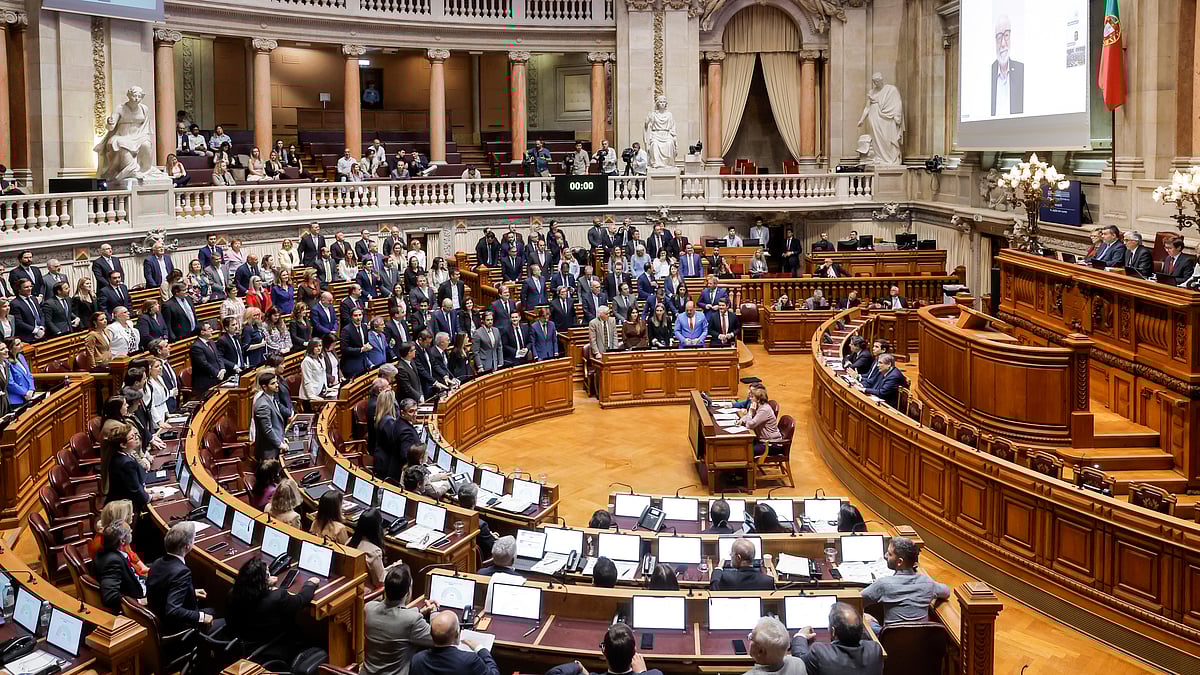
The Constitutional Court (TC) declared four provisions related to the nationality law unconstitutional, three of which were unanimous, while the fourth received only one dissenting vote from a judge. The court also deemed the amendments to the Penal Code unconstitutional. One of the provisions vetoed by the judges of the Palácio Ratton concerns the automatic effect of ...
Four nationality law provisions declared unconstitutional
Monday, 15 December 2025RSS

Context & Explainers
The Constitutional Court (Tribunal Constitucional) is Portugal's highest court for constitutional review. Its primary role is to assess whether laws, decrees, and government actions comply with the Portuguese Constitution, and it has the power to strike down or suspend unconstitutional measures.
The court consists of 13 judges — 10 appointed by the Assembly of the Republic and 3 co-opted by the other judges. It also oversees the legality of political parties and their finances, verifies election results, and rules on the constitutionality of referendums.
The Constitutional Court is frequently in the news when opposition parties, the President, or the Ombudsman refer controversial legislation for review — such as labor reforms, housing laws, or immigration policy changes. Its rulings are final and binding.
RSS source
Other news coverage of this topic
- Nationality Law: What 'did not pass', what 'passed', and the next steps • Dinheiro Vivo
- Winking to keep everything the same • Observador
- Nationality. What passes, what fails, and what comes next? • Observador
- Marques Mendes believes that the Constitutional Court did not undermine the essence of the Nationality Law • Correio da Manhã
- Immigration, nationality, poverty, and presidential models. The facts from the debate between Gouveia e Melo and Ventura • Público
- New poll shows a tie between Ventura and Marques Mendes • Observador
- Marques Mendes: Constitutional Court did not challenge the essence of the law • Observador
- Constitutional Court Rejects Nationality Law • RTP Notícias
- PSD believes that the Constitutional Court's decision does not hinder the Nationality Law • RTP Notícias
- Ventura says that the Constitution "is not a Bible" that cannot be changed. Gouveia e Melo says he is open to changes • Correio da Manhã
- Marques Mendes believes that the Constitutional Court did not undermine the 'essential marks' of the Nationality Law • ECO
- Court declares Nationality Law unconstitutional • Observador
- Marques Mendes believes that the Constitutional Court did not undermine the essence of the Nationality Law • Dinheiro Vivo
- 8pm. Catarina Martins applauds rejection of nationality law • Observador
- Constitutional Court considers that decree creates "disproportionate restriction" on access to citizenship • Correio da Manhã
- Immigrants. Association welcomes rejection of nationality law • Observador
- Nationality Law rejected. PSD wants to continue on its path • Observador
- PS available to negotiate with PSD/CDS new nationality law "without radicalism" • Correio da Manhã
- PCP believes that the unconstitutionality of the nationality law was evident • Correio da Manhã
- Book suggests that the right approved unconstitutional laws to justify a revision of the Constitution • Correio da Manhã
- IL expresses perplexity at some of the Constitutional Court's objections to nationality decrees • Correio da Manhã
- PSD believes that the Constitutional Court has enabled key points of the new nationality law • Correio da Manhã
- Nationality Law: Chega accuses the Constitutional Court of opposing the Assembly of the Republic • Observador
- Largest immigrant association in the country welcomes constitutional rejection of nationality law • Correio da Manhã
- Nationality Law. CDS-PP disagrees with the Court • RTP Notícias
- Nationality Law. PSD expresses disagreement with the decision • RTP Notícias
- 18h Rules rejected by the Constitutional Court. Law returns to Parliament • RTP Notícias
- New nationality law rejected: PS expresses satisfaction • Observador
- What happens to the Nationality Law? • Observador
- Nationality Law. IL does not understand the Constitutional Court's decision • RTP Notícias
- PS accuses Government of lack of caution after Constitutional Court rejects nationality law provisions • Dinheiro Vivo
- PS aims to "build a Nationality Law for all" and "without radicalism" • ECO
- Nationality Law. Socialists welcome unconstitutionality decided by judges • RTP Notícias
- 17h Nationality Law: there are unconstitutional norms • RTP Notícias
- Nationality law declared unconstitutional • Observador
- Constitutional Court rejects Nationality Law and amendments to the Penal Code • Público
- Court rejects several provisions of the nationality law and amendments to the Penal Code • Expresso
- Court declares Nationality Law unconstitutional • Correio da Manhã
- Constitutional Court rules on the unconstitutionality of the Nationality Law • RTP Notícias
- Constitutional Court rules the Nationality Law unconstitutional • RTP Notícias
- TC unanimously decides to reject four provisions of the Nationality Law • Dinheiro Vivo
- 15h. Nationality Law. IL accuses PS of "entropy" • Observador
- Nationality Law. IL accuses PS of "creating entropy" • Observador
- André Pestana formalises presidential candidacy at the Constitutional Court with 8000 signatures • Correio da Manhã
- Candidates for Belém speak out on Nationality Law • RTP Notícias
- 12h. Seguro, Ventura and Pestana formalise candidacy • Observador
- Nationality Law. Constitutional Court set to publish ruling • RTP Notícias