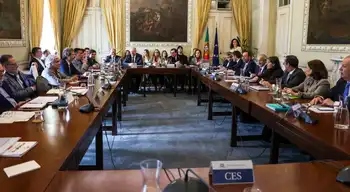
Minister of Labour, Palma Ramalho, has summoned the UGT and the four business confederations to a meeting at the ministry next Monday to resume negotiations on labour law, an official source told Lusa. The Prime Minister announced on Wednesday morning (11) that the Government will meet with social partners early next week regarding labour law, stating that he does not want to “prolong the discussion indefinitely” but rather “exhaust all possibilities for reaching an agreement.” An official source from the Ministry of Labour, Solidarity and Social Security confirmed to Lusa that the meeting is scheduled for Monday, March 16, at 3:00 PM at the Ministry of Labour in Lisbon, and will be attended by the UGT, the Government, and the business confederations. Luís Montenegro calls for “courage to act and to change” labour legislation.
Labour law: Minister to meet with UGT and employers on Monday

Context & Explainers
Rosário Palma Ramalho is Portugal’s Minister of Labour, responsible for labour policy, workplace regulation and negotiations with trade unions. Her statements today about the CGTP withdrawing from labour reform talks matter because they affect negotiation dynamics and can influence strikes or demonstrations that may disrupt public services and workplaces.

The General Union of Workers (UGT – União Geral de Trabalhadores) is one of Portugal’s two main national trade union confederations. Founded in Lisbon on 28 October 1978, it was created as a social‑democratic alternative to the more communist‑aligned CGTP after the 1974 Revolution, grouping unions close to the Socialist Party and moderate centre‑right currents.
UGT represents around 400,000 workers and is affiliated to the European Trade Union Confederation and International Trade Union Confederation, giving Portuguese labour a voice at EU and global level. Its principles stress union independence from the state, employers, churches and parties, internal democracy and active worker participation.
Historically, UGT’s hallmark has been “propositive” social dialogue: it is usually more willing than CGTP to sign tripartite agreements on wages, labour law and social policy with governments and employers, shaping minimum wage increases, working‑time rules and social protection reforms. This makes UGT a key centrist actor in Portugal’s industrial relations, often mediating between left and right while defending collective bargaining and incremental improvements to labour rights.