Latest news and stories about voter turnout in Portugal for expats and residents.
This page has only 1 story and is not indexed by search engines.
Liliana Reis welcomed the mobilisation of the Portuguese and said she will follow the results with the optimism and hope “that marked the electoral campaign”.

Voter turnout for the election today of the next President of the Republic stood at 45.51% as of 4pm, according to data from the General Secretariat of the Ministry of The post Presidential elections: abstention rate ‘down’; results to start coming through from 8pm appeared first on Portugal Resident.

In the Porto district, turnout is highest in the municipality of Maia and specifically in the parish of Milheirós, where the participation rate is greatest. Because “people are informed”.

There has not been such a low figure since Aníbal Cavaco Silva's first election.

It has been 20 years since the Portuguese voted at this pace. According to data from the General Secretariat of the Ministry of Internal Administration, turnout for the Presidential election up to 16:00 was 45.51% — the highest figure since 2006. The data were revealed by André Wemans, spokesperson for the CNE, in remarks to CNN Portugal.

In the municipality with the highest abstention rate in the country in the 2021 presidential election, João Vieira voted for the first time at 38. “I voted certain that I have a clear conscience,” he said.

Several Portuguese travelled about two hours to vote in the presidential election at the Consulate-General in London this morning, where there was a notably large turnout.

The appeal for Portuguese people to turn out to vote in the presidential election has been a constant in messages from candidates and party leaders who have already exercised their right to vote.

Presidential candidate Manuel João Vieira has already cast his vote but did not want to reveal who he voted for. However, he laments the excessively high abstention that has existed in the country “over the last 20 years”.

Compared with the last elections, turnout is up by more than four percentage points. Meanwhile, Iran accuses the US of increasing tensions by interfering in the country’s internal affairs.

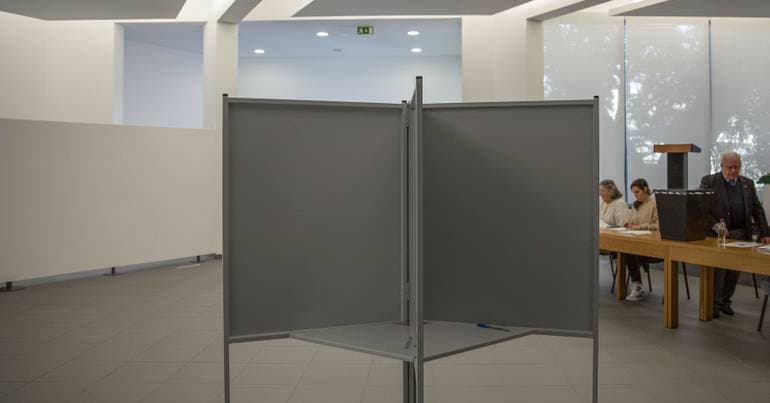
EB/JI Professor António dos Santos Botelho School is hosting three polling stations for the São Miguel parish, with 2,675 registered voters.

The Mayor of Lisbon urged people to vote on Sunday after casting his own ballot in Lisbon.

From left to right, the morning was marked by a unanimous appeal for electoral participation. Several political leaders have already cast their votes, including the prime minister, Luís Montenegro, who emphasised the role of the President as a 'key element of the country's social and political balance'.

Almost all party leaders have already voted. The Prime Minister says the campaign has shown that Portuguese democracy is 'very healthy'.
The Mayor of Lisbon urged people to vote on Sunday after he himself cast his vote in Lisbon.

The leader of the PS expressed his gratitude to “all the thousands of people who are supporting the electoral process” in Portugal and abroad, saying they are the “guarantee that the electoral process unfolds with full democratic unity”.

André Ventura says the good weather is an incentive for everyone to leave home and go to the polls. Meanwhile, Henrique Gouveia e Melo says these presidential elections could be significant.

In the village of Cristóval, in the parish of the Melgaço municipality — the northernmost in Portugal — 60 of the 516 registered voters had cast their ballots by 12:25 in the presidential election, and roughly 160 people are expected to have voted by the time the polls close.

After casting her vote, the candidate supported by the Left Bloc urged the Portuguese to turn out to vote and help tackle abstention.

The PAN leader has already voted and says she is counting on “everyone”, stressing a geopolitical situation “as complex as the one we face”.

COVID-19 and the automatic registration of Portuguese citizens abroad contributed to increasing the abstention rate in the presidential election, with 60.76% of registered voters abstaining in 2021.

The candidate called for a reduction in abstention and admitted he will use the day to “rest” and recharge his batteries.

Luís Marques Mendes has already exercised his right to vote in Oeiras. The presidential candidate backed by the AD parties told journalists he is clearly optimistic, stressing that his confidence is threefold: in his campaign's performance, in voter mobilisation and in reducing abstention.

Portugal's electorate has grown to a level not seen since the country's first presidential election in 1976. The increase may indicate renewed political engagement, demographic shifts or changes in registration practices; it will shape turnout dynamics and party strategies in forthcoming contests. Detailed analysis by age, region and registration trends is required to identify the underlying drivers and policy implications.