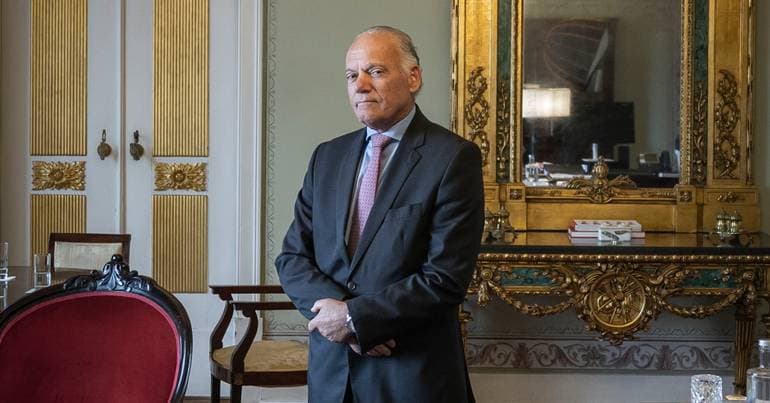
The Entity for Transparency (EpT) only completed the verification of 10.2% of the declarations submitted by Portuguese politicians by the end of 2025, reports the newspaper Público in today's edition.
The Commission for the Professional Card of Journalists (CCPJ) states that “scrutiny should not be interpreted as a political agenda” following accusations made by the Mayor of Coimbra, Ana Abrunhosa, against a Lusa journalist.
Carlos Moedas may continue without leaving a legacy that marks the memory of Lisbon residents, but he possesses one merit that no one can take away: the ability to repeatedly construct a narrative where criticism, demands, and accountability rarely touch him. Due to a lack of scrutiny, Moedas is the politician who seems to be allowed everything. Riding the wave of populism, he bases his discourse on an implicit rejection of political parties, seeking to place himself above them as an independent and unifying figure. This is not original: Cavaco Silva also tried to cultivate this image of supra-partisanship, which quickly collided with a reality that revealed the opposite, as he always acted as a reference for a party bloc. Moedas follows the same script, but without institutional weight, without tangible achievements, and with an obsessive dependence on the media construction of his image. While proclaiming distance from party logic, Moedas actively participates in the internal dynamics of his political space. He is permanently involved in power struggles, whether to avoid being overtaken by Passos Coelho, to position himself regarding Montenegro's leadership, or in attempts to influence the PSD in Lisbon. The inconsistency between his discourse and his actions is evident. None of this would be particularly relevant if not for an unavoidable and worrying detail: Lisbon needs a mayor more concerned with the city's problems than with TikTok views. Let us look at the facts. The alleged 17,000 jobs associated with the so-called 'unicorn factory' remain unidentified. Moedas repeatedly avoids clarifying who these 17,000 people are who were supposedly employed thanks to his unicorns. The appointment of Mafalda Livermore, from Chega, to the Lisbon City Council's Social Services raises serious doubts about a potential logic of exchanging favors to facilitate political decisions. Furthermore, there is an understanding with Chega that was hidden from Lisbon residents, compromising democratic transparency. Once again, Moedas is allowed to get away with everything. In parallel, there is a systematic appropriation of work that does not belong to him. Daycare centers, health clinics, schools, housing, gardens, and major urban interventions are repeatedly presented as his own achievements, even when they result from previous planning and investment. The General Drainage Plan is perhaps the most evident example of this political revisionism. Scrutiny? Non-existent or pathetic. The staging reaches its peak in moments like the handing over of keys to Gebalis houses, which are transformed into true personal promotion events. Communication replaces truth and factuality, while municipal resources are mobilized to reinforce a carefully constructed image. Ultimately, a simple logic prevails: good news is always appropriated, while bad news is systematically attributed to third parties. This pattern is not just a trait of political style, but a serious problem of public accountability. Lisbon deserves more than this. It deserves scrutiny, coherence, and truth.
“Given what has been said, if the leaders of the ICNF do not resign, the only option left is for the minister to resign,” said PS MP Luís Graça, who tried to obtain a comment from Graça Carvalho about the controversy.
The headline says Cotrim encouraged reporters to search for additional allegations of harassment linked to the former aide. The newspaper DN carried out an investigation and did not uncover any such complaints.
It will now be possible to investigate facts that have already occurred, and cooperation from the entities concerned is envisaged. The new rules are inspired by lessons learned from the Spinumviva and Pedro Nuno Santos cases.