The President of the Republic is the institutional survivor of a certain idea of the left. The polls leave no doubt. With the electoral collapse to the left of the PS, the country is experiencing a rare and strange political situation – Portuguese democracy is a democracy of the right. The left is reduced to a vocal and folkloric function.
He was re-elected with nearly 100%, but the Socialist leader is far from having an easy task and now faces his biggest challenge: establishing the PS as an alternative. Also, Centeno's departure from the Bank of Portugal after 20 years.
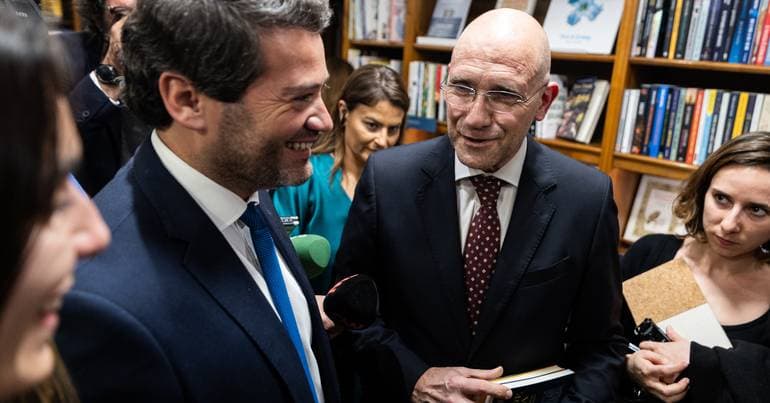
Chega wants to be in government and is already discussing positions or 'cushy jobs' in its own language. André Ventura seems to want to hitch a ride with Passos Coelho. But for what purpose? What points of agreement would they have?
What was once a mirage has become a hypothesis to be discussed. With Passos gaining strength in the media space and criticising the Government, Chega puts electoral problems aside and thinks long-term.
The latest DN/Aximage Barometer reveals a three-way political deadlock in Portugal. Following the end of a cycle of elections, the PS, AD, and Chega are in a technical tie within the 4.2% margin of error. José Luís Carneiro's PS leads with 27%, followed by the AD coalition at 26.6% and Chega at 25.8%. Despite the PS's slight lead in voting intentions, 59% of respondents identify André Ventura as the primary opposition leader, compared to 21% for Carneiro. While Carneiro holds a narrow lead in trust for the role of Prime Minister, Luís Montenegro remains the preferred choice overall.
Pedro Passos Coelho's recent interview with Eco and his explanations over the past week were not just isolated interventions from a former prime minister. They were a political gesture with consequences. At a time when the opposition appears diffuse and hesitant, with both André Ventura and José Luís Carneiro failing to offer anything new, Passos emerges with clarity and assertiveness, paradoxically positioning himself as one of the strongest voices against the direction of his own party's government. By stating that he would announce his candidacy without ambiguity if he ever decided to run, Passos Coelho keeps the door open for a return without making any commitments. More importantly than his personal future is the current political landscape. By arguing that the Executive should have sought a legislative agreement to the right, including Chega and Iniciativa Liberal, he is doing more than providing a strategic analysis: he is exposing what he sees as the insufficiency of the current social-democratic leadership. This is not a frontal attack, but perhaps something more uncomfortable: a structured critique from within. By insisting on the urgency of deep reforms, from Social Security to the economic model, Passos contrasts the government's caution with a reformist vision without concessions. Implicit is the idea that the government is falling short of what is necessary. A sharper critique is hard to find. In this sense, Passos Coelho positions himself as a kind of internal opposition leader: he does not formally contest the leadership of the PSD, but distinguishes himself; he does not present an organic alternative, but suggests one; he does not break away, but increases the tension. In a ruling party, incisive criticism rarely comes from within, hence the surprise. This not only demonstrates the potential weaknesses of the PSD; it primarily highlights the weakness of the political debate opposing the government, which has failed to articulate what Passos Coelho expressed in a single day over the past two years.