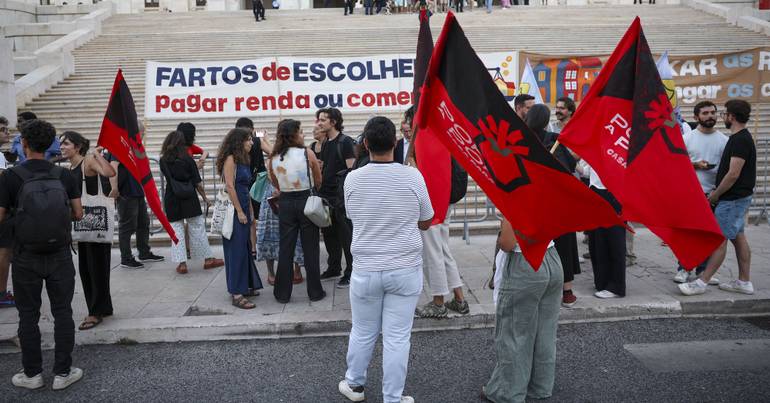
Thousands of people demonstrated in Lisbon, Porto, Braga, and Aveiro to protest rising living expenses and unaffordable housing. Organized by the civic platform “Não dá mais para viver assim” (We can no longer live like this), demonstrators marched through central avenues demanding rent caps, price controls, and an expansion of public housing. The demonstrations coincided with data from the National Statistics Institute (Instituto Nacional de Estatística or INE) showing residential construction costs rose 7.5% year-on-year in August.
Thousands Protest Across Portugal Over Soaring Housing Costs
Saturday, 10 October 2026AI summary
Context & Explainers
The INE housing price index (Índice de Preços da Habitação) tracks changes in residential property transaction prices across Portugal, published quarterly by the National Statistics Institute (INE). It covers both new and existing dwellings and breaks data down by region, property type, and buyer nationality.
The index is a key reference for policymakers debating housing affordability measures, for lenders assessing mortgage risk, and for buyers and investors tracking market trends. It has shown sustained price growth since 2015, with particularly sharp increases in Lisbon, Porto, and the Algarve driven by international demand, tourism, and housing shortages.
Related INE publications include monthly housing transaction data, rental indices, and construction statistics. Together, they provide the most comprehensive picture of Portugal's property market.
Portugal’s house prices have risen faster than the EU average since 2020, and recent reports list Portugal among the countries with the largest price increases over that period. That stronger price growth has worsened affordability in Lisbon and Porto in particular, so prospective buyers and renters should check local indices and mortgage costs before deciding.
6 sources
- Protests in four cities against the cost of livingobservador.pt ·
- Home construction costs in Portugal rise as materials and labour become more expensiveThe Portugal News ·
- The salary is not enough to live on: thousands gather in Lisbon against the cost of living and housingcmjornal.pt ·
- "We can't live like this anymore". Hundreds of people protest in Lisbon and Porto for better living conditionscnnportugal.iol.pt ·
- Protests in Lisbon and Porto against the cost of living and housing gathered thousands of peopledn.pt ·
- Thousands of people demonstrate against the cost of living and housingrtp.pt ·