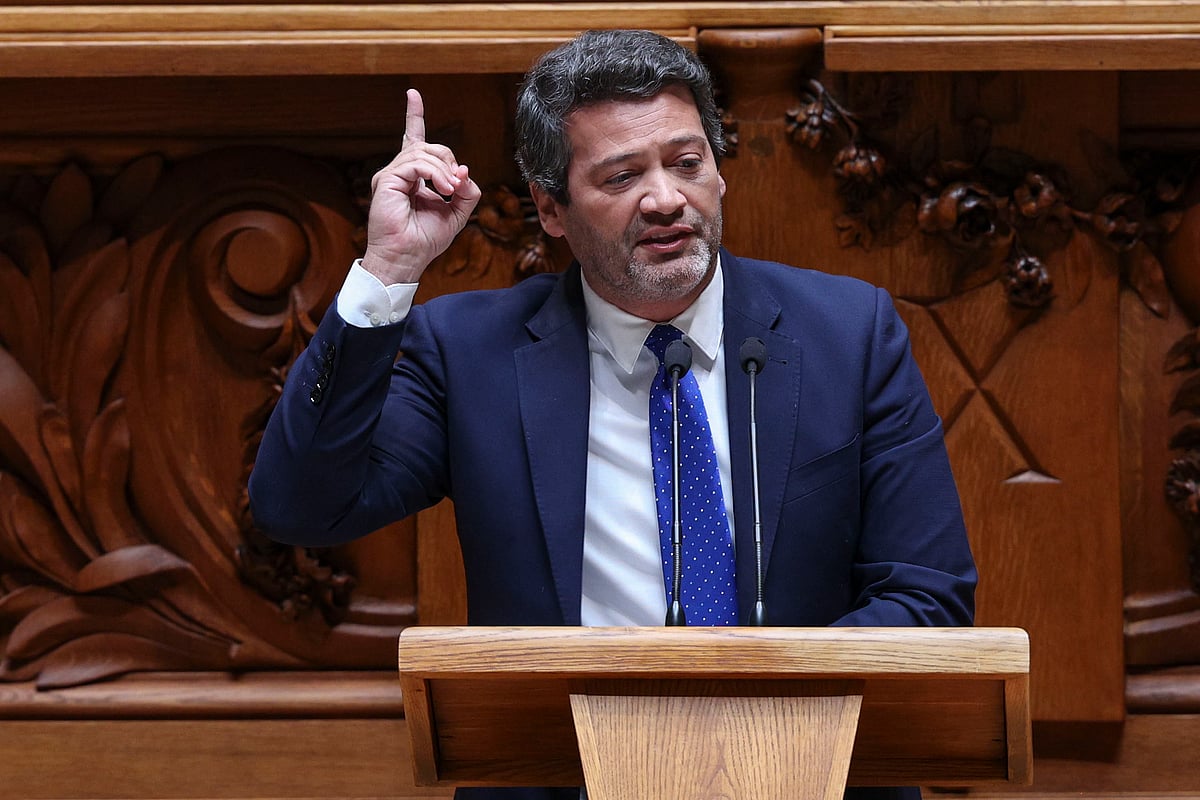
André Ventura, leader of the Chega party, announced five conditions for supporting the government's proposed labour law revisions, including protections against discretionary dismissals and improved parental leave. While the government maintains an open door for negotiations following the rejection of its proposal by the General Workers' Union (União Geral de Trabalhadores or UGT), the Socialist Party (Partido Socialista or PS) has ruled out collaborating on the reform. The government emphasized it will pursue negotiations on a case-by-case basis rather than relying on preferred partners.
Chega sets conditions for labour reform support
Thursday, 9 April 2026AI summary
Context & Explainers

André Ventura, born January 15, 1983, is a lawyer, academic, and Portugal's most prominent far-right leader. He founded Chega ("Enough") in 2019 after his PSD mayoral campaign attacked the Romani community. Chega surged from 1.3% in 2019 to 22.8% in May 2025, becoming parliament's second-largest party and making Ventura Leader of the Opposition.
His platform emphasizes immigration restrictions, law-and-order policies, constitutional reform, and contains inflammatory anti-Romani rhetoric that has triggered multiple discrimination convictions and investigations. Politically classified as far-right by international media, Ventura cultivates alliances with European far-right figures including Marine Le Pen and Santiago Abascal.

The General Union of Workers (UGT – União Geral de Trabalhadores) is one of Portugal’s two main national trade union confederations. Founded in Lisbon on 28 October 1978, it was created as a social‑democratic alternative to the more communist‑aligned CGTP after the 1974 Revolution, grouping unions close to the Socialist Party and moderate centre‑right currents.
UGT represents around 400,000 workers and is affiliated to the European Trade Union Confederation and International Trade Union Confederation, giving Portuguese labour a voice at EU and global level. Its principles stress union independence from the state, employers, churches and parties, internal democracy and active worker participation.
Historically, UGT’s hallmark has been “propositive” social dialogue: it is usually more willing than CGTP to sign tripartite agreements on wages, labour law and social policy with governments and employers, shaping minimum wage increases, working‑time rules and social protection reforms. This makes UGT a key centrist actor in Portugal’s industrial relations, often mediating between left and right while defending collective bargaining and incremental improvements to labour rights.

Socialist Party (PS)
- Leader: José Luís Carneiro (since June 2025)
- Ideology: Center-left, Social democracy, pro-Europeanism
Portugal's other traditional major party suffered a historic collapse in the 2025 election, dropping from 78 to 58 seats and falling to third place for the first time in democratic history. The party was led by Pedro Nuno Santos from January 2024 until his resignation following the May 2025 defeat. José Luís Carneiro, a 53-year-old former Minister of Internal Administration known for his moderate positioning within the party, was elected unopposed as the new Secretary-General with 95% of votes in June 2025. The Socialist Party governed Portugal from 2015 to 2024, including an absolute majority from 2022 to 2024 under António Costa, who resigned in November 2023 amid a corruption investigation. The PS previously led the innovative "Geringonça" (contraption) coalition government from 2015-2019, a minority government supported by the Left Bloc and Portuguese Communist Party that reversed austerity measures and presided over economic recovery.
8 sources
- Ventura sets five conditions for the Government to approve labour law reformDiário de Notícias ·
- Government says it has an "open door to complete negotiations" on labour law reformECO ·
- CGTP leaves with 'head held high' regarding labour law amendmentsObservador ·
- PS warns Government that it “will not count” on them to approve labour reform in parliamentDinheiro Vivo ·
- Chega willing to help Government with labour law 'with conditions', PS refuses to collaboratePúblico ·
- Government guarantees it has no preferred partners for approving reforms and will negotiate on a case-by-case basisCorreio da Manhã ·
- Government guarantees it has an "open door" for negotiations after UGT rejects labour packageCNN Portugal ·
- Government says it has "the door open to complete negotiations" on the labour packageRTP Notícias ·