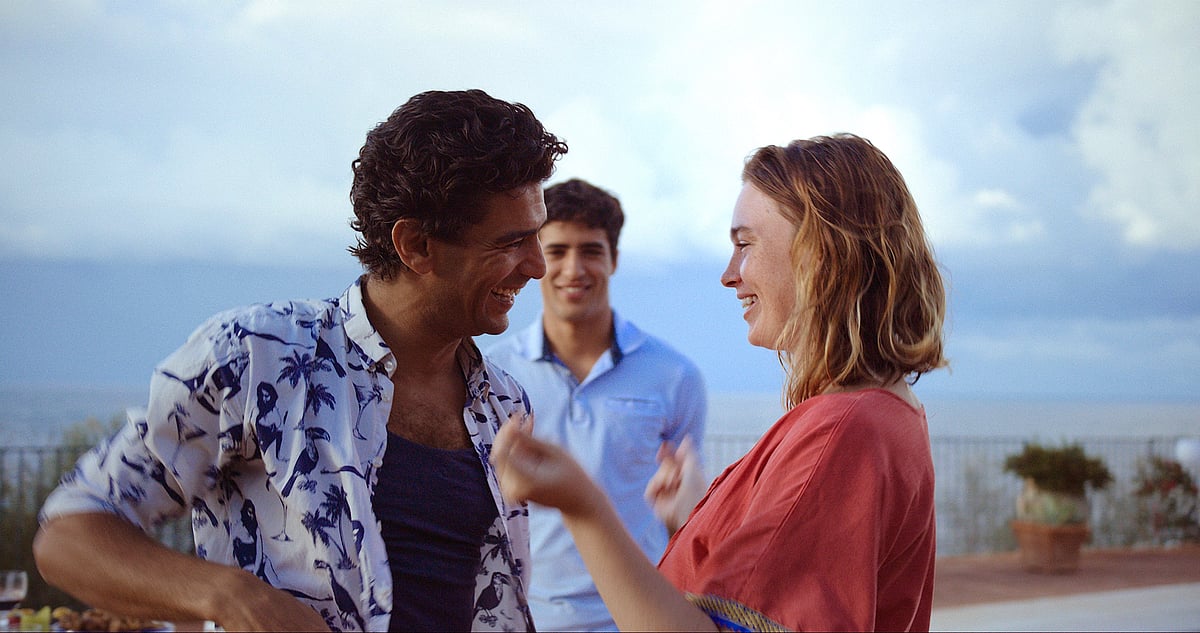
As with the work of many obsessive filmmakers, the oeuvre of Abdellatif Kechiche (a French director of Tunisian origin, born in Tunis in 1960) seduces us through the persistence of its melodramatic contrasts. He tells stories of mismatched loves where bodies and, at times, raw images of sexuality can possess as much transparent truth as indecipherable strangeness. This is once again the case with Mektoub, My Love: Canto Due, unveiled at the 2025 Locarno Film Festival and released in Portuguese cinemas this Thursday, 16 April. The new title involves an admitted contradiction, as this Canto Due is, in fact, the final title of a trilogy that began with Mektoub, My Love: Canto Uno (2017) and continued with Mektoub, My Love: Intermezzo (2019). Everything revolves around a family community in the coastal city of Sète, in the south of France. Although not a true central character, young Amin (Shaïn Boumedine) emerges as a decisive pole, extending events from the previous films—after his studies in Paris, he has returned to Sète, continuing to nurture his dream of making films. It remains to be seen whether Kechiche is still truly interested in the upheavals experienced by his characters, or if he is merely reproducing an authorial 'signature' generated by what is, for all intents and purposes, his most brilliant film: Blue Is the Warmest Colour, the Palme d'Or winner at the 2013 Cannes Film Festival. On one hand, his ability to film actors as if in a 'ballet' of many forms of sensuality persists, not necessarily through the exploration of nudity, but by entangling them in a web of gazes that carry multiple, perhaps unspeakable, desires. On the other hand, the introduction of a new couple—a Hollywood producer and an actress who might promote the realisation of an original screenplay by Amin—does not help much, as their caricatural dimension seems not to belong to the same film. Indeed, in its somewhat artificial agitation, the unexpected 'police' ending appears as a schematic trick to open the possibility that the trilogy does not end here. A proponent of handheld camerawork, Kechiche preserves a dimension that this type of (technical and narrative) choice rarely achieves: the creation of a space of physical movements in which each character appears as an unwitting actor in a community as strong in its cultural identity as it is vulnerable to its emotional fissures. Which, ultimately, does not prevent the feeling that something has been exhausted in this vision of Sète, of the brightness of its days and the mysteries of its nights. 'What House Are You From?'. How to reorganise all memories? 'La Grazia'. Politics is an art of solitude.
'Mektoub, My Love: Canto Due'. The days and nights of Abdellatif Kechiche
Thursday, 16 April 2026RSS