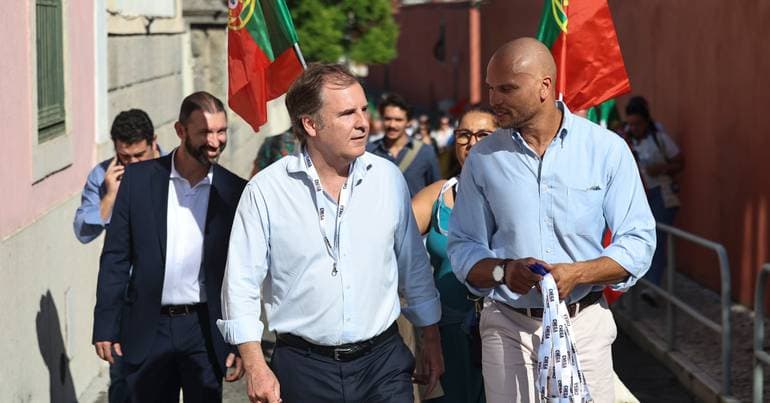
The Cascais PSD has officially handed over municipal portfolios to Chega, following a governance agreement approved by Chega's national leadership. The party, led by Ventura, will now oversee the portfolios for transparency and sports. In response, the Socialist Party (PS) has decided to return their portfolios in protest, marking a significant shift in the local political landscape.
The president of the Cascais City Council, Nuno Piteira Lopes, has formed a new coalition with Chega after the previous agreement with the Socialist Party (PS) fell apart. This strategic move aims to secure a majority in the Municipal Chamber, marking a significant shift in local governance dynamics.
The completion of only two of the cases contradicts announcements made by Moedas. The Left Bloc (BE) challenged the lack of scrutiny regarding the below-market price of the contract with the maintenance company MNTC.
The Oeiras Municipal Assembly today rejected a motion of no confidence, proposed by Chega, which called for the suspension of the mayor's mandate, Isaltino Morais, following a Public Prosecutor's indictment regarding meal expenses.
Carlos Moedas is keeping Joana Baptista in her role as a councillor in Lisbon, despite her being one of 23 formal suspects in an investigation into 150,000 euros spent on meals paid for by the Oeiras municipality. The Public Prosecutor's Office has charged Isaltino Morais, the mayor of Oeiras, in a case involving over 1,400 meals improperly paid for with public funds between 2017 and 2025. While the Lisbon City Council stated that Baptista will remain in the executive, it noted that she has yet to provide any clarification regarding the allegations. This situation contrasts with Moedas's previous stance on maintaining officials under suspicion, as well as his recent decision to dismiss Alberto Laplaine Guimarães following a court order in a separate investigation.
The Vice-President of the Lisbon City Council criticises the “arrogance” of requests for clarification regarding the non-continuation of Rita Rato and Francisco Frazão. He asked for the “benefit of the doubt” for the new directors.
The Public Prosecutor's Office has charged Isaltino Morais and 22 other municipal officials with embezzlement and abuse of power regarding over 150,000 euros spent on more than 1,400 meals paid for by the municipality.
With votes against from PSD, IL, CDS-PP, and Chega, recommendations from Livre and the PCP regarding the city of Lisbon's cultural policy were rejected.
Left-wing parties in the Lisbon Municipal Assembly accuse Carlos Moedas' administration of yielding to the “pressure of the radical far-right” to change the city's cultural policy.
Carlos Moedas may continue without leaving a legacy that marks the memory of Lisbon residents, but he possesses one merit that no one can take away: the ability to repeatedly construct a narrative where criticism, demands, and accountability rarely touch him. Due to a lack of scrutiny, Moedas is the politician who seems to be allowed everything. Riding the wave of populism, he bases his discourse on an implicit rejection of political parties, seeking to place himself above them as an independent and unifying figure. This is not original: Cavaco Silva also tried to cultivate this image of supra-partisanship, which quickly collided with a reality that revealed the opposite, as he always acted as a reference for a party bloc. Moedas follows the same script, but without institutional weight, without tangible achievements, and with an obsessive dependence on the media construction of his image. While proclaiming distance from party logic, Moedas actively participates in the internal dynamics of his political space. He is permanently involved in power struggles, whether to avoid being overtaken by Passos Coelho, to position himself regarding Montenegro's leadership, or in attempts to influence the PSD in Lisbon. The inconsistency between his discourse and his actions is evident. None of this would be particularly relevant if not for an unavoidable and worrying detail: Lisbon needs a mayor more concerned with the city's problems than with TikTok views. Let us look at the facts. The alleged 17,000 jobs associated with the so-called 'unicorn factory' remain unidentified. Moedas repeatedly avoids clarifying who these 17,000 people are who were supposedly employed thanks to his unicorns. The appointment of Mafalda Livermore, from Chega, to the Lisbon City Council's Social Services raises serious doubts about a potential logic of exchanging favors to facilitate political decisions. Furthermore, there is an understanding with Chega that was hidden from Lisbon residents, compromising democratic transparency. Once again, Moedas is allowed to get away with everything. In parallel, there is a systematic appropriation of work that does not belong to him. Daycare centers, health clinics, schools, housing, gardens, and major urban interventions are repeatedly presented as his own achievements, even when they result from previous planning and investment. The General Drainage Plan is perhaps the most evident example of this political revisionism. Scrutiny? Non-existent or pathetic. The staging reaches its peak in moments like the handing over of keys to Gebalis houses, which are transformed into true personal promotion events. Communication replaces truth and factuality, while municipal resources are mobilized to reinforce a carefully constructed image. Ultimately, a simple logic prevails: good news is always appropriated, while bad news is systematically attributed to third parties. This pattern is not just a trait of political style, but a serious problem of public accountability. Lisbon deserves more than this. It deserves scrutiny, coherence, and truth.
The position comes in response to PS councillor Alexandra Leitão, who accused Carlos Moedas of keeping Alberto Laplaine Guimarães illegally in the position of municipal secretary-general since 2024.
Chega councillor defends his girlfriend, Mafalda Livermore, with whom the mayor used a different criterion, he accuses. He also states that the credibility of the municipality is at risk.
The councillor and socialist leader who returned his portfolios admits bad faith from Mayor Nuno Piteira Lopes in a strategy to try to place parties in governance and weaken them.
The world is dangerous, but the greatest tension may well be on the Oeiras-Amadora border. There are walls, pavement invasions, and even gardeners mobilised.