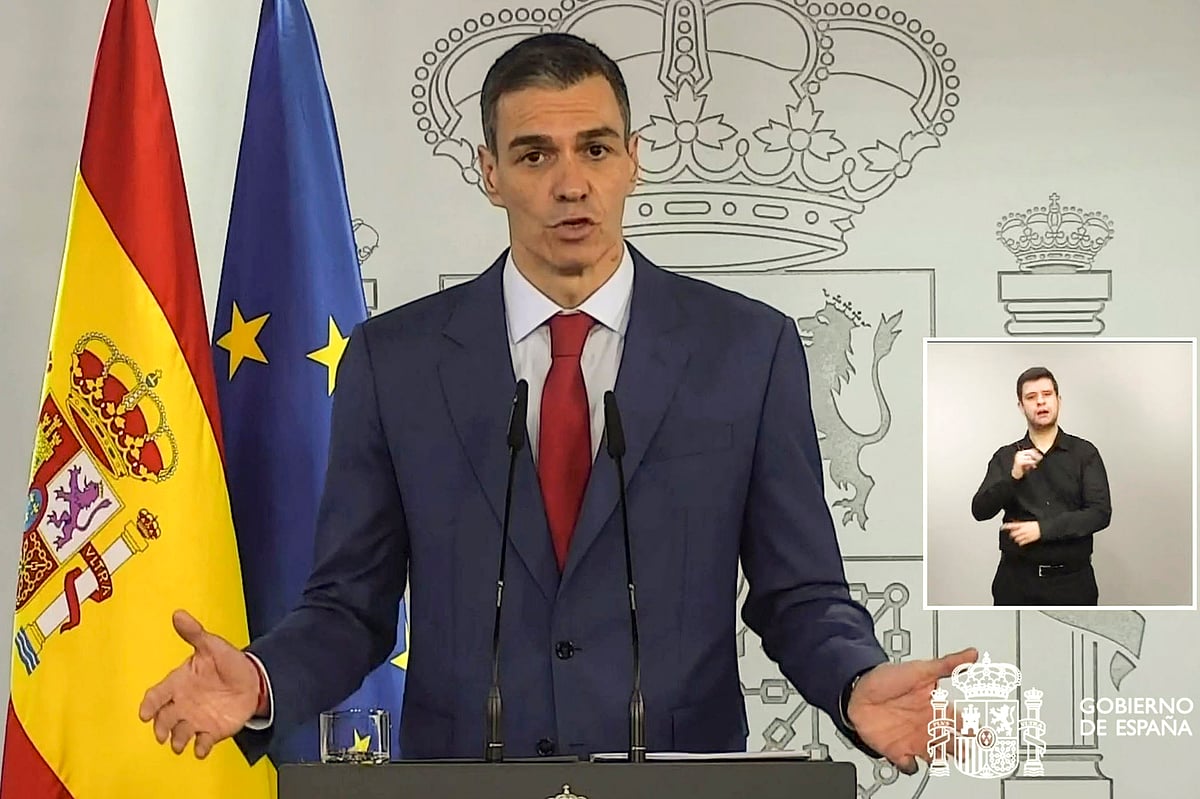
The head of the left-wing coalition government did not back down in the face of criticism and threats from the US president the day before. “The position of the Spanish government is a clear no to war,” said Pedro Sánchez in a statement to the nation. Later, the White House spokesperson claimed that Spain would begin to “cooperate militarily,” which was denied by Madrid. The day before, while praising European countries for generally cooperating with the US regarding military operations against Iran, Donald Trump criticized the UK and Spain, calling them “a terrible ally” and threatening to cut economic ties. The Madrid government did not authorize US military planes involved in the offensive to use the Rota (Cádiz) and Morón (Seville) air bases. The Spanish government, along with the European Commission, responded the same day, emphasizing that trade policy between the US and Spain is conducted within the framework of the EU agreement. Alberto Núñez Feijóo, leader of the Popular Party (PP), seized the opportunity: “If Iran appreciates you and the United States considers you a terrible ally, it is because your foreign policy has failed.” In light of the shockwaves created in Spain, the socialist leader felt the need to revisit the topic and explain his position, recalling the support of the PP government, then led by José María Aznar, for the Anglo-American invasion of Iraq in 2003. “The world has been here before. 23 years ago, another US administration led us into an unjust war. The Iraq war resulted in a drastic increase in terrorism, a severe migration and economic crisis. That was the legacy of the Azores trio [the Lajes Summit, where Durão Barroso was omitted], a more insecure world and a worse life.” Sánchez continued with the parallel: “No one is in favour of the ayatollahs. But the question is whether we are on the side of international legality and peace. The Spanish citizens were against Saddam Hussein, but that did not lead them to support an unjust war. We reject the Tehran regime, but we call for a diplomatic solution.” The Spanish leader has been Trump's most critical voice in the EU. Regarding his trade policy, he denounced the “blackmail of tariff duties.” He opposed the 5% GDP target in Defence, as imposed by the American to NATO allies. He criticized US immigration policy and became embroiled in controversy with Secretary Marco Rubio for denouncing abuses by large American tech companies. The socialist and the New York businessman also disagree on Gaza.
Sánchez recalls Iraq invasion to say no to Trump
Wednesday, 4 March 2026RSS
RSS source
Other news coverage of this topic
- Sánchez revives the "no to war" to respond to Trump's economic rupture threats10:00pm, 4 Mar 2026 • Expresso
- Sanchez responds to Trump. Spain ready to withstand reprisals9:32pm, 4 Mar 2026 • RTP Notícias
- White House claims Spain has ‘agreed to cooperate’ on strikes. Spain says it hasn’t.7:49pm, 4 Mar 2026 • POLITICO Europe
- White House says Spain will "militarily cooperate" with the US. Madrid categorically denies7:22pm, 4 Mar 2026 • ECO